


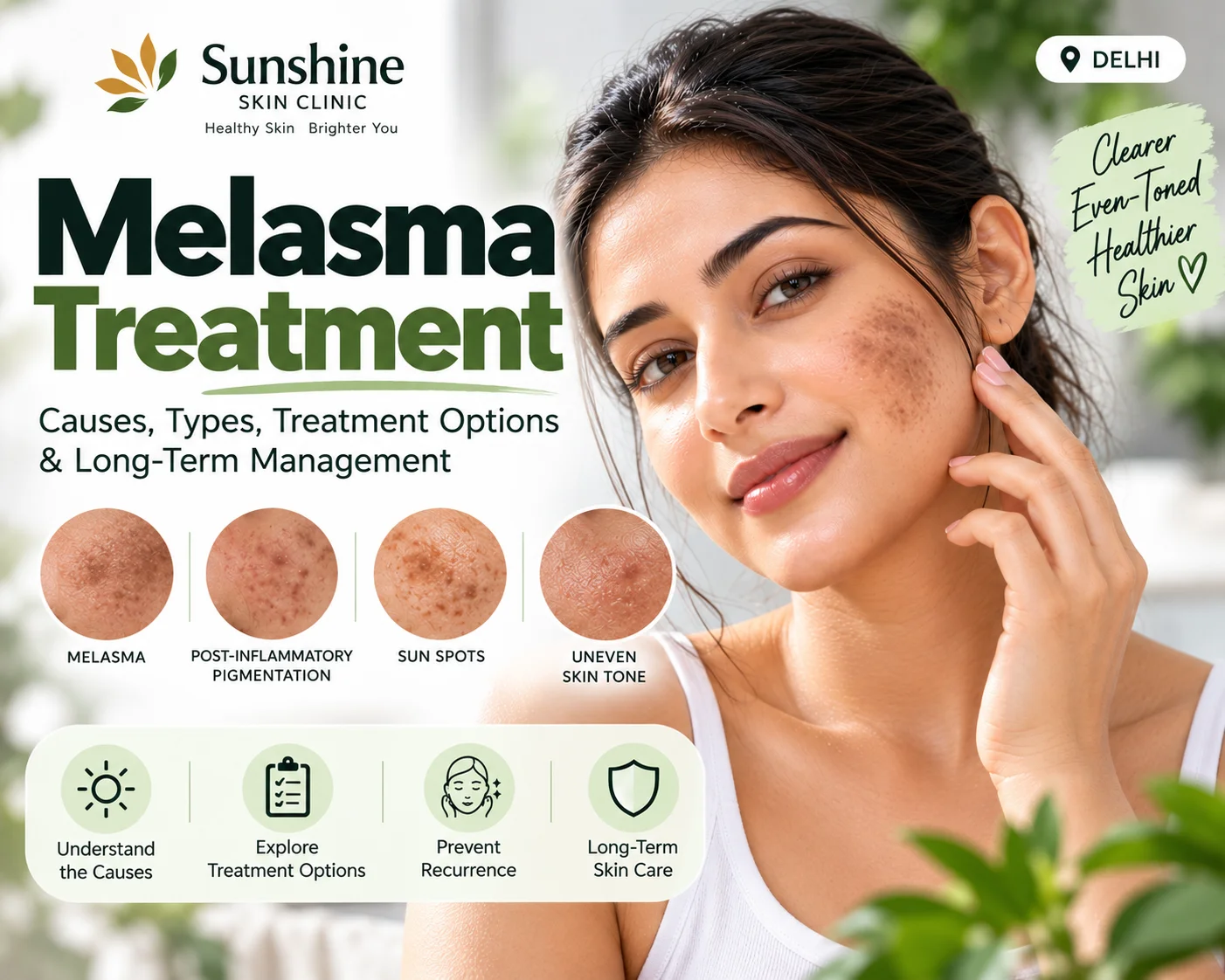
Melasma can be one of the most frustrating pigmentation problems to manage because the skin may improve for a while and then develop darker patches again.
The reason is simple but often overlooked: melasma is not just a dark spot that needs to be removed. It is a pigmentary disorder influenced by several factors, and it can have a chronic, relapsing course.
Melasma usually appears as brown to gray-brown patches on sun-exposed areas of the face, especially the cheeks, forehead, nose, and upper lip. It is more commonly seen in people with darker skin tones, and sunlight, hormonal influences, genetics, and other environmental factors can all contribute.
That is why successful melasma treatment is usually less about finding one “strong” cream and more about answering a series of questions:
What type of melasma is present? What is triggering it? How deep is the pigment? How sensitive is the skin? What treatment can reduce the pigmentation without causing more irritation? And how will improvement be maintained?
Current dermatology guidance emphasizes individualized treatment rather than a single universal therapy.
What Is Melasma?
Melasma is an acquired hyperpigmentation disorder in which pigment-producing cells become more active, leading to darker patches on the skin.
It most commonly affects the face and tends to occur symmetrically. Some people develop mild patches, while others have more persistent and noticeable pigmentation.
Melasma is not dangerous in itself, but it can have a substantial effect on appearance and quality of life. The condition may last for years and can return after treatment, which is one reason long-term management matters.
8 Things to Understand Before Choosing Melasma Treatment
1. Start With a Diagnosis, Not a Pigmentation Cream
One of the most common mistakes is assuming that every brown patch on the face is melasma.
A dermatologist may need to distinguish melasma from conditions such as:
- Post-inflammatory hyperpigmentation
- Sun-induced pigmentation
- Acquired dermal macular hyperpigmentation
- Pigmented contact dermatitis
- Periorbital hyperpigmentation
- Other causes of facial discoloration
These conditions can sometimes look similar, but the treatment approach may be quite different. The 2026 Indian expert consensus specifically highlights the clinical overlap among pigmentary disorders and recommends careful diagnosis.
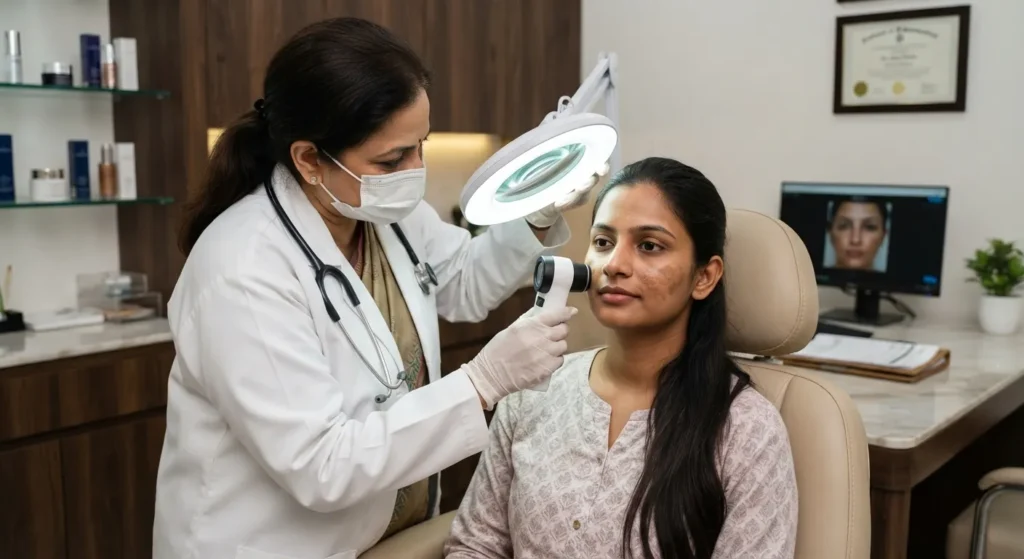
A dermatologist may use clinical examination and, when useful, tools such as Wood’s lamp or dermoscopy to better understand the pigment pattern and depth. In selected cases where the diagnosis remains uncertain, a biopsy may be considered.
A useful rule:
Do not treat a dark patch until you are reasonably sure what caused it.
That single step can prevent months of using the wrong products.
2. Think of Melasma as a “Trigger Map,” Not Just a Facial Patch
A patient often notices where the pigment is.
A dermatologist also needs to think about why the pigment is there.
Commonly discussed triggers and influences include:
Sun exposure
Ultraviolet radiation can stimulate pigment production and darken existing melasma.
Hormonal influences
Pregnancy and hormonal medications can contribute in susceptible individuals.
Genetic tendency
Some people are more prone to melasma because of their individual biology.
Visible light
Research has shown that visible light can contribute to pigmentation, particularly in darker skin tones.
Skin irritation
Repeated burning, stinging, over-exfoliation, or inflammatory skin conditions can make pigmentary problems harder to control.
Recent research is also exploring melasma through the concept of the exposome—the combined effect of environmental, hormonal, lifestyle and other exposures over time. These findings are still evolving, but they help explain why melasma may behave differently from person to person.
Try making a “melasma trigger map”
Think about:
When did it start?
Did it follow pregnancy or hormonal changes?
Does it become darker after outdoor exposure?
Did you recently start strong skincare products?
Did the pigmentation begin after acne, a rash, or a procedure?
This history can be more useful than simply searching online for another brightening cream.
3. The “Depth” of Pigment Can Change the Treatment Strategy
Melasma does not always involve pigment at exactly the same depth.
A dermatologist may assess whether the pigmentation appears predominantly superficial or whether there are deeper dermal components.
Wood’s lamp examination and dermoscopy can sometimes help with this assessment, although these tools have limitations and are interpreted together with the clinical appearance.
Why is this useful?
Imagine two people with patches that look almost identical in a photograph.
One may respond relatively well to topical treatment.
The other may have a deeper or more complicated pigment pattern and require a different strategy.
This is one reason an online photograph cannot reliably determine which treatment a person needs.
The better question is:
“Where is the pigment, and what is maintaining it?”
rather than simply:
“How dark is the patch?”
4. In Indian Skin, Preventing Extra Inflammation Can Be as Important as Fading Pigment
This is a particularly important concept for Indian patients and others with skin of color.
Skin with higher melanin content can be more prone to post-inflammatory pigmentation. That means irritation from aggressive skincare or procedures can sometimes create another round of discoloration.
Recent reviews discussing pigmentation in skin of color have highlighted the possibility of post-inflammatory hyperpigmentation after procedures such as chemical peels and laser treatments, particularly when treatment is too aggressive or poorly matched to the patient’s skin.
This creates an “irritation paradox”
Someone may think:
more exfoliation → more peeling → faster pigment removal
But the real sequence may become:
aggressive treatment → irritation → inflammation → increased pigment → more visible darkening
That does not mean peels or procedures should never be used.
It means the treatment needs to be selected and adjusted carefully.
The 2026 Indian consensus specifically recognizes irritation, paradoxical hyperpigmentation, treatment resistance and recurrence as important therapeutic challenges in darker skin phototypes.
What Is the Most Important Part of Melasma Treatment?
For most patients, treatment has several layers rather than one isolated step.
Photoprotection
Daily sun protection is foundational because sunlight can worsen melasma and contribute to recurrence.
AAD guidance recommends broad-spectrum, water-resistant sunscreen with SPF 30 or higher, together with shade, protective clothing and other sun-protective measures.
For melasma, visible light also matters. Tinted sunscreens containing iron oxide can provide additional visible-light protection, particularly in darker skin tones.
Topical Treatments
Depending on the diagnosis and individual situation, dermatologists may consider topical agents such as:
- Hydroquinone
- Tretinoin-containing regimens
- Azelaic acid
- Kojic acid
- Tranexamic acid
- Vitamin C
- Niacinamide
- Other depigmenting or pigment-modulating agents
AAD guidance lists hydroquinone, retinoid-based combinations, triple-combination therapy, azelaic acid, kojic acid and vitamin C among treatment options that may be considered.
The 2026 Indian consensus also supports several non-hydroquinone agents for longer-term maintenance in appropriate patients.
What Is Triple-Combination Cream?
Triple-combination treatment traditionally combines:
Hydroquinone + tretinoin + a mild corticosteroid
It has strong evidence for melasma and can be effective when used appropriately. However, it is not something that should simply be used continuously without supervision.
The 2026 Indian consensus describes triple-combination cream as an effective treatment for melasma in skin of color while also noting that treatment-related adverse effects are common and that supervised use is important.
The important idea is not:
“Triple combination is the strongest cream.”
The more useful idea is:
“It is a medical treatment with benefits, limitations, duration considerations and a place within a broader plan.”
What About Tranexamic Acid?
Tranexamic acid has become an important area of interest in melasma treatment.
It may be used in topical, oral, or procedure-assisted approaches depending on the clinical situation.
Systematic reviews have found potential benefit from tranexamic acid in melasma, including when used with microneedling or other treatments, although results across studies are not completely uniform.
The 2026 Indian expert consensus recognizes oral tranexamic acid as an option for selected moderate-to-severe cases.
However, oral tranexamic acid is not a routine skincare supplement.
Before prescribing it, a dermatologist needs to review the patient’s medical history, particularly thromboembolic risk. AAD guidance specifically notes that patients with a history of blood clots need to discuss this before oral tranexamic acid is considered.
5. Melasma Often Needs a Treatment Ladder, Not a Treatment Leap
A common mistake is to jump immediately to the most advanced procedure.
A more logical strategy is often a treatment ladder.
Step 1 — Diagnosis and trigger control
Understand what is driving the pigmentation.
Step 2 — Photoprotection
Reduce the environmental stimulus that keeps activating pigmentation.
Step 3 — Topical treatment
Use an evidence-based topical plan suited to the person’s skin and tolerance.
Step 4 — Reassessment
Allow enough time to see whether the treatment is working.
Step 5 — Add procedures when appropriate
For persistent or resistant melasma, selected patients may be considered for procedures such as chemical peels, microneedling, or laser/light-based treatments. The Indian consensus supports adjunctive procedures in appropriately selected cases.
Step 6 — Maintenance
Once improvement has been achieved, the strategy changes from aggressive correction to maintaining control.
This staged approach is usually more sensible than starting with a procedure simply because it sounds faster.
Are Chemical Peels Used for Melasma?
Yes, but their use needs to be individualized.
Chemical peels can help remove pigment from the upper layers of the skin and may be used as an adjunct to topical treatment.
However, chemical peels also deliberately affect the skin barrier. Excessive strength, poor patient selection, or inappropriate aftercare can contribute to irritation and post-inflammatory pigmentation.
This is particularly relevant for Indian skin.
The goal should therefore be:
controlled improvement without unnecessary inflammation.
A peel should be chosen because it makes sense for the patient’s diagnosis and skin—not because a stronger peel sounds more powerful.
Can Laser Help Melasma?
Laser and light-based devices have been studied extensively in melasma, and some patients do experience improvement.
But melasma is not simply “excess surface pigment.”
Its biology involves multiple pathways, and recurrence remains a major challenge. Systematic reviews have found benefit from several device-based approaches, particularly when used with topical therapies, but no single laser is universally effective for everyone.
Procedural treatments also require particular caution in skin of color because inflammation can lead to unwanted pigment changes.
This is why:
“laser treatment”
is not enough information to decide whether someone is a good candidate.
The device, wavelength, settings, diagnosis, skin type, previous treatment, and maintenance plan all matter.
Can Microneedling Be Used for Melasma?
Microneedling has been investigated both alone and as a way to enhance delivery of topical agents.
Systematic reviews suggest that microneedling, particularly when combined with topical therapies such as tranexamic acid, can improve melasma severity in some patients. However, the evidence has limitations, including heterogeneity between studies and variable study quality.
This is an important example of why scientific evidence should be interpreted carefully.
A treatment can be promising without being universally appropriate.
6. Treat “Activity” and “Leftover Pigment” as Two Different Problems
Here is a useful way to understand persistent melasma.
A person can have:
active melasma
and
pigment that remains after previous activity
These are not necessarily the same thing.
Imagine that treatment has reduced the original trigger, but some pigmentation is still visible. Looking only at the remaining colour might create the impression that treatment has failed.
On the other hand, if new areas are appearing or existing patches are repeatedly getting darker, there may still be ongoing stimulation.
A simple monitoring question:
“Is the pigmentation fading, or is new pigmentation still forming?”
That question can be surprisingly useful during follow-up.
It shifts attention from the color of a single patch to the direction of the disease over time.
7. Maintenance Is Not an Optional “Afterthought”
This may be the most important difference between a short-term cosmetic improvement and long-term melasma management.
Melasma is well known for recurrence.
AAD explains that treatment can take several months and that melasma may persist for years. The 2026 Indian expert consensus specifically emphasizes maintenance therapy and recurrence prevention after improvement.
Think of treatment as a three-stage process:
Correction → Stabilization → Maintenance
During correction, the aim is to reduce visible pigmentation.
During stabilization, the focus shifts toward keeping the skin calm and reducing the factors that continue to stimulate pigmentation.
During maintenance, suitable non-hydroquinone agents and ongoing photoprotection may be used according to the individual’s treatment plan.
Why does this matter?
Because a person may think:
“My skin is clear now, so I can stop everything.”
For recurrent melasma, that may not be the most useful long-term strategy.
8. Use a “Pigmentation Calendar” Instead of Judging Your Skin Every Day
Melasma often changes slowly.
Daily mirror-checking can therefore be misleading.
Lighting, camera exposure, skin hydration, makeup, and even the angle of your face can make pigmentation appear different.
A more practical method is to create a simple pigmentation calendar.
Take photographs:
- Under similar lighting
- With the same camera
- From similar distances
- At similar angles
- Without filters
Then compare them over several weeks rather than several hours.
You can also record:
Sun exposure
Major hormonal changes
New skincare products
Periods of irritation
Treatment changes
Periods when pigmentation becomes darker
This creates a useful timeline.
Instead of asking:
“Does my skin look better today?”
you can ask:
“What changed over the last 6–12 weeks?”
That is a much more meaningful way to evaluate a slow condition.
Melasma and Visible Light: Why Tinted Sunscreen Gets So Much Attention
Traditional sunscreen conversations often focus only on UV radiation.
For melasma, visible light has become an important part of the discussion.
Studies and expert consensus indicate that visible light can contribute to pigmentation, especially in darker skin tones. Tinted sunscreens containing iron oxides can provide protection in this part of the spectrum.
This does not mean every person with melasma needs a specific expensive tinted product.
The more important principle is:
Choose photoprotection that you can actually use consistently and that fits your skin and daily routine.
For someone prone to melasma, a sunscreen that feels unpleasant, leaves an unacceptable cast, or is abandoned after a few days is not practically useful.
Can Heat or Pollution Affect Melasma?
Research into melasma is increasingly moving beyond UV exposure alone.
Recent reviews are investigating how factors such as heat, air pollution, oxidative stress, hormonal changes, visible light, and other environmental exposures may interact with melasma biology. These areas are still developing, and not every proposed trigger has the same level of evidence.
This matters for everyday life because a treatment plan should consider the environment in which the patient actually lives.
For someone living in a hot, sunny city, reducing cumulative environmental exposure may be more realistic than relying on one evening cream to reverse everything.
What Should You Do at Home?
A simple routine is generally easier to maintain than a complicated one.
Morning
Gentle cleanser → prescribed/appropriate treatment → moisturizer if needed → sunscreen
For melasma-prone skin, tinted sunscreen with iron oxide can be considered when visible-light protection is relevant.
Evening
Gentle cleanser → prescribed treatment → moisturizer
The exact ingredients and frequency should be individualized.
Avoid turning your skincare routine into a collection of strong active ingredients.
If a product repeatedly burns or stings, that is a reason to reassess it. AAD guidance specifically warns that irritating skincare can make dark spots more noticeable.
Common Melasma Mistakes
Using too many products at the same time
This makes it difficult to know which product is helping and which one is causing irritation.
Changing treatment every week
Melasma usually needs longer-term assessment rather than rapid product switching.
Ignoring sunscreen
Even a good topical treatment can struggle when ongoing sun exposure continues to stimulate pigmentation.
Using aggressive DIY peels
Irritation can worsen pigmentation, particularly in darker skin.
Treating “fairness” instead of pigmentation
The goal of medical pigmentation treatment is not to unnaturally change someone’s baseline skin colour.
The goal is to reduce excess discoloration and achieve a more even appearance.
Stopping everything as soon as the skin improves
Melasma commonly recurs, making maintenance important for many patients.
How Long Does Melasma Treatment Take?
Melasma rarely changes dramatically overnight.
AAD guidance notes that treatment commonly takes around 3 to 12 months to produce meaningful results, and longstanding cases may take longer.
The exact timeline depends on:
- Type of melasma
- Duration
- Depth of pigmentation
- Trigger control
- Skin sensitivity
- Treatment approach
- Consistency with photoprotection
- Individual response
This is why a treatment that is judged after only one or two weeks may be judged too early.
At the same time, “be patient” should not mean ignoring poor response or worsening irritation.
If the skin is getting darker, inflamed, or increasingly sensitive, the plan may need to be reassessed.
Can Melasma Be Permanently Cured?
There is no reliable way to promise permanent removal for every patient.
Melasma may improve significantly, but recurrence is common, especially when triggers continue or maintenance is discontinued. AAD and Indian expert guidance both emphasize long-term management and recurrence prevention.
So a realistic goal is:
Reduce the pigmentation → control the triggers → maintain the improvement.
That is more medically realistic than promising that melasma will never return.
When Should You See a Dermatologist?
A professional evaluation is especially useful when:
- The diagnosis is uncertain.
- Pigmentation appeared suddenly.
- The patches are spreading.
- Home products are causing burning or irritation.
- Melasma keeps returning.
- You have already tried several treatments without improvement.
- You are considering oral tranexamic acid.
- You are considering a peel, laser, or microneedling.
- Pigmentation developed after another inflammatory skin condition.
- You are pregnant, planning pregnancy, or breastfeeding and want to know which treatments are appropriate.
Melasma can look similar to other pigmentary conditions, and treatment safety depends on the individual diagnosis and health history.
What Should a Good Melasma Treatment Plan Answer?
Before starting treatment, you should be able to understand:
What is the diagnosis?
What are the likely triggers?
Is the pigment superficial, deep, or mixed?
What is the first treatment step?
What is being added only if the first step is insufficient?
What are the potential side effects?
What should be done if the skin becomes irritated?
How will improvement be measured?
What happens after the pigment improves?
These questions are more useful than simply asking for the “strongest” melasma treatment.
A Simple Melasma Treatment Roadmap
For someone beginning treatment, the process can be thought of as:
1. Confirm
Make sure the pigmentation is actually melasma.
2. Map
Understand distribution, depth, triggers and skin characteristics.
3. Protect
Start reliable photoprotection and reduce avoidable irritation.
4. Correct
Use an appropriate topical or medical treatment.
5. Escalate Carefully
Consider peels, microneedling, laser/light procedures, or systemic options when appropriate for the individual.
6. Reassess
Evaluate the direction of improvement over an appropriate timeframe.
7. Maintain
Continue a long-term strategy when recurrence is likely.
This is not a one-size-fits-all prescription. It is a way to understand how dermatologists can think about a chronic pigmentary condition.
Final Takeaway
Melasma is much more complicated than a simple dark patch.
It is influenced by pigment biology, sunlight, visible light, hormones, genetics, environmental exposures and inflammation, and it can follow a chronic, relapsing course.
That is why successful melasma treatment is rarely about finding one miracle cream or one powerful procedure.
A better approach is:
Diagnose the condition → identify the triggers → protect against light → choose an appropriate treatment → avoid unnecessary irritation → monitor progress → maintain the result.
For Indian skin and other darker skin types, the balance between improvement and irritation is particularly important because post-inflammatory pigmentation can become another problem when treatment is too aggressive.
Topical treatments remain an important foundation. Selected patients may benefit from tranexamic acid, chemical peels, microneedling, or laser/light-based treatments, but these options should be considered within an individualized treatment plan rather than treated as universally superior solutions. Current Indian expert consensus supports a combination of medical and procedural approaches in appropriate cases while emphasizing safety and maintenance.
Most importantly, improvement and control are more realistic goals than a promise of permanent removal.
For a condition that can return, good treatment is not only about making the pigmentation lighter today.
It is also about understanding why it came back yesterday—and how to reduce the chance that it returns tomorrow.
Frequently Asked Questions About Melasma Treatment
What is the best treatment for melasma?
There is no single treatment that is best for every person. Melasma treatment is individualized according to diagnosis, skin type, pigment depth, triggers, previous treatments and recurrence risk.
Can melasma be permanently removed?
Permanent clearance cannot be guaranteed. Melasma can recur, so long-term photoprotection and maintenance treatment are often important.
Is sunscreen important during melasma treatment?
Yes. Sun protection is one of the foundations of melasma management. Broad-spectrum SPF 30+ sunscreen, along with other sun-protective measures, is recommended. Tinted sunscreen containing iron oxide may provide additional visible-light protection.
Why is tinted sunscreen useful for melasma?
Visible light can worsen melasma, particularly in darker skin tones. Iron oxide-containing tinted sunscreens can help provide protection against visible light in addition to UV protection.
Is hydroquinone still used for melasma?
Yes. Hydroquinone remains an important topical treatment for melasma and is often used within supervised treatment plans. The duration and formulation matter because irritation and other adverse effects can occur.
What is triple-combination treatment?
Triple-combination cream generally contains hydroquinone, tretinoin and a mild corticosteroid. It is an effective evidence-based option for melasma but should be used under appropriate medical supervision because treatment-related adverse effects can occur.
Can tranexamic acid help melasma?
Tranexamic acid may help selected patients and can be used in topical or oral approaches. Evidence also exists for combination approaches such as microneedling with topical tranexamic acid, although study results are not completely uniform. Oral tranexamic acid requires medical assessment because it is not appropriate for everyone.
Is laser treatment good for melasma?
Laser and light-based treatments may help selected patients, but no single device is universally appropriate. Because procedures can sometimes trigger pigmentary changes, especially in skin of color, treatment should be carefully individualized.
Can microneedling be used for melasma?
Microneedling has been studied as an adjunctive treatment and may be combined with topical agents such as tranexamic acid. However, the quality and consistency of evidence vary, so it should be considered according to the individual case rather than as a universal treatment.
How long does melasma treatment take?
Meaningful improvement commonly takes months rather than days. AAD guidance notes that results often take around 3–12 months, with longer timelines possible for longstanding cases.
Why does melasma return after treatment?
Melasma is a chronic and relapsing condition. Continued exposure to light and other triggers can contribute to recurrence, which is why maintenance therapy and long-term photoprotection are important.