


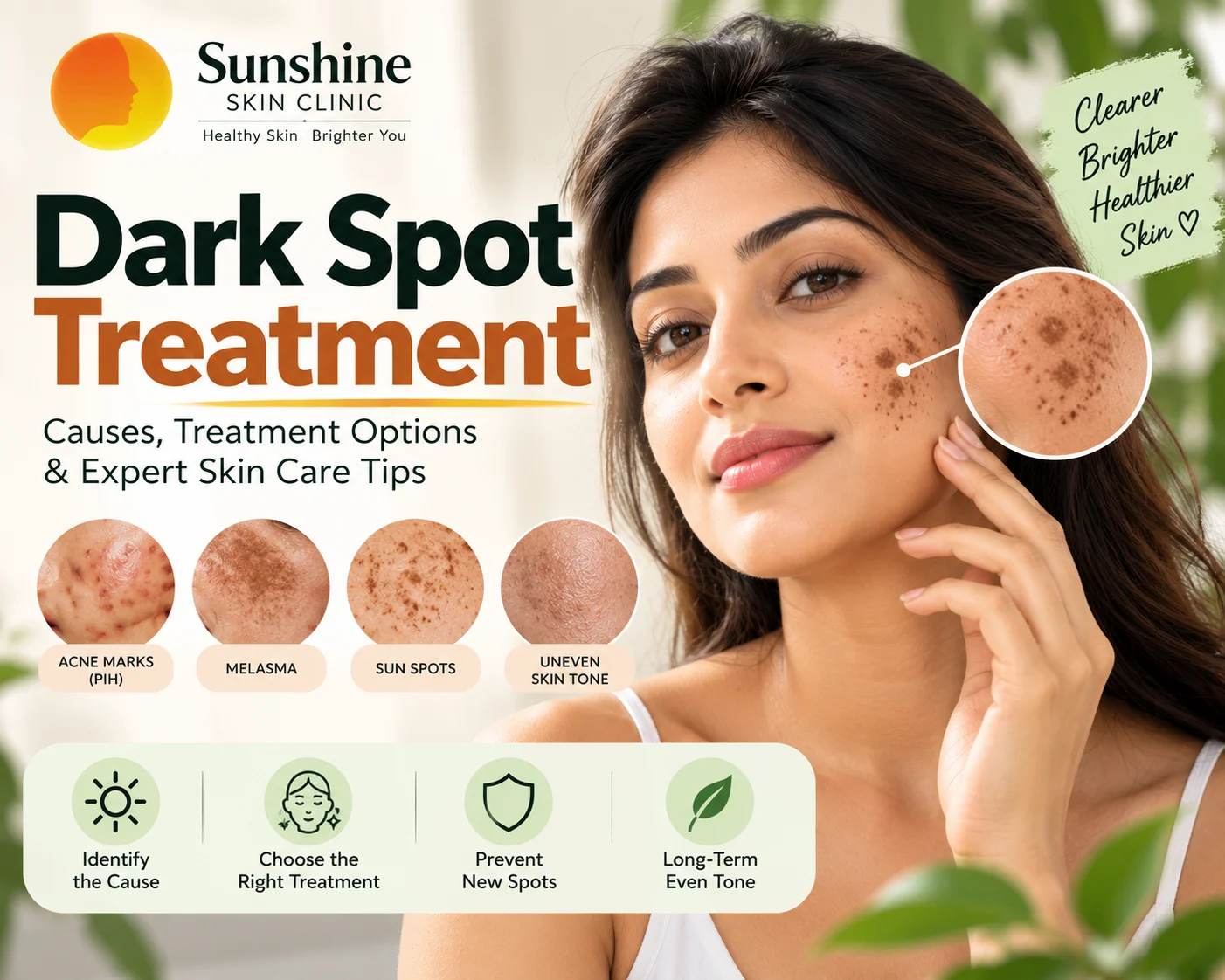
Dark spots can appear after acne, prolonged sun exposure, minor skin injuries, irritation, or certain skin conditions. Sometimes they fade gradually. In other cases, they remain visible for months or keep returning even after treatment.
The frustrating part is that not every dark spot has the same cause, and not every spot responds to the same treatment.
A flat brown mark left after a pimple is different from a patch of melasma. A sun-related spot may need a different approach from pigmentation caused by an irritated skincare product. Some dark spots are not pigmentation problems at all and need medical examination before any cosmetic treatment is considered.
That is why effective dark spot treatment starts with identifying the cause, protecting the skin, choosing an appropriate treatment, and avoiding unnecessary irritation.
This guide explains eight important ideas that can help you understand dark spots, compare treatment options, and make informed decisions about your skincare.
What Are Dark Spots?
Dark spots are areas of skin that appear darker than the surrounding skin. When the colour comes from excess melanin, the condition is commonly described as hyperpigmentation.
Melanin is the pigment responsible for much of our natural skin colour. Certain triggers can increase pigment production or change how pigment is distributed in the skin, leaving darker marks or patches.
Dark spots can appear on the face, forehead, cheeks, upper lip, neck, hands, shoulders, and other areas exposed to sunlight or affected by inflammation.
Common causes include:
- Acne and post-inflammatory pigmentation
- Sun exposure
- Melasma
- Freckles and solar lentigines
- Inflammation from eczema or contact dermatitis
- Skin injuries and certain cosmetic procedures
- Some medications and other skin conditions
Some pigmented moles and growths can also resemble ordinary dark spots. A spot should not automatically be treated as a cosmetic concern simply because it is brown or black.
8 Important Ideas to Understand Before Choosing Dark Spot Treatment
1. Give Every Dark Spot a History Before Choosing a Treatment
Most people focus on the appearance of a dark spot. A more useful starting point is to understand how it developed.
Ask yourself:
When did the spot first appear?
Did it develop after a pimple, rash, injury, or skin treatment?
Does it become more noticeable after spending time outdoors?
Have you recently started using a new skincare product?
Has the spot remained stable, or has it changed in size, shape, or colour?
These questions can provide useful clues, although they cannot establish a diagnosis on their own.
For example, a flat brown mark that appears after acne may be post-inflammatory hyperpigmentation, while symmetrical brown patches across the cheeks may suggest melasma. A spot that develops after a medication or an inflammatory skin condition may have another explanation.
A practical idea: Create a spot history
For each area of pigmentation, record when it appeared, what was happening to the skin at that time, and whether it has changed.
This simple record can help a dermatologist understand the likely trigger and avoid treating every mark as the same condition.
The principle is simple: identify the cause before choosing a spot-fading product.
2. Understand the Difference Between a Dark Mark and a Different Skin Condition
The word “dark spot” describes appearance rather than a specific medical diagnosis.
Here are some common possibilities.
Post-inflammatory hyperpigmentation
Post-inflammatory hyperpigmentation (PIH) develops after inflammation or injury, including acne, eczema, irritation, or certain skin procedures.
It often appears as a flat brown or darker mark where the original inflammation occurred. PIH is particularly common and can remain noticeable for longer in darker skin tones.
Sun-related spots
Solar lentigines, sometimes called age spots or sun spots, develop in areas that have received cumulative sun exposure. They are commonly seen on the face, hands, and other exposed areas.
Melasma
Melasma usually appears as larger brown or grey-brown patches, often distributed symmetrically across the cheeks, forehead, or upper lip. It can be influenced by sunlight, hormonal factors, and individual susceptibility.
Freckles
Freckles are small pigmented spots that often become more noticeable after sun exposure. Their behaviour and treatment considerations differ from those of other pigmentation disorders.
Other pigmented lesions
Some moles and other growths can resemble ordinary dark spots. A changing, irregular, bleeding, or otherwise unusual lesion requires medical assessment rather than an attempt to fade it with a cosmetic product.
The important distinction is that a product designed for post-acne marks may not be suitable for every pigmented lesion.
3. Treat the Trigger, Not Just the Leftover Colour
Imagine that a pimple heals and leaves a brown mark.
If new acne continues to develop, the skin may keep producing additional marks while the older ones are still fading.
The same basic principle applies to other causes of pigmentation. Ongoing irritation, repeated sun exposure, or an untreated inflammatory skin condition may continue to contribute to discoloration.
This leads to an important treatment strategy:
Control the source of pigmentation while working on the pigmentation that already exists.
For acne-related dark marks, this may mean controlling active acne and avoiding picking or squeezing lesions. For irritation-related pigmentation, it may mean identifying and stopping the irritating product with appropriate medical guidance. For sun-related pigmentation, consistent photoprotection becomes particularly important.
The American Academy of Dermatology advises that successful dark-spot management begins with identifying and addressing the underlying cause. It also notes that treatment can help fade existing spots while sun protection helps prevent new ones.
4. Your Skin Tone and the Location of Pigment Matter
Two people can have similar-looking dark marks but different treatment needs.
One important reason is that pigmentation does not always involve the same structures or depth within the skin.
Superficial pigmentation may respond differently from pigment deposited more deeply. Deeper pigment can be more persistent and may take considerably longer to fade.
Colour can sometimes provide clues, but it cannot reliably reveal the depth or cause of a spot on its own. A dermatologist may use the history, examination, and selected diagnostic tools to clarify the problem.
Skin tone also matters. In people with darker skin, inflammation from acne, irritating products, chemical peels, or laser procedures can sometimes lead to additional post-inflammatory pigmentation.
This creates an important consideration when selecting treatment:
The aim is to reduce unwanted pigmentation without creating another source of inflammation.
The 2026 Indian expert consensus on hyperpigmentation emphasizes the need for diagnosis-led, individualized management in the Indian context, where different pigmentary conditions can overlap and treatment responses vary.
5. The Irritation Paradox: Why Stronger Skincare Can Sometimes Make Dark Spots Worse
When a dark mark refuses to fade, it can be tempting to add stronger products or combine several active ingredients.
However, skin irritation can trigger inflammation, and that inflammation may lead to additional pigmentation.
This is particularly relevant for people who are prone to post-inflammatory hyperpigmentation.
For example, combining multiple exfoliating acids, retinoids, scrubs, and brightening products without considering skin tolerance may cause burning, peeling, or persistent irritation. Those reactions can make the original concern harder to manage.
Signs that your routine may be too irritating
- Persistent burning or stinging
- Redness or unusual sensitivity
- Excessive peeling
- A worsening of dark marks after starting a product
If a product repeatedly irritates your skin, stop using it and seek appropriate advice before restarting or adding another active ingredient.
A simple routine that your skin tolerates consistently may be more useful than an aggressive routine that repeatedly causes inflammation.
Avoid unlabelled skin-lightening products and do not use prescription-strength ingredients or corticosteroid-containing creams without appropriate medical supervision.
6. Choose Treatment Ingredients According to the Cause
There is no universal dark spot cream that works best for everyone.
Different ingredients act through different mechanisms, and the appropriate choice depends on the diagnosis, skin sensitivity, other treatments, and individual medical circumstances.
Azelaic acid
Azelaic acid may be considered for selected forms of hyperpigmentation, particularly when acne and post-inflammatory marks occur together.
Retinoids
Topical retinoids can help with certain forms of acne and pigmentation. However, they may cause dryness and irritation, so appropriate selection and use matter.
Vitamin C
Some vitamin C formulations are used to support a more even-looking skin tone. Results depend on the formulation, stability, consistency, and the cause of pigmentation.
Niacinamide
Niacinamide is used in skincare formulations that aim to support the skin barrier and improve the appearance of uneven skin tone.
Hydroquinone
Hydroquinone is an established depigmenting treatment for selected conditions. It should be used appropriately, particularly when prescription strengths or combination formulations are involved.
Other pigment-modulating ingredients
Ingredients such as kojic acid, cysteamine, tranexamic acid, and alpha-arbutin may be considered in selected circumstances. Evidence and suitability vary by ingredient, formulation, and diagnosis.
No ingredient should be chosen purely because it is popular online. The appropriate treatment for post-acne marks may differ from the approach used for melasma or sun-related spots.
If pigmentation persists despite a sensible routine, a dermatologist can assess whether a different ingredient, prescription treatment, or diagnosis is needed.
7. Sunscreen Helps Prevent Dark Spots From Getting Darker
One of the most important parts of managing dark spots is reducing repeated light exposure.
Ultraviolet radiation can contribute to pigmentation, and visible light can worsen certain pigmentary conditions, particularly in darker skin tones.
For this reason, a suitable sunscreen should be part of a routine designed to manage many types of facial hyperpigmentation.
Look for a product with:
- Broad-spectrum protection
- SPF 30 or higher
- Water resistance when appropriate for your activities
- A formulation suited to your skin type
- A finish that allows you to apply an adequate amount consistently
For people concerned about pigmentation, a tinted sunscreen containing iron oxides may offer additional protection against visible light. The AAD specifically recommends considering this type of sunscreen for darker skin tones affected by dark spots.
Make sun protection practical
Apply sunscreen generously to exposed skin and reapply approximately every two hours while outdoors, as well as after swimming or heavy sweating.
Shade, hats, and protective clothing can add further protection.
Sunscreen is not an instant dark-spot remover. Its value is that it helps prevent additional darkening and supports the rest of the treatment plan.
8. Measure Progress Over Months, Not by Checking the Mirror Every Day
Dark spots often fade gradually. Judging progress from one day to the next can be misleading because lighting, camera exposure, makeup, and skin hydration can all change their appearance.
A more useful method is to track the same areas under comparable conditions.
Create a simple progress record
Take photographs:
- In similar lighting
- Using the same camera
- From a similar distance
- At the same angle
- Without filters
You can also record the products used, any irritation, outdoor exposure, and whether new marks are appearing.
This makes it easier to see whether the skin is improving, remaining stable, or developing new pigmentation.
The expected timeline varies. The AAD notes that a spot a few shades darker than a person’s natural skin colour may fade within 6–12 months, while deeper pigmentation can take years to fade. Treatment may speed this process, but results are not identical for everyone.
Do not interpret a slow response as a reason to use increasingly aggressive products. If a spot is worsening, becoming irritated, or failing to respond as expected, the diagnosis and treatment plan may need to be reviewed.
What Are the Treatment Options for Dark Spots?
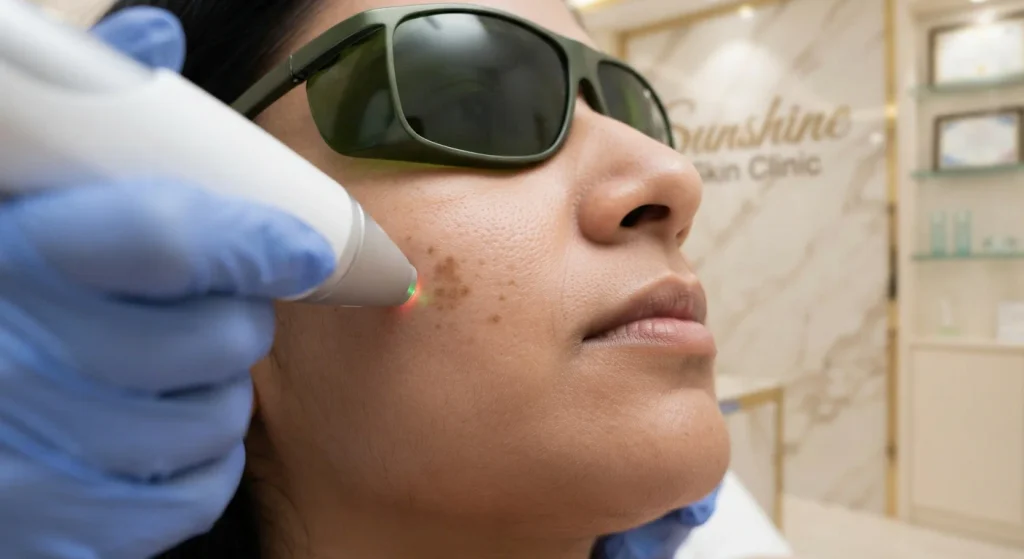
Treatment depends on the underlying cause and may involve one or more approaches.
Topical treatment
Suitable topical ingredients may help reduce excess pigmentation or improve the appearance of uneven skin tone. A dermatologist may recommend a specific ingredient, prescription medication, or combination according to the diagnosis.
Chemical peels
Selected chemical peels may improve certain superficial forms of pigmentation. However, they can also cause irritation and further pigment changes, especially when the depth, formulation, or skin type is not considered carefully.
Laser and light-based treatments
Certain laser or light-based procedures may be useful for selected pigmented lesions. However, they are not appropriate for every kind of dark spot, and the wrong treatment can cause additional pigmentation or other complications.
A spot that is changing, bleeding, or suspicious should be evaluated before any cosmetic procedure is considered.
Treatment of the underlying condition
If pigmentation follows acne, eczema, dermatitis, or another inflammatory problem, controlling the underlying condition is often an important part of management.
The Indian expert consensus on hyperpigmentation disorders emphasizes the importance of distinguishing between different pigmentary conditions and selecting treatment accordingly.
The main principle is to choose treatment based on the actual condition, not simply on how dark a spot looks.
Why Do Dark Spots Sometimes Return After Treatment?
Dark spots can return or new ones can develop when the original trigger remains active.
Examples include continued acne, recurring skin irritation, ongoing sun exposure, or a chronic pigmentary condition such as melasma.
A treatment that reduces existing pigment may not prevent every new spot from forming.
This is why long-term management may involve:
- Controlling the original cause
- Maintaining daily photoprotection
- Using suitable skincare consistently
- Avoiding unnecessary irritation
- Reviewing treatment if the pattern changes
The aim is not merely to make an existing spot lighter. It is also to reduce the circumstances that allow new discoloration to develop.
A Simple Daily Routine for Dark-Spot-Prone Skin
A routine does not need to contain many products to be useful.
Morning
Gentle cleanser → suitable treatment product if needed → moisturizer if needed → sunscreen.
Evening
Gentle cleanser → appropriate treatment → moisturizer if needed.
Introduce active ingredients cautiously, especially if your skin is sensitive or you have previously experienced irritation.
If acne, eczema, or another skin condition is contributing to the pigmentation, the routine should also address that underlying problem.
Avoid adding several new products at once, as this can make it difficult to identify the cause if irritation develops.
When Should You See a Dermatologist?
Consider a professional evaluation if:
- Dark spots persist despite consistent skincare.
- Pigmentation repeatedly returns.
- Several treatments have caused irritation.
- You are unsure whether a spot is acne-related pigmentation, melasma, or another condition.
- The marks developed after a medication or skin procedure.
- You are considering prescription creams, peels, or laser treatment.
Seek prompt medical assessment for a new or changing spot, especially if it grows, bleeds, itches, develops an irregular appearance, or does not heal. A suspicious lesion should not be treated at home as ordinary pigmentation.
Final Thoughts
Dark spots can develop for several different reasons, and effective treatment starts by understanding what caused them.
Post-acne marks, melasma, sun-related spots, and other pigmented lesions should not automatically be treated as the same condition. The right approach depends on the diagnosis, skin characteristics, previous irritation, and the likelihood of recurrence.
For many people, sensible management involves addressing the trigger, using appropriate treatment, protecting the skin from sunlight, and giving the plan enough time to work.
More importantly, the aim is not to make the skin unnaturally lighter. It is to reduce unwanted discoloration while protecting the skin’s health.
The most useful first question is not “Which cream removes dark spots fastest?” It is “What caused these spots, and what approach is appropriate for my skin?”
That is the foundation of informed and sustainable dark spot treatment.
Frequently Asked Questions
What is the best treatment for dark spots?
There is no single best treatment for every dark spot. The appropriate option depends on whether the pigmentation is related to acne, sun exposure, melasma, irritation, medication, or another condition.
How long do dark spots take to fade?
The timeline varies. Some spots fade over several months, while deeper pigmentation may take much longer. Treatment can help in selected cases, but the underlying cause and the individual’s skin characteristics influence the response.
Can sunscreen help fade dark spots?
Sunscreen helps prevent further darkening and supports other pigmentation treatments. Tinted sunscreen containing iron oxides may offer additional visible-light protection for people concerned about pigmentation.
Can dark spots be removed permanently?
Some marks fade considerably, but new ones can form if the underlying trigger remains. Certain pigmentary conditions may also recur, so maintenance and prevention can be important.
Is a dark spot after acne the same as a scar?
No. A flat brown mark is often post-inflammatory hyperpigmentation, whereas an acne scar changes the skin’s texture or structure. They may occur together, but they are not the same problem.
Can strong skincare products make dark spots worse?
Yes. Products that irritate the skin can cause inflammation and contribute to additional pigmentation. Burning or persistent stinging is a reason to stop and reassess the product.
When should a dark spot be checked by a dermatologist?
A spot should be examined if its cause is unclear, it is changing, growing, bleeding, itching, or not healing. It is particularly important not to assume that an unusual or changing lesion is simply pigmentation.