

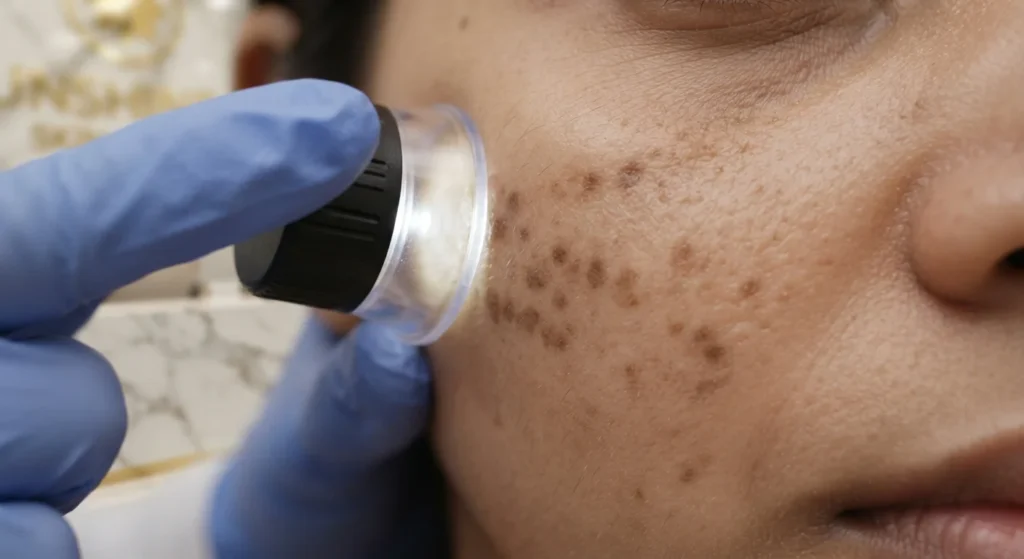
Common Types of Dark Spots
Post-Acne Dark Spots
One of the most common reasons people seek treatment for dark spots is pigmentation left behind after acne.
After an inflammatory pimple heals, the skin may remain darker than its original colour even though the acne itself has disappeared. This is different from an acne scar, which involves a structural change in skin texture.
Related:
Acne Treatment →
Acne Scar Treatment →
Post-Inflammatory Hyperpigmentation
PIH can develop after inflammation or injury to the skin.
Possible triggers include:
- Acne
- Eczema
- Skin irritation
- Infections
- Insect bites
- Cuts or injuries
- Burns
- Certain cosmetic procedures
The pigmentation may gradually fade, but the timeline varies according to its depth, cause, skin type, and ongoing exposure to triggers such as sunlight.
Sun-Related Dark Spots
Repeated ultraviolet exposure can contribute to localized pigmentation and make existing dark spots more noticeable.
Sun protection is therefore an important part of managing pigmentation, particularly when the affected areas are regularly exposed.
Age-Related Dark Spots
With increasing age and cumulative sun exposure, some people develop localized pigmented spots, particularly on areas such as the face, hands, shoulders, and other exposed skin.
A dermatologist can assess whether a dark spot is consistent with a common sun-related pigmentation or whether it needs further examination.
Dark Marks After Skin Injury
A cut, burn, insect bite, irritation, or other skin injury can sometimes be followed by darker pigmentation as the skin heals.
This is another common pattern of post-inflammatory hyperpigmentation.
Why Do Dark Spots Develop?
There can be several contributing factors.
Acne & Inflammation
Inflammation can stimulate pigment production and leave darker areas after the original skin problem has healed.
Sun Exposure
UV exposure can increase pigmentation and make existing dark spots darker.
Skin Irritation
Harsh skincare products, repeated rubbing, or irritation can contribute to pigmentation in susceptible skin.
Hormonal Influences
Hormonal changes can contribute to some pigmentation conditions, including melasma.
Certain Medications
Some medications can contribute to skin pigmentation, making a medication history relevant when investigating unexplained discoloration.
Individual Skin Characteristics
The tendency to develop and retain pigmentation differs between individuals. Post-inflammatory pigmentation can be more pronounced and longer-lasting in darker skin types.
Are Dark Spots the Same as Acne Scars?
No.
This distinction is important.
Dark Spot
A dark spot is primarily a change in skin colour.
Acne Scar
An acne scar involves a structural change in skin texture, such as a depression or raised scar.
For example, a brown mark left after a pimple may be post-inflammatory pigmentation, while a depressed area in the same location may represent an acne scar.
The two concerns can occur together but may require different treatment approaches.
Explore Acne Scar Treatment →
Dark Spots on Indian Skin
Pigmentation can be especially noticeable in medium-to-dark skin tones, and post-inflammatory pigmentation may remain visible for longer after inflammation or injury.
For this reason, pigmentation treatment should be planned carefully.
Before recommending a procedure, a dermatologist may consider:
- Natural Skin Tone
- Pigmentation History
- Cause of the Dark Spot
- Skin Sensitivity
- Previous Procedures
- Current Skincare
- Tendency Toward Post-Inflammatory Pigmentation
- Sun Exposure
The aim is not simply to make the spot lighter as quickly as possible but to improve pigmentation while minimizing unnecessary irritation.
When Should You See a Dermatologist for a Dark Spot?
Not every dark spot needs treatment. However, a new or changing spot deserves professional attention, particularly when its appearance is unusual.
Seek dermatological evaluation if a spot:
- Is new and unexplained
- Changes in size
- Changes in colour
- Develops an irregular appearance
- Bleeds
- Crusts repeatedly
- Becomes painful
- Itches persistently
- Does not behave like your other pigmentation
A dermatologist can determine whether the spot is likely to be simple hyperpigmentation or whether it requires further investigation.
Our Approach to Dark Spot Treatment
At Sunshine Skin Clinic, treatment begins by identifying the likely cause of the discoloration.
During assessment, we may consider:
- Appearance of the spot
- Location
- Duration
- Previous skin inflammation
- Acne history
- Sun exposure
- Current skincare
- Previous treatments
- Skin type
- Pigmentation tendency
This helps determine whether the concern is likely to respond to skincare, an in-clinic procedure, or a combination of approaches.
Dark Spot Treatment Options
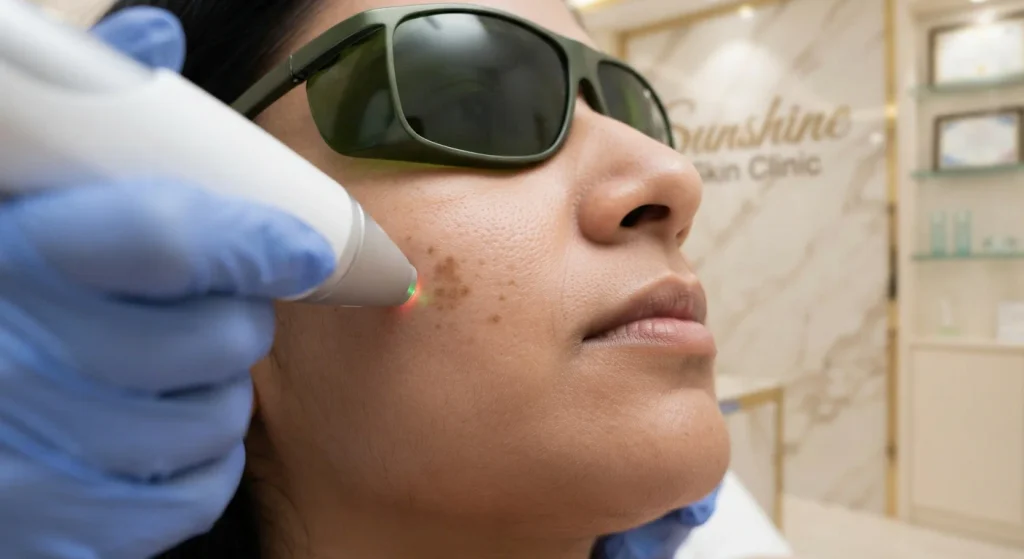
The appropriate treatment depends on the underlying cause. There is no single procedure that is suitable for every dark spot.
Dermatologist-Guided Skincare
Topical treatment may form the foundation of care for many types of superficial pigmentation.
Depending on the individual’s condition, a dermatologist may recommend pigment-targeting or skin-renewing ingredients as part of a personalized routine.
The exact products and strength should be selected according to skin type, sensitivity, pregnancy status where relevant, and the cause of pigmentation.
Self-prescribing strong bleaching or irritating products can sometimes worsen pigmentation rather than improve it.
Chemical Peels for Dark Spots
Selected chemical peels can help improve superficial pigmentation by producing controlled exfoliation of the skin.
The type and strength of peel should be selected based on:
- Type of pigmentation
- Skin tone
- Sensitivity
- Existing inflammation
- Previous treatment response
Peels may be particularly useful when pigmentation occurs alongside uneven skin tone or superficial textural concerns.
However, procedures themselves can sometimes aggravate pigmentation in susceptible skin, so careful treatment selection is important.
Explore Chemical Peel →
Laser Treatment for Dark Spots
Selected laser technologies can be used for certain types of pigmentation.
However, laser treatment is not automatically appropriate for every dark spot. The choice depends on the underlying cause, pigment characteristics, skin type, and treatment goals.
In skin that is prone to post-inflammatory pigmentation, unnecessarily aggressive treatment can sometimes create additional discoloration.
Explore Laser Treatments →
Laser Toning
Laser toning may be considered as part of a personalized approach to selected pigmentation concerns.
Treatment settings and frequency should be determined according to the patient’s skin characteristics and response rather than applying the same protocol to everyone.
Explore Laser Toning →
Pigmentation-Focused Skin Rejuvenation
Some patients have dark spots together with:
- Dull skin
- Uneven skin tone
- Enlarged pores
- Rough texture
- Post-acne changes
In selected situations, pigmentation management can be incorporated into a broader skin-rejuvenation plan.
Explore Skin Rejuvenation Procedures →
Combination Dark Spot Treatment
A combination approach may sometimes be considered when multiple concerns are present.
Depending on assessment, treatment planning may include:
- Dermatologist-Guided Skincare
- Sun Protection
- Chemical Peels
- Laser Toning
- Selected Laser Treatments
- Skin Rejuvenation Procedures
- Maintenance Care
The objective is not to use every available treatment. Instead, the plan should focus on the treatments that are appropriate for the specific cause and characteristics of the pigmentation.
Sun Protection Is an Important Part of Treatment
Treatment for dark spots should not be separated from protection against the factors that can contribute to pigmentation.
Dermatology guidance commonly emphasizes broad-spectrum sunscreen and other sun-protection measures as part of hyperpigmentation care. For darker skin tones with hyperpigmentation, the American Academy of Dermatology also discusses tinted sunscreen containing iron oxide because visible light can contribute to darkening in some pigmentary conditions.
Depending on your skin and pigmentation pattern, your dermatologist may discuss:
- Broad-Spectrum Sunscreen
- Appropriate SPF
- Reapplication
- Hat or Protective Clothing
- Shade During Strong Sun Exposure
- Tinted Sunscreen When Appropriate
How Long Do Dark Spots Take to Fade?
The timeline varies considerably.
Some superficial post-inflammatory dark spots gradually fade over time, while deeper pigmentation can persist much longer. Darker skin may also show post-inflammatory pigmentation more noticeably and for longer periods.
Treatment can sometimes speed improvement, but there is no universal timeline.
The important factors include:
- Cause of Pigmentation
- Depth
- Skin Type
- Treatment Selected
- Continued Sun Exposure
- Ongoing Inflammation
- Individual Skin Response
Can Dark Spots Come Back?
Yes.
Even when an existing spot improves, new pigmentation can develop if the original trigger remains.
For example:
- New acne can cause new dark marks
- Sun exposure can worsen pigmentation
- Repeated skin irritation can contribute to new discoloration
- An underlying inflammatory condition can cause further pigmentation
This is why long-term management often focuses on both treating existing spots and controlling the factors that contribute to new ones.
Your Dark Spot Treatment Journey
Step 1 — Consultation
We discuss when the dark spot appeared, whether it followed acne or another skin problem, previous treatments, skincare products, and sun exposure.
Step 2 — Skin Examination
The dermatologist evaluates the colour, pattern, location, and characteristics of the pigmentation.
Step 3 — Identify the Likely Cause
The clinical appearance and history are used to determine the most likely type of pigmentation and whether additional evaluation is required.
Step 4 — Personalized Treatment Plan
Suitable skincare, procedures, or combination approaches are discussed according to your skin and the cause of the pigmentation.
Step 5 — Follow-Up
Your response is reviewed and the treatment plan can be adjusted when appropriate.
Step 6 — Maintenance
Once pigmentation improves, continued sun protection and appropriate skincare can help reduce the chance of new or worsening discoloration.
Dark Spot Treatment Aftercare
Aftercare depends on the treatment performed.
Your dermatologist may advise:
- Gentle Cleansing
- Appropriate Moisturization
- Daily Sun Protection
- Temporary Avoidance of Irritating Products
- Avoiding Excessive Exfoliation
- Prescribed Post-Procedure Care
- Follow-Up as Recommended
Avoid using multiple aggressive pigment-lightening products together unless they have been specifically recommended for your skin.
What Should You Avoid?
Trying to remove dark spots aggressively at home can sometimes cause additional irritation and pigmentation.
Avoid:
- Unsupervised Strong Bleaching Products
- Liquid Bleach on Skin
- Excessive Scrubbing
- Harsh Exfoliation
- Burning or Irritating Home Remedies
- Repeatedly Picking or Scratching the Area
- Randomly Combining Multiple Active Ingredients
The American Academy of Dermatology specifically advises against using liquid bleach on dark spots, and recommends gentle skincare when managing hyperpigmentation.
Why Choose Sunshine Skin Clinic for Dark Spot Treatment?
Dark spots may look similar on the surface but can have very different causes.
At Sunshine Skin Clinic, the focus is on understanding the pigmentation before selecting a treatment.
Personalized Assessment
We evaluate the appearance, history, skin type, and possible cause of the pigmentation.
Multiple Treatment Options
Depending on the condition, care may include dermatologist-guided skincare, peels, laser-based treatments, or combination approaches.
Skin-Type Consideration
Treatment planning takes pigmentation tendency and previous treatment response into account.
Long-Term Management
The focus is not only on reducing existing dark spots but also on minimizing factors that can contribute to new pigmentation.
Realistic Expectations
Pigmentation can improve gradually, but no procedure can guarantee that every dark spot will disappear permanently.
Frequently Asked Questions
What is the best treatment for dark spots?
There is no single treatment that is appropriate for every dark spot. The best approach depends on the cause, depth, location, skin type, and individual circumstances.
Can dark spots disappear naturally?
Some post-inflammatory dark spots gradually fade as the underlying skin condition resolves, although the process can take months or longer depending on the depth and individual skin characteristics.
Is laser treatment safe for dark spots?
Laser treatment can be useful for selected pigmentation concerns, but suitability and settings need to be individualized. In susceptible skin, inappropriate treatment can potentially worsen pigmentation.
Are acne marks the same as acne scars?
No. Acne marks are primarily changes in pigmentation, while acne scars involve structural changes in skin texture.
Can dark spots come back after treatment?
Yes. New pigmentation can develop when factors such as acne, inflammation, irritation, or sun exposure continue.
Is sunscreen necessary during dark spot treatment?
Sun protection is an important part of hyperpigmentation management because UV and, in some conditions, visible light can contribute to darkening.
Can I use home remedies for dark spots?
Irritating or unproven home remedies can worsen skin inflammation and pigmentation. Persistent or recurring dark spots are better evaluated professionally.
When should I have a dark spot examined?
A new, rapidly changing, bleeding, crusting, painful, or otherwise unusual pigmented spot should be evaluated rather than automatically assumed to be simple pigmentation.