

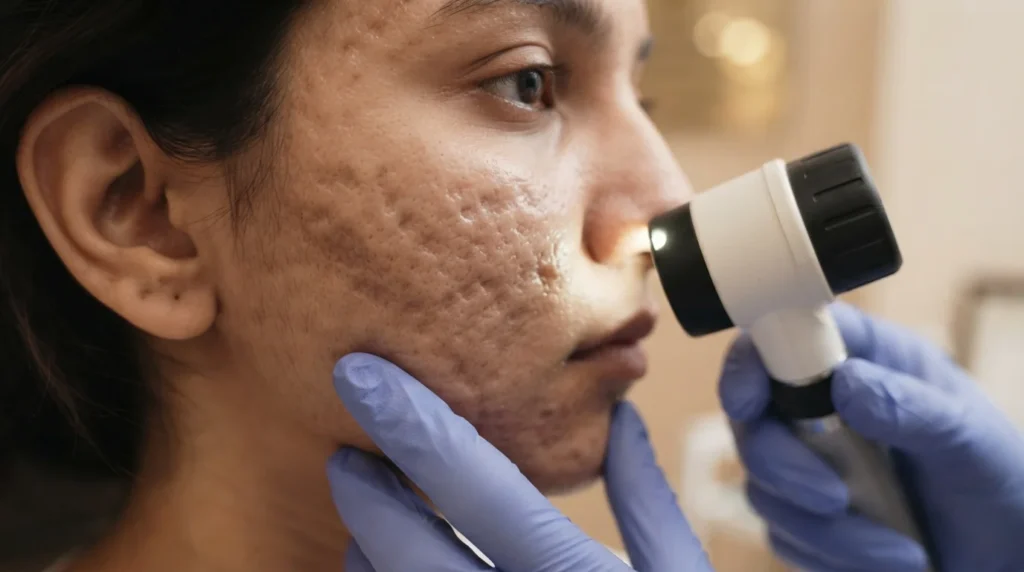
Acne Marks vs Acne Scars
Many people use the terms “acne marks” and “acne scars” interchangeably, but they can represent different types of post-acne changes.
Post-Acne Marks
These may appear as:
- Brown or dark spots
- Red or pink marks
- Uneven skin tone
They do not necessarily involve a structural depression in the skin.
Acne Scars
These involve a change in skin texture and may appear as:
- Depressed areas
- Pitted scars
- Uneven skin surface
- Raised scars
The appropriate treatment depends on which type of change is actually present.
Types of Acne Scars
Understanding the scar type is one of the most important parts of treatment planning.
Ice Pick Scars
These are narrow, deeper depressions that extend into the skin.
Because of their depth and shape, they may require a more targeted treatment approach than superficial textural changes.
Boxcar Scars
Boxcar scars are broader depressions with more clearly defined edges. They can vary in depth and may occur on the cheeks, temples, or other areas affected by acne.
Treatment planning depends on their depth, number, and overall skin condition.
Rolling Scars
Rolling scars create an uneven or wave-like appearance on the skin surface and may become more visible under certain lighting conditions.
They can be associated with changes in the deeper supporting tissue beneath the surface.
Hypertrophic & Raised Acne Scars
Unlike depressed scars, raised scars project above the skin surface because of excess scar tissue.
These scars require a different approach from atrophic or depressed acne scars.
Why Do Acne Scars Develop?
Not everyone who develops acne will develop permanent scars. The likelihood can be influenced by several factors.
Severity of Inflammation
Deep, inflamed acne can increase the possibility of long-term scarring.
Picking or Squeezing
Repeatedly manipulating active acne can increase irritation and tissue damage.
Delayed Acne Management
Persistent untreated inflammatory acne may increase the risk of lasting skin changes.
Individual Healing Response
People heal differently, and the way the skin produces and remodels collagen can influence scar formation.
Genetic Factors
Some individuals may be more prone to developing noticeable scars than others.
When Should You Consider Acne Scar Treatment?
You may benefit from a professional acne-scar evaluation if you notice:
- Persistent depressed scars
- Pitted facial scars
- Uneven skin texture
- Rolling scars
- Boxcar scars
- Ice-pick scars
- Raised scars
- Visible texture changes after acne has healed
A dermatologist can determine whether the concern is actually scarring or whether pigmentation or another post-acne change is responsible.
Our Approach to Acne Scar Treatment
Acne scar treatment should begin with scar assessment, not with choosing a procedure from a list.
During evaluation, we consider:
- Scar Type
- Scar Depth
- Scar Distribution
- Skin Type
- Skin Texture
- Pigmentation
- Active Acne
- Previous Procedures
- Healing History
- Individual Treatment Goals
This helps us determine which treatment options may be appropriate for your skin.
Acne Scar Treatment Options
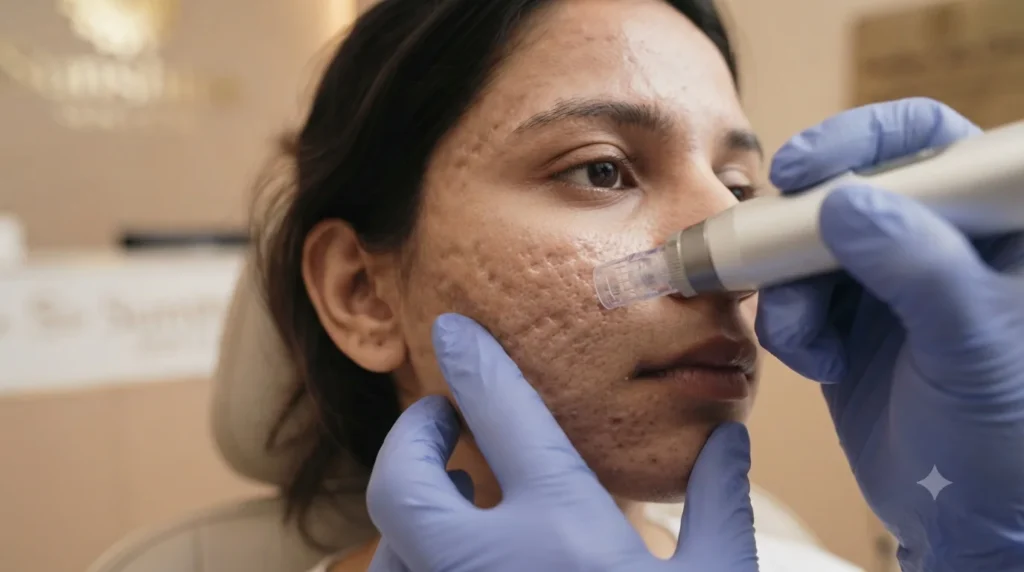
Different types of scars respond differently to treatment. Depending on the clinical assessment, one or more procedures may be considered.
Microneedling for Acne Scars
Microneedling uses controlled micro-injuries to stimulate the skin’s natural healing response and support collagen remodeling.
It may be considered for selected acne scars and uneven skin texture.
Treatment suitability depends on scar type, depth, active acne, skin sensitivity, and other individual factors.
Learn More About Microneedling →
MNRF for Acne Scars
Microneedling Radiofrequency (MNRF) combines controlled microneedling with radiofrequency energy to target deeper layers of the skin.
It may be considered for selected acne scars, enlarged pores, uneven texture, and mild skin laxity.
The appropriate treatment depth and settings depend on individual assessment.
Explore MNRF Treatment →
Chemical Peels
Chemical peels use selected chemical exfoliating agents to improve the appearance and texture of the skin.
They may be useful for certain superficial post-acne concerns, particularly when pigmentation or uneven skin tone is also present.
Chemical peels are not suitable for every type of deep acne scar, which is why professional evaluation is important.
Explore Chemical Peel →
Laser Treatments for Acne Scars
Certain laser procedures may be considered for acne scars and textural changes.
The type of laser, treatment intensity, number of sessions, and recovery requirements depend on the patient’s skin characteristics and scar pattern.
Laser treatment should be selected after assessing skin type and scar severity.
Explore Laser Treatments →
Subcision
Subcision is a procedure used for selected depressed acne scars that are tethered to deeper tissues.
A specialized needle or instrument is used beneath the scar to release fibrous attachments that pull the skin downward.
It may be considered particularly for certain rolling or tethered scars.
The suitability of subcision depends on scar type and clinical assessment.
TCA CROSS
TCA CROSS is a localized chemical treatment that may be considered for selected narrow, deeper acne scars such as some ice-pick-type scars.
Because the treatment is highly targeted, suitability depends on the scar characteristics and the patient’s skin type.
It is not intended for every type of acne scar.
Dermal Fillers for Selected Acne Scars
In selected cases, dermal fillers may be considered to improve the appearance of certain depressed acne scars.
This approach is different from collagen-induction treatments and may be useful for carefully selected scars.
A detailed assessment is required to determine whether filler treatment is appropriate.
Learn More About Dermal Fillers →
Combination Acne Scar Treatment
Acne scars are often mixed.
A patient may have:
- Rolling scars
- Boxcar scars
- Enlarged pores
- Pigmentation
- Uneven texture
Because different concerns may respond differently to treatment, a combination approach may sometimes be considered.
Depending on the clinical assessment, a treatment plan may combine options such as:
- Microneedling
- MNRF
- Subcision
- TCA CROSS
- Chemical Peels
- Laser Treatments
- Selected Dermal Fillers
The purpose of combining treatments is not to perform as many procedures as possible. It is to select the appropriate treatments for the specific scar characteristics.
Active Acne Should Also Be Considered
Scar treatment becomes more complicated when new inflammatory acne is still developing.
If active acne is present, treatment planning may need to address ongoing breakouts alongside scar management.
This helps reduce the possibility of developing additional scars while existing textural concerns are being treated.
Explore Acne Treatment →
Acne Scar Treatment for Different Skin Types
Skin type matters when planning scar treatments.
This is particularly important for patients who are prone to pigmentation changes following procedures.
Before recommending a treatment, your dermatologist may consider:
- Natural Skin Tone
- Pigmentation Tendency
- Previous Treatment Response
- Sensitivity
- Active Inflammation
- Current Skincare
The aim is to choose a treatment approach that is appropriate for both the scars and the surrounding skin.
How Many Sessions Are Needed?
There is no single session count that applies to all acne scars.
The required number of sessions may depend on:
- Type of Scar
- Scar Depth
- Area Being Treated
- Treatment Selected
- Skin Response
- Individual Healing
- Treatment Goals
Some patients may require a series of sessions rather than one procedure, especially when significant textural changes are present.
Your dermatologist can provide a more individualized treatment plan after examining your scars.
What Results Can You Expect?
Acne scar treatment generally aims to improve the appearance of scars, not necessarily make them disappear completely.
The amount of improvement varies between individuals and depends on the type and depth of scarring, chosen procedure, number of sessions, and individual healing response.
Collagen-remodeling treatments may also show gradual changes over time rather than immediate final results.
For this reason, realistic expectations are an important part of consultation.
Your Acne Scar Treatment Journey
Step 1 — Scar Assessment
We examine the skin to determine the type, depth, distribution, and severity of acne scars.
Step 2 — Skin Evaluation
Skin type, pigmentation, sensitivity, active acne, and previous procedures are reviewed.
Step 3 — Treatment Planning
Appropriate treatment options are discussed based on the scar pattern and individual needs.
Step 4 — Treatment Session
The selected procedure is performed according to the personalized treatment plan.
Step 5 — Follow-Up
Treatment response is evaluated and the next stage of care is planned when additional sessions are appropriate.
Acne Scar Treatment Aftercare
Aftercare varies depending on the procedure.
Your dermatologist may provide guidance regarding:
- Gentle Cleansing
- Moisturization
- Sun Protection
- Temporary Product Restrictions
- Avoiding Irritation
- Prescribed Post-Procedure Care
Following treatment-specific instructions is important because different procedures have different recovery requirements.
Why Choose Sunshine Skin Clinic for Acne Scar Treatment?
Acne scars are not identical, and neither should their treatment be.
At Sunshine Skin Clinic, our approach focuses on identifying the scar pattern first and then selecting treatment options according to your individual skin.
Personalized Scar Assessment
We evaluate the type and depth of your scars before recommending treatment.
Combination Treatment When Appropriate
Different scar types may require different procedures, and combinations may be considered when clinically appropriate.
Skin-Type Consideration
Treatment planning takes pigmentation tendency and individual skin characteristics into account.
We focus on meaningful improvement while avoiding unrealistic promises about complete scar removal.
Realistic Treatment Goals
Long-Term Approach
Treatment may involve multiple sessions and follow-up rather than expecting one procedure to solve every concern.
Frequently Asked Questions
Can acne scars be completely removed?
Acne scar treatment generally focuses on improving the appearance and texture of scars. Complete removal cannot be guaranteed, and the degree of improvement varies according to the scar type, severity, treatment and individual response.
What is the best treatment for acne scars?
There is no single treatment that is best for every acne scar. Rolling, boxcar, ice-pick and raised scars can require different approaches.
Is microneedling good for acne scars?
Microneedling may be appropriate for selected acne scars, particularly certain textural and depressed scars. Suitability depends on the scar type and individual skin condition.
Which is better for acne scars: laser or microneedling?
Neither is universally better. The appropriate treatment depends on scar type, skin type, pigmentation risk, depth and treatment goals.
Can deep acne scars be treated?
Deep scars can often be treated or improved, but they may require specialized or combination approaches and multiple sessions.
Can acne scars return after treatment?
A treated scar does not typically recreate itself simply because treatment has ended, but new acne can create new scars. Managing active acne remains important.
How long does acne scar treatment take?
Treatment duration depends on the procedures selected and whether multiple sessions are required. Improvement may continue gradually as the skin remodels.
Can acne scar treatment be done if I still have active acne?
Treatment planning depends on the amount and type of active acne. In many cases, controlling significant active inflammation is an important part of the overall plan.