


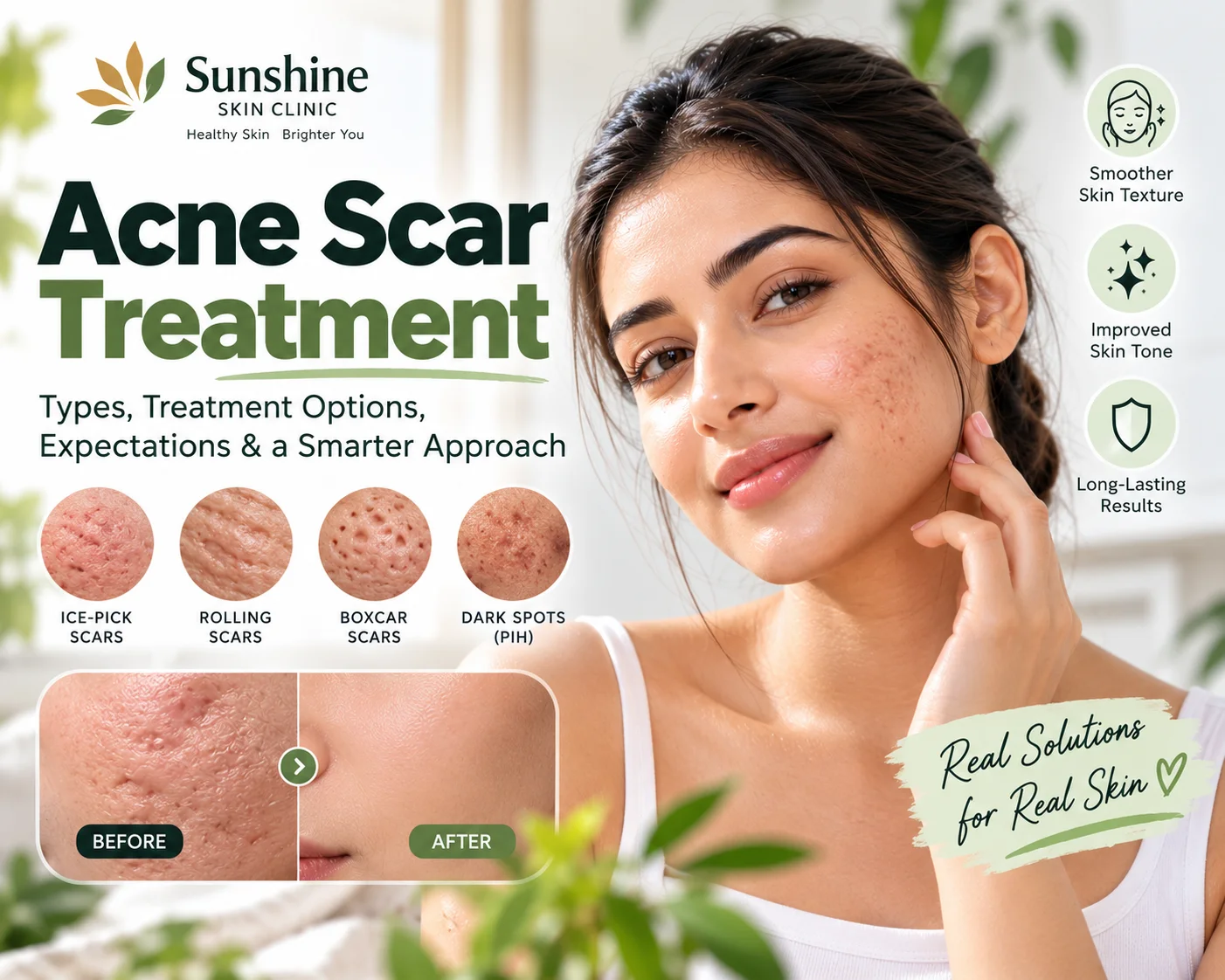
Acne may eventually disappear, but the changes it leaves behind can remain much longer.
For some people, the main concern is a flat brown or red mark. For others, the skin develops visible dents, pits, uneven texture, or raised areas. These problems are often grouped together as “acne scars,” even though they are not the same thing and should not necessarily be treated in the same way.
That is one of the most important things to understand before considering acne scar treatment.
There is no single procedure that works equally well for every scar. Dermatologists first look at the type of scar, its depth, location, skin tone, active acne, previous treatments, downtime preferences, and the result a person is realistically hoping to achieve. The American Academy of Dermatology also emphasizes individualized treatment because different scar types can require different approaches.
This guide explains how acne scars form, how to tell scars apart from marks, what treatment options may be considered, why combination treatment is common, and what patients should think about before starting treatment.
Acne Scars Are Not All the Same
One of the biggest mistakes people make is looking at every indentation or dark spot and calling it an acne scar.
After acne heals, the skin may be left with:
- A flat dark or reddish mark
- An ice-pick scar
- A rolling scar
- A boxcar scar
- A raised hypertrophic scar
- A keloid
- Uneven skin texture
The distinction matters because each develops through a different healing process.
When the body produces too little collagen while repairing deeper acne-related inflammation, depressed scars can form. When it produces excess collagen, a raised scar may develop. Deep inflammatory acne, particularly nodules and cysts, is more likely to cause scarring, and picking or squeezing can increase the risk.
A useful first question
Before asking:
“Which acne scar treatment is best?”
ask:
“What exactly am I looking at?”
That simple change in thinking can prevent a lot of unnecessary trial and error.
10 Smart Ideas to Understand Before Choosing Acne Scar Treatment
1. A Dark Mark Is Not Necessarily a Scar
This is probably the most overlooked distinction.
After a pimple heals, you may see a flat brown or darker area where the acne was. This is often post-inflammatory hyperpigmentation (PIH) rather than a true scar.
A scar changes the structure or texture of the skin. A flat pigmentary mark mainly changes its color.
The two can also occur together.
This is particularly relevant in darker skin tones, where acne-related pigmentation can be more noticeable and may persist for a considerable period. The AAD recommends addressing acne and post-inflammatory pigmentation while also trying to prevent new inflammation that can create additional marks.
Why this matters for treatment
A person with flat pigmentation may not need the same scar procedures used for deep textural scars.
Trying to aggressively treat pigment with a procedure intended primarily for structural scarring can create unnecessary irritation.
So before considering a procedure, determine whether the main problem is:
color, texture, or both.
That is the first decision point.
2. Learn the “Shape Language” of Your Scars
Depressed acne scars are commonly classified into three major types:
Ice-Pick Scars
These are narrow scars that extend deeper into the skin.
They can look small from a distance but may be structurally deep.
Rolling Scars
These are generally wider and shallower. They can create an uneven or wavy appearance because of changes beneath the skin.
Boxcar Scars
These are broader depressions with relatively defined edges and can vary considerably in depth.
A person can have more than one type at the same time, which is common.
A practical idea: Make a “Scar Map”
Instead of simply saying:
“I have acne scars.”
divide the face into areas.
For example:
Cheek → rolling + shallow boxcar
Temple → boxcar
Lower cheek → mixed scars
Nose → ice-pick
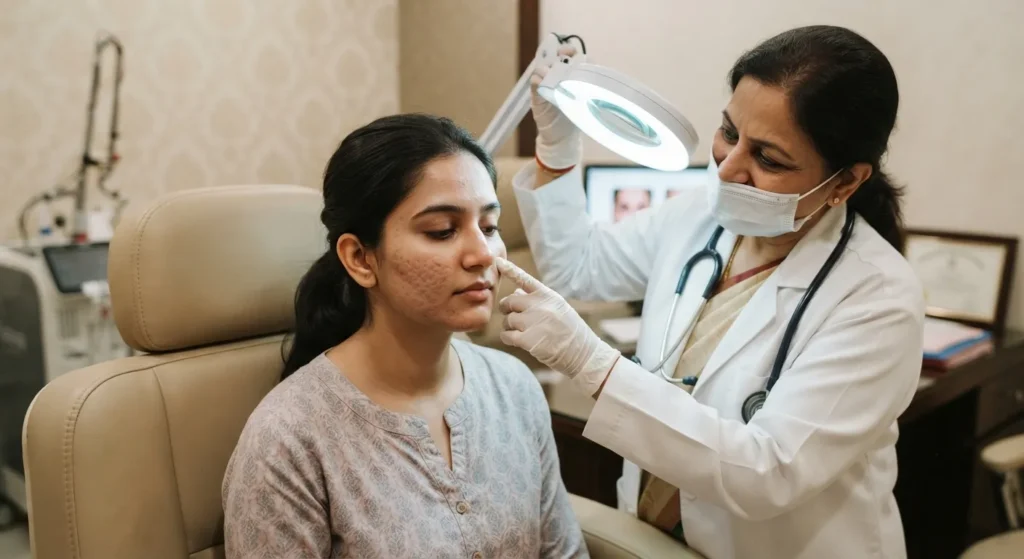
A dermatologist does something similar during scar assessment by examining the type, location and characteristics of the scars before choosing a treatment plan.
You do not need to diagnose the scars yourself. The purpose of a scar map is simply to understand why one procedure may not address every area equally.
3. Think About Scar Depth, Not Just Scar Count
Ten shallow scars are not necessarily the same treatment problem as three deep scars.
Two people can have a similar number of visible marks but very different degrees of tissue change underneath the skin.
This is why counting scars alone can be misleading.
During an evaluation, a dermatologist may consider:
- Depth
- Width
- Edge definition
- Tissue tethering
- Skin thickness
- Location
- Overall scar pattern
The AAD notes that different scars require different treatment approaches and specifically gives the example that ice-pick scars may require a different strategy from rolling scars.
An important takeaway
Scar severity is not simply “how many scars do I have?”
It is also:
“How deeply has the skin architecture changed?”
That is why a simple online photo comparison cannot reliably determine what procedure someone needs.
4. Active Acne and Acne Scars Should Be Treated as Two Connected Problems
A person may be eager to start scar treatment immediately after noticing uneven texture.
But if active acne is still producing new inflammatory lesions, the skin is still being exposed to the process that created the scars in the first place.
The AAD recommends getting active acne under control before beginning many scar-focused treatments, because continuing breakouts can lead to additional scarring.
That does not mean every person must have perfectly clear skin before any scar-related care begins.
Rather, the treatment plan should account for both problems.
Think of it as two stages
Stage 1: Reduce new acne and inflammation
Stage 2: Address established textural or raised scars
Sometimes these stages overlap, but the principle remains the same:
There is little value in repairing yesterday’s scars while today’s inflammation is still creating new ones.
5. Skin Tone Is a Treatment Parameter, Not a Footnote
People often compare acne scar procedures based only on photographs of results.
That can be misleading.
A treatment that produced a particular result on one skin type may not have the same risk-benefit profile for another person.
Skin tone can influence:
- Risk of post-inflammatory hyperpigmentation
- Risk of temporary pigment changes
- Choice of energy settings
- Treatment intensity
- Recovery planning
- Importance of sun protection
- Whether a gentler approach is preferable
The international consensus on energy-based devices specifically addresses acne scar treatment in skin of color, and recent literature also discusses pigmentary complications with procedures such as lasers and TCA-based treatments.
This is particularly relevant for Indian skin.
The smarter question is not:
“Which treatment gives the strongest resurfacing?”
It is:
“Which treatment can address this scar while keeping the risk of unwanted pigment change acceptably low for my skin?”
That is a much more useful treatment conversation.
6. Texture and Pigmentation May Need Different Strategies
A person may have:
Pitted scars + brown marks + uneven tone
and think it is all one problem.
It is not.
The depressed area represents a structural change.
The brown area represents a pigmentary change.
These concerns can overlap, but they are not identical.
This is another reason why acne scar treatment should not be based only on one visible feature.
The AAD notes that treatment may involve procedures such as microneedling, laser treatment, chemical peels, radiofrequency, scar surgery and other approaches, depending on the scar characteristics.
A dermatologist may therefore design a plan in which one part of the treatment addresses texture while another part focuses on pigment control or prevention.
7. Combination Treatment Is Often About Matching Mechanisms, Not Adding More Procedures
“Combination treatment” can sound like marketing language, but the underlying idea is fairly simple.
Different scars may have different structural problems.
For example, a rolling scar may be tethered by fibrous tissue beneath the surface, while an ice-pick scar is narrow and deep. A broader depressed scar may have different resurfacing needs.
One technique may therefore address one mechanism while another addresses a different one.
The AAD states that dermatologists may combine treatments to improve outcomes, while evidence reviews describe multimodal approaches involving techniques such as lasers, microneedling, subcision, chemical reconstruction and fillers.
Think “division of labor”
Instead of asking:
“Why do I need two procedures?”
ask:
“What is each procedure supposed to change?”
A good treatment plan should be explainable in simple language.
For example:
Procedure A → releases or changes one structural problem
Procedure B → remodels surface texture
Procedure C → addresses a remaining focal scar
That explanation is much more useful than simply hearing that a treatment is “advanced.”
8. The Procedure Name Is Less Important Than the Treatment Question
People often begin their research with:
- “Is microneedling good?”
- “Is CO₂ laser better?”
- “Does TCA CROSS work?”
- “Should I get RF microneedling?”
But procedures are tools.
The more important question is:
“What problem is this tool being used to solve?”
Microneedling
Microneedling creates controlled micro-injuries that can stimulate collagen formation and may improve depressed acne scars. The AAD lists microneedling among established options for depressed acne scars.
Fractional Laser Resurfacing
Fractional lasers create controlled treatment zones that stimulate healing and collagen remodeling. Evidence supports their use in atrophic acne scarring, although treatment intensity, downtime and pigmentary risk vary by device and patient.
Radiofrequency Microneedling
This combines microneedling with radiofrequency energy and is used to stimulate remodeling at controlled depths. It is one of several options considered for atrophic acne scars.
Subcision
Subcision works beneath the surface to release fibrous strands that tether certain depressed scars. It is particularly associated with rolling scars, although patient selection and technique matter, and complications such as bruising, infection and pigment changes can occur.
TCA CROSS
TCA CROSS uses focal application of trichloroacetic acid to selected atrophic scars and is particularly discussed for ice-pick and some boxcar scars. A 2026 review found that multiple sessions and carefully controlled technique are common, while transient pigmentary changes remain an important possible adverse effect.
Fillers
Certain depressed scars may be elevated with injectable fillers, sometimes as part of a combination strategy. The AAD includes fillers among options that may be used for selected depressed scars.
Scar surgery
Some scars are better addressed with a minor surgical technique such as punch excision or elevation rather than broad resurfacing. Surgical methods are generally considered according to scar morphology.
The key lesson is:
The procedure should follow the scar diagnosis—not the other way around.
9. Downtime, Budget, and Schedule Are Part of Medical Decision-Making
Patients sometimes compare treatments only by expected improvement.
But real life has other constraints.
The AAD specifically suggests discussing expectations, affordability, downtime and the amount of time a patient can devote to treatment and aftercare during an acne scar consultation.
That means a practical treatment decision may look like this:
How much downtime can I manage?
Can I avoid significant sun exposure during recovery?
How many visits can I realistically attend?
Can I follow the aftercare instructions properly?
Is my schedule compatible with repeated sessions?
These are not secondary questions.
A procedure that theoretically suits a scar but cannot be followed safely or consistently may not be a practical choice for that individual.
10. Measure Progress With Consistent Photos, Not With a Different Mirror Every Day
Acne scar improvement is usually gradual.
That creates a psychological problem: when you look at your face every day, small changes can be difficult to notice.
Different lighting can also make scars appear dramatically deeper or shallower.
Try a “same-lighting rule”
When comparing progress:
- Use similar lighting.
- Use the same camera.
- Keep the face at a similar distance.
- Photograph the same angles.
- Avoid changing filters or beauty modes.
- Compare photographs weeks apart rather than checking daily.
This does not replace professional assessment, but it can provide a much more realistic way to observe gradual changes.
A dermatologist may also use standardized photographs during follow-up to assess treatment response.
One more important point
Do not expect every scar to respond at the same speed.
A shallow rolling scar and a deep ice-pick scar are fundamentally different structures.
The goal of treatment is generally improvement, not an unrealistic promise that every depression will disappear completely.
AAD patient guidance notes that depressed acne scars rarely disappear completely on their own, although treatment can make them less noticeable.
Which Acne Scar Treatment Is Used for Which Scar?
There is no universal treatment chart that can replace an examination, but understanding the general relationship between scar type and treatment approach can make consultations easier.
| Scar type | Common treatment approaches that may be considered |
|---|---|
| Ice-pick scars | TCA CROSS, selected focal techniques, punch procedures, and combination approaches |
| Rolling scars | Subcision, microneedling, radiofrequency microneedling, laser resurfacing, fillers in selected cases |
| Boxcar scars | Fractional laser, microneedling, RF microneedling, subcision or focal/surgical techniques depending on depth |
| Mixed atrophic scars | Often a combination plan based on the dominant scar types |
| Raised hypertrophic scars | Treatments such as corticosteroid injections, certain lasers, or prescription approaches |
| Keloids | Often require a different strategy from depressed scars and may involve injections, laser, surgery, or other specialist treatments |
These are broad treatment categories rather than prescriptions for an individual. The AAD emphasizes that treatment depends on scar type, skin tone, age, number of scars, and other factors.
Can Acne Scars Be Removed Completely?
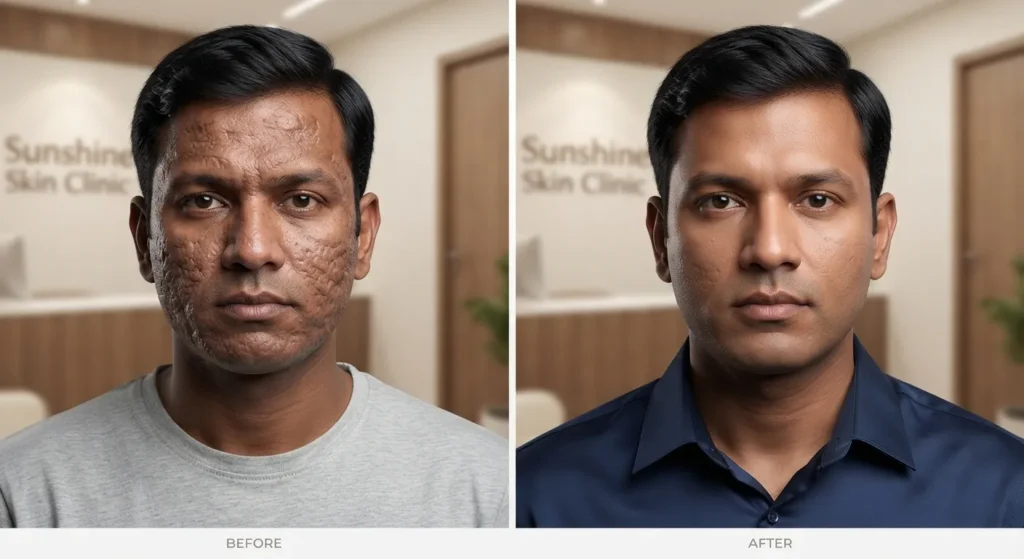
The word “remove” can create unrealistic expectations.
Most evidence-based scar treatment aims to reduce the visibility of scars, improve texture, and make the skin look more even rather than guaranteeing completely scar-free skin.
The outcome depends on:
- Scar type
- Scar depth
- Duration
- Skin characteristics
- Active acne
- Treatment method
- Number of sessions
- Aftercare
- Individual healing response
AAD guidance explains that treatment can make depressed acne scars less noticeable, while deeper scars often require a more individualized approach.
So a more realistic goal is:
“How much improvement can reasonably be achieved?”
rather than:
“Can every scar be erased?”
How Many Sessions Are Needed?
There is no fixed number of sessions that applies to everyone.
Some procedures are performed more than once, while others may be used selectively in combination with another treatment.
For example, the AAD notes that mild-to-moderate chemical peels often require multiple sessions, while some laser treatments and microneedling plans may also involve repeated sessions depending on the device and clinical situation.
The 2026 review of TCA CROSS also found that multiple sessions were associated with greater improvement in the reviewed literature, while technique and concentration affected complication risk.
Therefore, “How many sessions?” should ideally be answered only after evaluating the actual scar pattern.
Does Age of the Scar Matter?
Scar duration can be one consideration, but “old scar” does not automatically mean “untreatable.”
The AAD recommends evaluating the type of scar, age of the scar, skin characteristics, and individual treatment goals when planning scar management.
Older scars may still respond to treatment, but the expected improvement depends much more on their structure than simply on the number of years they have been present.
A scar that has been present for five years may actually be easier to characterize than a newly healing mark that has not fully stabilized.
When Is It Better to Wait Before Treating an Acne Scar?
Not every mark needs immediate procedural treatment.
A flat post-acne mark may gradually become less noticeable, while a true depressed scar is less likely to disappear on its own.
It can therefore be useful to determine whether you are looking at:
recent inflammation → temporary pigmentation → mature scar
rather than assuming that every post-acne change needs a procedure.
AAD guidance notes that many flat marks can fade, while depressed acne scars and keloids generally do not disappear on their own.
That does not mean you should simply wait indefinitely.
It means treatment should be based on what is actually present.
How Can You Prevent More Acne Scars?
Scar treatment becomes much easier when the skin is not continuously developing new scars.
Some preventive steps are surprisingly simple:
Do not squeeze or pick
Picking, popping, or scratching acne can increase inflammation and raise the risk of scarring.
Treat significant acne early
More severe and prolonged inflammatory acne carries a greater risk of scarring, particularly in people prone to pigmentary changes.
Avoid excessive irritation
Aggressive scrubbing and constantly changing active ingredients can irritate acne-prone skin.
Use appropriate sun protection
Photoprotection is particularly relevant when pigmentation accompanies acne.
Control recurrent acne
Preventing the next deep inflammatory breakout is part of scar prevention.
The most cost-effective scar treatment is often the scar that never develops.
A Dermatologist’s Acne Scar Assessment: What Should Be Checked?
A meaningful assessment can include more than simply looking at the face from a distance.
Important questions include:
Are there active acne lesions?
Are the remaining changes pigmentary, structural, or both?
Which scar types are present?
Are the scars tethered?
How deep are they?
What is the person’s skin tone and pigmentary risk?
What treatments have already been tried?
How sensitive is the skin?
How much downtime is acceptable?
What result is the patient expecting?
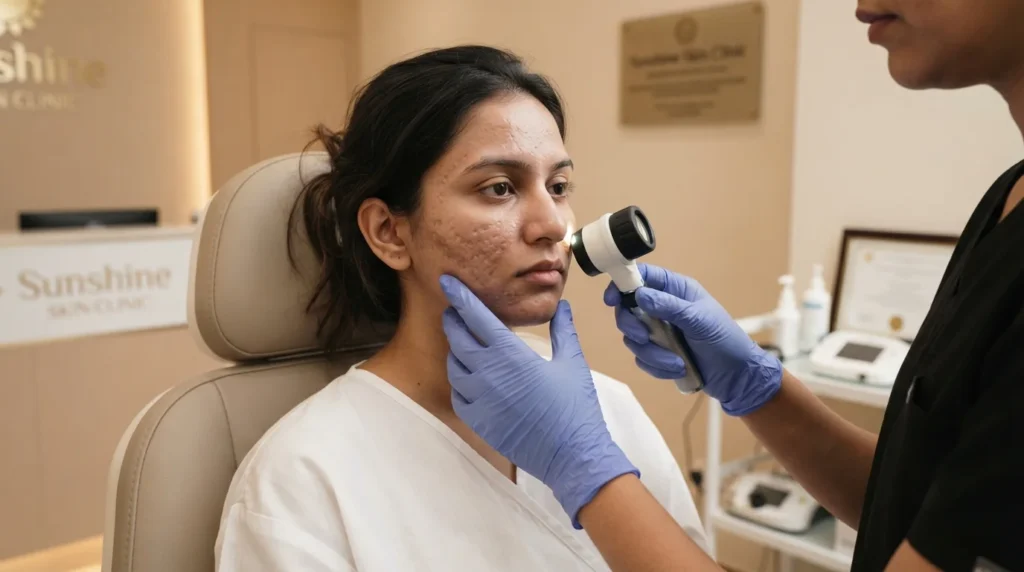
AAD consultation guidance recommends evaluating scar type and location and considering factors such as skin tone, age, budget and treatment goals when developing an individualized plan.
This is why a good consultation should feel more like planning than shopping for a procedure.
What Should You Ask Before Starting Acne Scar Treatment?
Before agreeing to a procedure, ask the practitioner:
“What type of scar do I have?”
You should be able to get a clear explanation.
“What is this treatment supposed to improve?”
The answer should relate to your particular scar pattern.
“What improvement is realistic?”
Ask about improvement rather than guaranteed elimination.
“How much downtime should I expect?”
Especially important with laser or more invasive procedures.
“What are the risks for my skin tone?”
Pigmentary changes deserve particular attention in skin of color.
“Will I need more than one type of treatment?”
Combination treatment is common when multiple scar types coexist.
“What happens if active acne returns?”
A long-term plan should address this possibility.
These questions can help turn an intimidating treatment decision into an informed one.
Acne Scar Treatment in Delhi: What Should Patients Look For?
If you are researching acne scar treatment in Delhi, do not judge a clinic only by dramatic before-and-after photographs.
Instead, look for whether the consultation process explains:
- Your exact scar type
- Why a particular treatment is being considered
- Possible alternatives
- Expected downtime
- Potential pigmentary changes
- Number of sessions
- Aftercare requirements
- What happens if you still have active acne
- What level of improvement is realistic
This approach is more useful than choosing a procedure simply because it appears frequently on social media.
The quality of acne scar management depends not only on the device or procedure but also on patient selection, treatment settings, technique, sequencing, aftercare, and follow-up. Energy-based international consensus recommendations specifically emphasize treatment planning by scar presentation and patient characteristics.
A Simple Acne Scar Treatment Roadmap
For someone beginning the process, a practical roadmap might look like this:
Step 1: Confirm the problem
Is it active acne, pigmentation, true scarring, or a combination?
Step 2: Classify the scars
Identify ice-pick, rolling, boxcar, raised, or mixed patterns.
Step 3: Check the skin environment
Look at skin tone, sensitivity, active inflammation and pigmentary risk.
Step 4: Decide the treatment goal
Is the main goal:
texture improvement?
scar depth reduction?
pigment control?
overall skin refinement?
Step 5: Choose the method
Select the treatment based on the scar problem rather than the popularity of the procedure.
Step 6: Plan the sequence
Some patients may need more than one modality, while others may not.
Step 7: Protect the skin during recovery
Aftercare and sun protection can influence how the skin heals.
Step 8: Review progress
Treatment plans can be adjusted according to the response and any side effects.
This staged approach is consistent with the broader principle in dermatology that acne scar management should be individualized.
Final Thoughts
Acne scars can be stubborn, but they are not a problem that should be approached with guesswork.
The first step is to identify what you actually have.
A flat brown mark is not the same as an ice-pick scar. An ice-pick scar is not the same as a rolling scar. A tethered rolling scar may require a very different strategy from a shallow boxcar scar. A raised scar should not be treated like a depressed scar.
And even when two people have the same scar type, their treatment plans may differ because of skin tone, active acne, sensitivity, previous treatments, lifestyle, recovery time and treatment goals.
Current evidence supports a range of approaches, including microneedling, laser-based treatments, radiofrequency, chemical reconstruction such as TCA CROSS, subcision, fillers, and selected surgical techniques. Combination treatment may be useful when different structural problems exist, but the exact plan should be individualized rather than based on a standard package.
The most useful question is therefore not:
“Which acne scar treatment is the best?”
It is:
“Which treatment—or combination of treatments—matches my scar type, skin characteristics, risks, schedule and realistic goals?”
That is the question that turns acne scar treatment from trial and error into a structured medical decision.
Frequently Asked Questions About Acne Scar Treatment
What is the best treatment for acne scars?
There is no single treatment that is best for every acne scar. The appropriate option depends on whether the scars are ice-pick, rolling, boxcar, raised, mixed, superficial or deep, along with skin tone and other individual factors.
Can acne scars disappear naturally?
Some flat marks left after acne may fade over time, but depressed acne scars generally do not completely disappear on their own. Treatment can make them less noticeable.
What are the three main types of depressed acne scars?
The three commonly described types are ice-pick, rolling and boxcar scars. A person can have more than one type at the same time.
Is acne scar treatment safe for Indian skin?
Many acne scar treatments can be used in darker skin tones, but treatment intensity, device selection and technique need to be considered carefully because post-inflammatory pigment changes can occur. International consensus recommendations specifically address acne scar procedures in skin of color.
Is microneedling effective for acne scars?
Microneedling can improve the appearance of certain depressed acne scars by stimulating collagen remodeling. Suitability depends on scar type and individual skin characteristics.
What is TCA CROSS used for?
TCA CROSS is a focal chemical technique most commonly discussed for atrophic scars such as ice-pick and selected boxcar scars. Recent literature continues to evaluate its technique, efficacy and complications.
Is subcision useful for rolling acne scars?
Subcision is designed to release fibrous strands that tether some depressed scars and is commonly used for rolling scars. It can cause temporary bruising and other complications, so proper patient selection and technique are important.
Can acne scar treatment remove scars 100%?
No procedure should be presented as a guarantee of complete scar removal. Treatment generally aims to make scars less noticeable and improve texture and overall skin appearance.
Should active acne be treated before acne scars?
In many cases, yes. Controlling active acne helps reduce ongoing inflammation and the formation of new scars. The AAD recommends getting active acne under control before beginning many scar-focused treatments.
How many sessions are needed for acne scar treatment?
There is no universal number. The number of sessions depends on the procedure, scar type, severity, skin response and whether combination treatment is required. Some treatments are repeated over multiple sessions.