


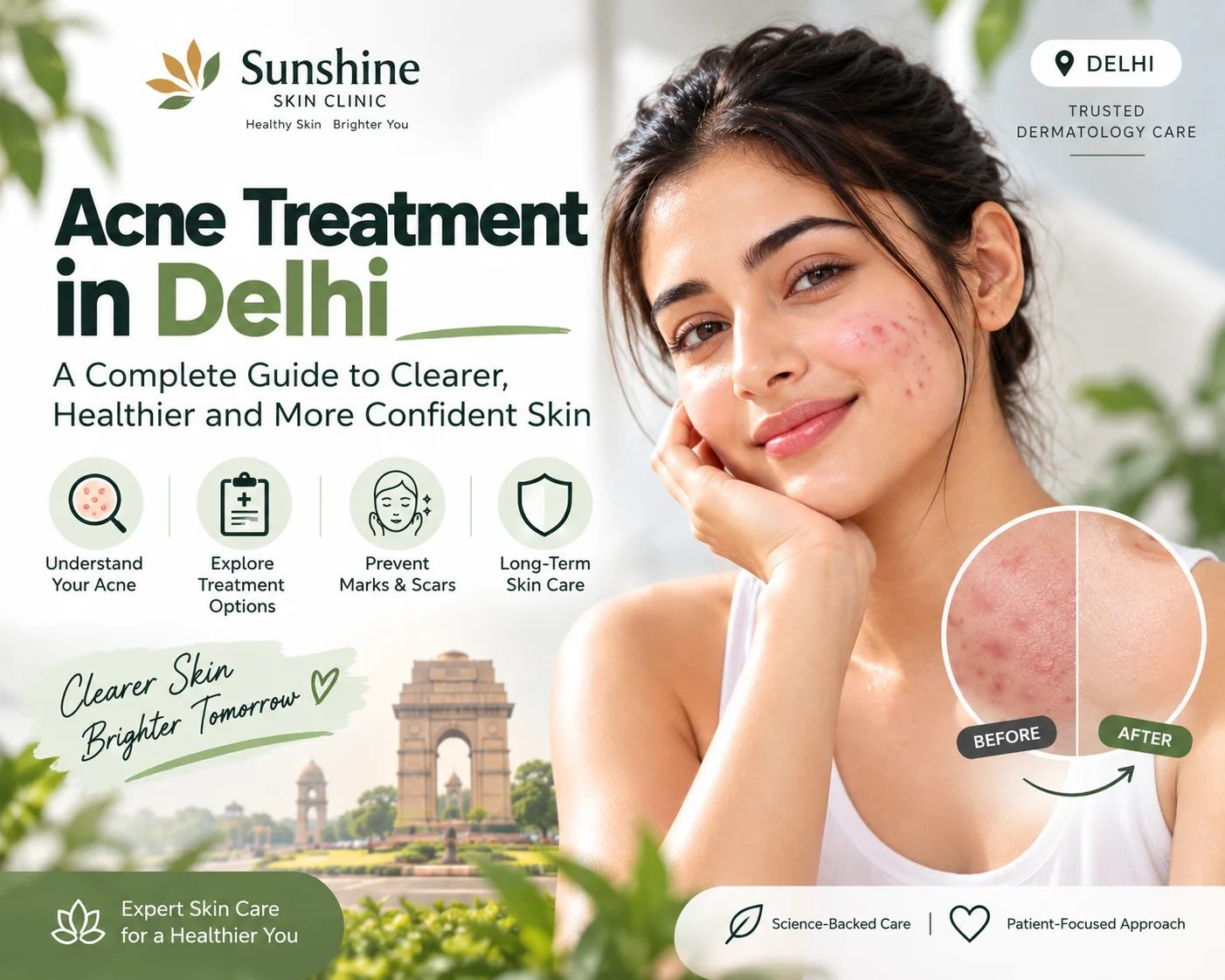
A Practical Guide to Understanding Acne, Treatment Options, and Long-Term Skin Care
Acne is often treated like a simple skin problem: a few pimples appear, a new cream is purchased, and the expectation is that the skin should clear quickly.
Real acne is rarely that simple.
A breakout can involve blocked pores, excess sebum, inflammation, hormonal influences, skin-care habits, and individual susceptibility. Two people may have acne that looks similar but need very different approaches. Acne can also leave behind dark marks or scars even after the active pimples disappear.
That is why effective acne treatment in Delhi is not simply about finding the strongest cream or the latest procedure. It starts with understanding what type of acne you have, how severe it is, what has already been tried, and whether your skin is developing pigmentation or scarring.
Current dermatology guidelines support several evidence-based topical and systemic treatments, but the appropriate choice depends on acne severity, individual circumstances, tolerability, and treatment goals.
What Is Acne?
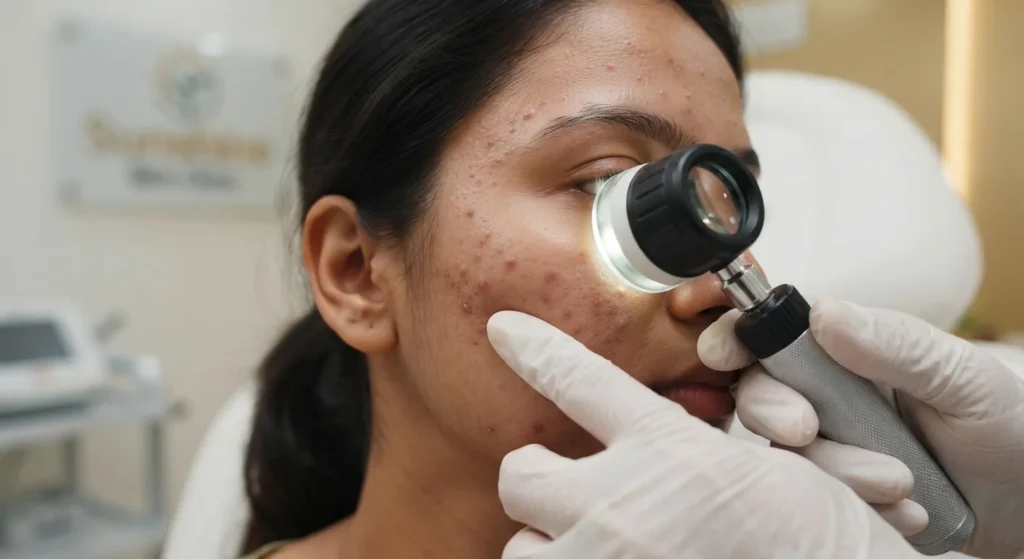
Acne vulgaris is a common inflammatory skin condition that develops around hair follicles. It can appear as:
- Blackheads
- Whiteheads
- Small red bumps
- Pus-filled pimples
- Painful nodules
- Deep cyst-like lesions
Acne commonly affects the face, but it can also develop on the chest, shoulders, upper arms, and back.
The important point is that acne is not caused by a single factor. Oil production, abnormal shedding of skin cells, inflammation and changes in the follicular environment all contribute to the development of acne.
Genetics also matter. Some people are simply more prone to persistent or severe acne than others.
10 Things People Often Miss When Treating Acne
A good acne article should answer more than “Which cream should I use?” These ten points can make acne management easier to understand.
1. First Identify What Kind of Acne You Actually Have
Not every facial bump is the same.
Blackheads and whiteheads are mainly non-inflammatory lesions. Red, swollen pimples are inflammatory lesions. Larger painful nodules or deep cystic lesions represent a more severe form of acne.
This distinction matters because treatment should match the type and severity of the acne.
For example, someone with mostly clogged pores may need a very different approach from someone with frequent painful nodules.
An especially useful question is:
“What is the dominant problem on my skin right now?”
Is it clogged pores, inflammation, painful deep acne, recurring breakouts, or marks left after old pimples?
That simple distinction can make a skincare routine much more logical.
2. Treat the Acne Before Focusing Only on the Marks
One of the most common frustrations is:
“My pimples are fewer, but I keep getting dark spots.”
In people with medium-to-dark skin tones, acne can be followed by post-inflammatory hyperpigmentation (PIH). These flat areas of discoloration are not necessarily acne scars.
If new acne keeps appearing, new marks can continue forming while older ones are still fading.
That means treating active acne and reducing the chance of new inflammation is often the first step toward improving the overall appearance of the skin.
Sun protection is also important because ultraviolet exposure can contribute to ongoing pigment changes. Indian acne guidance specifically emphasizes sun protection and non-comedogenic, oil-free sunscreen in people with acne-related pigmentation.
A useful way to think about it:
Stop the new inflammation → reduce new marks → then work on persistent pigmentation.
This is often more productive than continuously changing brightening products.
3. More Products Do Not Necessarily Mean Better Acne Control
Acne can create a strange cycle.
A new pimple appears → a new product is added → the skin becomes irritated → another product is added → dryness and sensitivity increase → the routine becomes even more complicated.
Dermatologists commonly advise giving acne treatments enough time to work rather than replacing them every few days. The AAD notes that repeatedly changing treatments can irritate acne-prone skin, while visible improvement often takes several weeks and clearing may take several months.
A simpler routine is often easier to follow consistently.
For many people, the basic framework is:
Gentle cleansing + appropriate acne treatment + moisturizer when needed + daily sunscreen
The exact active ingredients and schedule should depend on the individual’s skin and diagnosis.
4. Acne Treatment Is Usually a Process, Not a One-Day Procedure
Many people expect acne treatment to work like a cosmetic facial: one session, visible change, and the problem is finished.
Medical acne treatment is different.
Depending on the severity, treatment may involve topical medication, oral medication, hormonal treatment in selected patients, or other procedures. The AAD’s 2024 guideline includes topical retinoids, benzoyl peroxide, salicylic acid, azelaic acid and other therapies, as well as systemic options for appropriate patients.
NICE recommends reviewing first-line acne treatment after about 12 weeks, rather than assuming that an early lack of dramatic improvement means the treatment has failed.
This creates an important shift in expectations:
The aim is not to find a magical overnight solution. The aim is to find a treatment plan that steadily controls acne and can be maintained safely.
5. Your Treatment History Is Part of the Diagnosis
When you visit a dermatologist, “What are you using?” is not a routine question.
Your previous treatments can reveal:
- What has already been tried
- Whether you tolerated the treatment
- Whether acne improved and then returned
- Whether irritation contributed to the problem
- Whether antibiotics were previously used
- Whether you have already used prescription treatments
- Whether pigmentation or scarring developed during the process
This is one reason it is helpful to keep a simple record of your skincare and acne treatments.
A practical idea: Create an “Acne Timeline”
Write down:
When acne started → major flare-ups → treatments tried → what improved → what caused irritation → current symptoms
For someone who has been struggling with acne for months or years, this can provide much more useful information than simply taking another close-up photograph of the latest pimple.
6. Not Every Persistent “Acne” Problem Is Ordinary Acne
Sometimes acne-like bumps may actually represent another condition.
For example, some cases of folliculitis, perioral dermatitis, or irritation from hair and skincare products can look similar to acne.
The AAD specifically advises people with persistent acne-like breakouts to consider whether the condition is really acne and notes that hair-care products, cosmetics, sports equipment, and other factors can contribute to acne or acne-like breakouts.
This is where diagnosis becomes more important than trying another product.
A useful checkpoint:
If your skin repeatedly fails to respond as expected, ask:
“Am I treating the correct condition?”
That question can sometimes save months of trial and error.
7. Adult Acne Deserves a Different Conversation
Acne is often associated with teenagers, but acne can continue into adulthood or develop for the first time later in life.
Adult acne can be influenced by hormonal factors, medications, cosmetics, stress and other individual factors. Stress may worsen existing acne even though it is not considered the sole cause of acne.
For some women, repeated breakouts around the lower face or jawline may raise questions about hormonal contribution. That does not automatically mean that hormones are the cause, but the pattern and medical history can help a dermatologist decide whether further evaluation is appropriate.
This is why adult acne should not always be approached as “teenage acne that never went away.”
8. Acne on Indian Skin Needs Attention to Pigmentation as Well as Pimples
For many Indian patients, the visible problem is not only the acne itself.
A pimple may disappear while a brown mark remains for weeks or months.
PIH is particularly relevant in skin of color, and the AAD notes that people with darker skin tones often develop dark spots after acne. Early acne treatment can also help reduce the risk of persistent marks and scarring.
This creates a two-part treatment goal:
Control active acne + minimize the factors that contribute to post-acne discoloration.
That may mean avoiding unnecessary irritation, not picking lesions, using suitable acne treatment, and maintaining sun protection.
9. Your Skin Can Be Oily and Still Need Moisturizer
“Oily skin doesn’t need moisturizer” is a common assumption.
In reality, acne treatments can cause dryness, irritation or peeling. Some patients may therefore benefit from a lightweight, non-comedogenic moisturizer even when their skin naturally produces excess oil.
The goal is not to make the skin completely oil-free.
The goal is to maintain a healthy skin barrier while treating acne.
For oily skin, dermatologists generally recommend products labelled oil-free and non-comedogenic, while also avoiding aggressive scrubbing.
This is another reason why “stronger” is not always “better.”
10. The End of Acne Treatment Is Not the Same as the End of Acne Management
Suppose the skin becomes clear.
Should everything immediately be stopped?
Not necessarily.
Some people experience frequent relapse and may benefit from maintenance treatment after active acne has been controlled. NICE recommends considering maintenance treatment in people with a history of frequent relapse, with options chosen according to the individual’s circumstances and tolerability.
This leads to an important concept:
Acne treatment has two stages: control and maintenance.
The first stage aims to reduce active lesions.
The second aims to help prevent unnecessary recurrence.
That distinction can make long-term acne management much more realistic.
What Are the Main Acne Treatment Options?
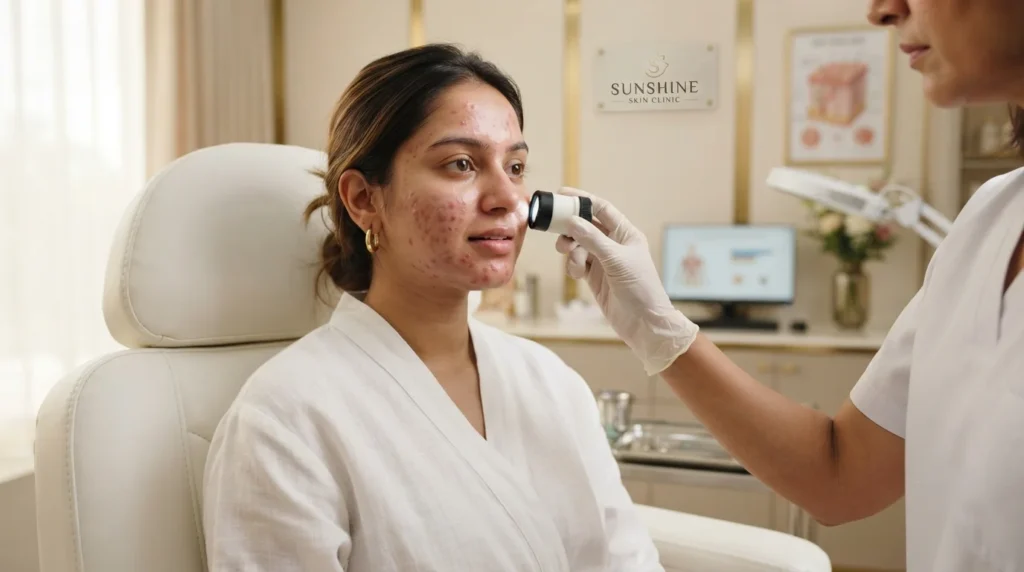
There is no single treatment that works for every person with acne.
The choice depends on factors such as acne severity, lesion type, inflammation, scarring risk, age, previous treatment, pregnancy considerations, other medical conditions, and individual tolerance.
Topical Treatments
Topical treatments are applied directly to the skin.
Depending on the diagnosis, dermatologists may use ingredients such as:
Retinoids
These help normalize follicular cell turnover and can reduce clogged pores and inflammation.
Benzoyl Peroxide
This helps reduce acne-associated bacteria and inflammation.
Azelaic Acid
It can be useful for acne and may also have a role when post-inflammatory pigmentation is a concern.
Salicylic Acid
It can help with clogged pores and is used in some acne regimens.
Topical Antibiotics
These may be used in selected cases, generally as part of a broader treatment strategy rather than indefinitely.
The AAD’s updated guideline supports several of these topical therapies and favors appropriate combinations that work through different mechanisms.
When Are Oral Medicines Used?
Moderate-to-severe inflammatory acne may sometimes require systemic treatment.
Depending on the patient, dermatologists may consider:
- Oral antibiotics
- Hormonal therapies for selected patients
- Isotretinoin for severe or treatment-resistant acne
- Other systemic options based on individual circumstances
These medicines are not suitable for everyone.
For example, some medications have important pregnancy-related restrictions, and oral antibiotics should not be used casually or indefinitely. Current guidelines emphasize limiting antibiotic exposure and using antibiotics appropriately with other acne therapies to reduce antimicrobial resistance.
Isotretinoin also requires medical supervision because of its risks, monitoring requirements, and pregnancy-related safety considerations. It should never be started simply because an online article describes it as a powerful acne medicine.
Do Acne Procedures Have a Role?
Procedures can have a role in selected patients, but they should not automatically replace medical acne treatment.
Depending on the presentation, a dermatologist may consider certain procedures or adjunctive approaches for specific situations.
For example, a large painful inflammatory lesion may sometimes be treated with an intralesional corticosteroid injection for relatively rapid reduction of inflammation and pain. The AAD includes this as an adjunctive option for larger acne bumps.
Other procedures such as chemical peels, light-based treatments, or certain devices may be considered in selected situations, but evidence and suitability vary. NICE notes that evidence for some physical treatments and chemical peels is more limited than for established pharmacological options.
This is an important distinction:
A procedure may be useful, but “advanced” does not automatically mean “necessary.”
What About Acne Scars?
Acne scars are different from active acne.
There is also an important difference between a true scar and a flat dark mark.
Post-inflammatory hyperpigmentation
A flat brown or darker mark left after a pimple is often PIH rather than a scar. These marks can fade over time.
Depressed acne scars
These include:
- Ice-pick scars
- Boxcar scars
- Rolling scars
Raised acne scars
Some people develop raised scars, including hypertrophic or keloid-type scarring.
The treatment depends heavily on the scar type. There is no single procedure that is ideal for every scar.
This is why acne scar treatment is usually more effective when scar morphology is assessed first rather than selecting a procedure simply because it is popular.
How Can You Reduce the Risk of Acne Scarring?
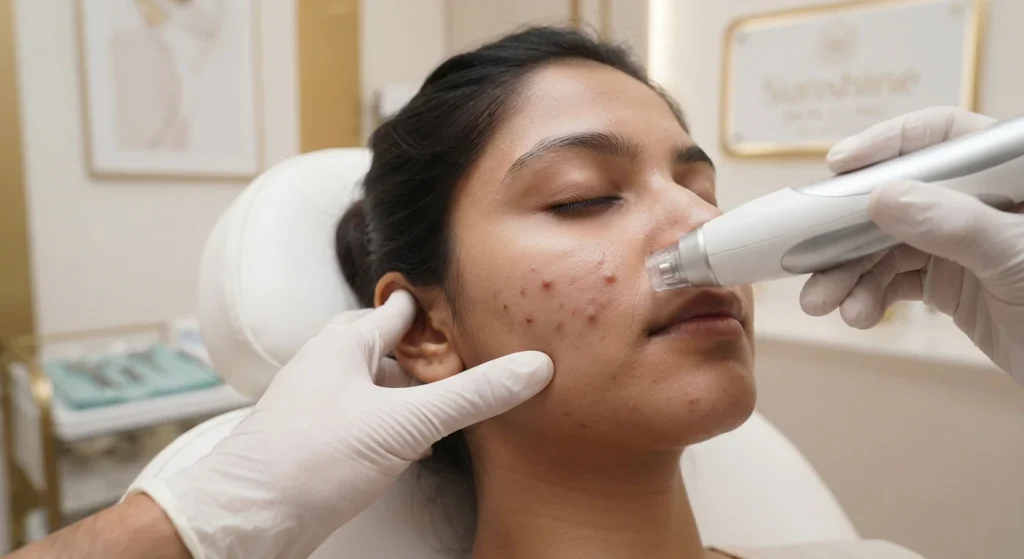
The most important step is not waiting until severe scars have developed.
Early and appropriate acne management can reduce the risk of worsening disease and persistent marks. The AAD specifically recommends treating acne early, especially in people with darker skin who may be more likely to develop post-inflammatory hyperpigmentation.
Also try to avoid:
- Picking pimples
- Squeezing cysts
- Aggressive scrubbing
- Frequently changing acne products
- Using multiple irritating active ingredients at once
Picking and squeezing can prolong inflammation and increase the risk of scarring and dark marks.
A Simple Acne-Friendly Daily Routine
A useful routine does not have to contain ten products.
Morning
Gentle cleanser → lightweight moisturizer if needed → broad-spectrum sunscreen
Evening
Gentle cleanser → prescribed/acne treatment → moisturizer if needed
The exact active treatment should depend on the acne pattern and whether it has been recommended by a healthcare professional.
For oily skin, products labelled oil-free and non-comedogenic are often practical choices. Dermatologists also advise avoiding excessive washing and scrubbing because irritation can make acne-prone skin worse.
Does Diet Cause Acne?
This question is more complicated than the common statement:
“Chocolate causes acne.”
Research suggests that a high-glycemic diet may worsen acne in some people, but the evidence is not strong enough to say that one particular food is universally responsible for acne. The AAD notes that some studies support a possible relationship between high-glycemic foods and acne, while other research has not found the same connection.
So instead of unnecessarily eliminating large groups of foods, it can be more useful to pay attention to your own pattern.
A simple food-and-skin diary can help:
Food → date → breakout pattern → other factors
This does not prove that a particular food caused acne, but it can help identify a repeated personal pattern that can then be discussed with a healthcare professional.
Can Stress Cause Acne?
Stress does not appear to be the sole cause of acne, but it may worsen existing acne in some people.
Stress can also affect sleep, skincare habits, diet, and treatment adherence, which may indirectly make acne harder to control.
So stress management should be viewed as one part of overall wellbeing rather than as a replacement for acne treatment.
Why Delhi Weather and Lifestyle Can Make Acne Management More Difficult
Delhi presents a practical skincare environment that many patients recognize: periods of heat, sweating, pollution exposure, commuting, outdoor activity, masks or helmets, and long days away from home.
These factors do not necessarily cause acne by themselves, but sweat, friction, occlusion, unsuitable cosmetic products, and inconsistent cleansing or skincare can complicate acne-prone skin.
The AAD notes that friction and pressure from equipment can contribute to a form of acne called acne mechanica, while oily hair or hair products can also contribute to breakouts around the forehead and hairline.
A practical Delhi-specific habit
After significant sweating:
Cleanse gently rather than aggressively scrubbing the skin.
And where helmets, masks, straps or sports equipment repeatedly rub the same area, pay attention to whether breakouts consistently appear there.
When Should You See a Dermatologist for Acne?
You do not need to wait until acne becomes severe.
Professional evaluation becomes especially useful when:
- Acne keeps returning despite a consistent routine
- Painful nodules or deep lesions are appearing
- Acne is leaving dark marks
- You are developing scars
- Breakouts are widespread on the back or chest
- Acne is affecting daily life or confidence
- Over-the-counter products have not produced enough improvement
- You are unsure whether the bumps are actually acne
- Acne developed suddenly in adulthood
- You are considering prescription medication
NICE recommends specialist referral in situations such as diagnostic uncertainty, nodulocystic acne, scarring, persistent pigmentary changes, or acne that has not responded adequately to appropriate treatment courses.
What to Expect From an Acne Consultation
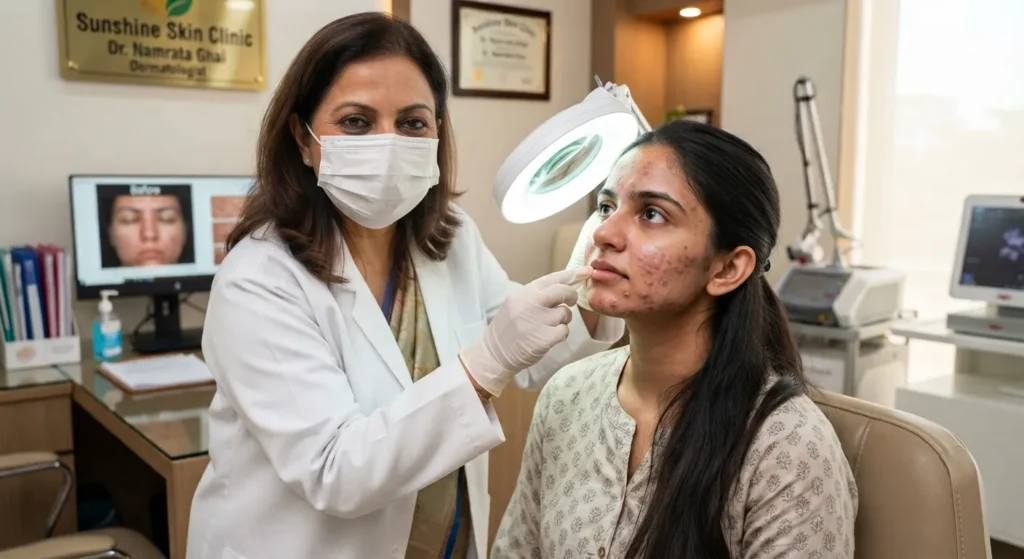
A useful acne consultation should be more than simply being handed a cream.
The assessment may consider:
1. Type of acne
Blackheads, whiteheads, inflammatory lesions, nodules, or mixed acne.
2. Severity
How widespread and inflammatory the condition is.
3. Distribution
Face, jawline, chest, shoulders, or back.
4. Previous treatments
What you have already tried and how your skin responded.
5. Scarring and pigmentation
Whether acne is already leaving permanent or persistent changes.
6. Skin sensitivity
Whether aggressive products are causing irritation.
7. Possible contributing factors
Hormonal pattern, medications, cosmetics, hair products, friction, or other relevant factors.
8. Long-term plan
How active acne will be controlled and how recurrence may be managed.
This approach helps turn acne treatment into a structured process rather than a series of random product experiments.
How Long Does Acne Treatment Take?
There is no universal timeline.
Some people see early changes within several weeks, while meaningful improvement may take longer. The AAD notes that acne treatment can require several weeks to a few months before noticeable improvement, and NICE recommends reviewing first-line treatment at around 12 weeks.
This is why switching treatments every few days is usually counterproductive.
A better question is:
“Is the treatment producing measurable improvement over an appropriate period, and are the side effects acceptable?”
That is a much more useful way to judge progress.
A Better Way to Track Your Acne Progress
Here is another simple idea that can make treatment easier to evaluate.
Use a Monthly Acne Check-In
Once every four weeks, record:
Number of new painful pimples
Number of deep lesions
New dark marks
New scars
Oiliness
Irritation or dryness
Overall skin comfort
You do not need to photograph your face every day.
A monthly comparison under similar lighting can provide a more realistic picture than checking the mirror multiple times a day.
It also gives you something useful to discuss during follow-up appointments.
The Most Important Mindset for Acne Treatment
Acne treatment becomes much easier to understand when you stop asking:
“What is the strongest treatment?”
and start asking:
“What is the right treatment for this type and severity of acne, and how can I control it without unnecessarily irritating my skin?”
That change in perspective matters.
The strongest medicine is not automatically the right medicine.
The most expensive treatment is not automatically the most effective treatment.
And the newest procedure is not automatically necessary.
Good acne management is about matching the treatment to the individual problem, monitoring the response, adjusting when needed, and preventing avoidable complications such as pigmentation and scarring.
Final Takeaway
Effective acne treatment in Delhi is not about chasing the newest product or expecting an overnight transformation.
The better approach is to identify the type and severity of acne, understand what may be contributing to the breakouts, use evidence-based treatment consistently, protect the skin barrier, and address pigmentation or scarring before these problems become harder to manage.
Current dermatology guidelines support several proven treatments, including topical retinoids, benzoyl peroxide and other appropriate topical therapies, while systemic medicines are used when the severity and individual situation justify them. Antibiotics should be used carefully, and severe or persistent acne may require specialist management.
For people with Indian or other skin of color, controlling inflammation early is particularly important because acne can leave noticeable post-inflammatory dark spots.
Most importantly, acne is treatable, but treatment works best when it is approached as a long-term skin-management process rather than a quick cosmetic fix.
Frequently Asked Questions
What is the best treatment for acne?
There is no single best treatment for everyone. The appropriate option depends on acne type, severity, previous treatments, age, pregnancy considerations, skin sensitivity, and other individual factors. Evidence-based options include topical retinoids, benzoyl peroxide, azelaic acid, salicylic acid and other treatments, with systemic therapies considered when appropriate.
Can acne be permanently cured?
Acne can often be controlled very effectively, but some people experience recurrence. Maintenance treatment may be appropriate for people who frequently relapse.
How long does acne treatment take to work?
Visible improvement can take several weeks, while more meaningful control may take a few months. Treatment should generally be assessed over an appropriate timeframe rather than changed every few days.
Does squeezing pimples cause scars?
Picking, popping, or squeezing acne can prolong inflammation and increase the risk of scarring and post-inflammatory hyperpigmentation.
Is acne caused by dirty skin?
No. Acne is a complex inflammatory condition, not simply a result of poor hygiene. Over-washing or aggressive scrubbing can actually irritate acne-prone skin. Dermatologists generally recommend gentle cleansing rather than repeated harsh washing.
Is acne only a teenage problem?
No. Acne can continue into adulthood or begin later in life. Adult acne may have different contributing factors and sometimes requires a different evaluation.
Can oily skin use moisturizer?
Yes. Acne treatments can cause dryness and irritation, and some people with oily skin benefit from a lightweight, non-comedogenic moisturizer.
Can sunscreen help acne-prone skin?
Sunscreen does not treat the underlying cause of acne, but regular photoprotection is important, especially when acne leaves dark marks or when certain acne treatments increase sun sensitivity. For acne-prone skin, a non-comedogenic sunscreen can be a practical choice.
When should I see a dermatologist for acne?
Consider professional evaluation if acne is painful, persistent, scarring, leaving persistent pigmentation, not responding to appropriate treatment, or if you are uncertain whether the condition is actually acne.