


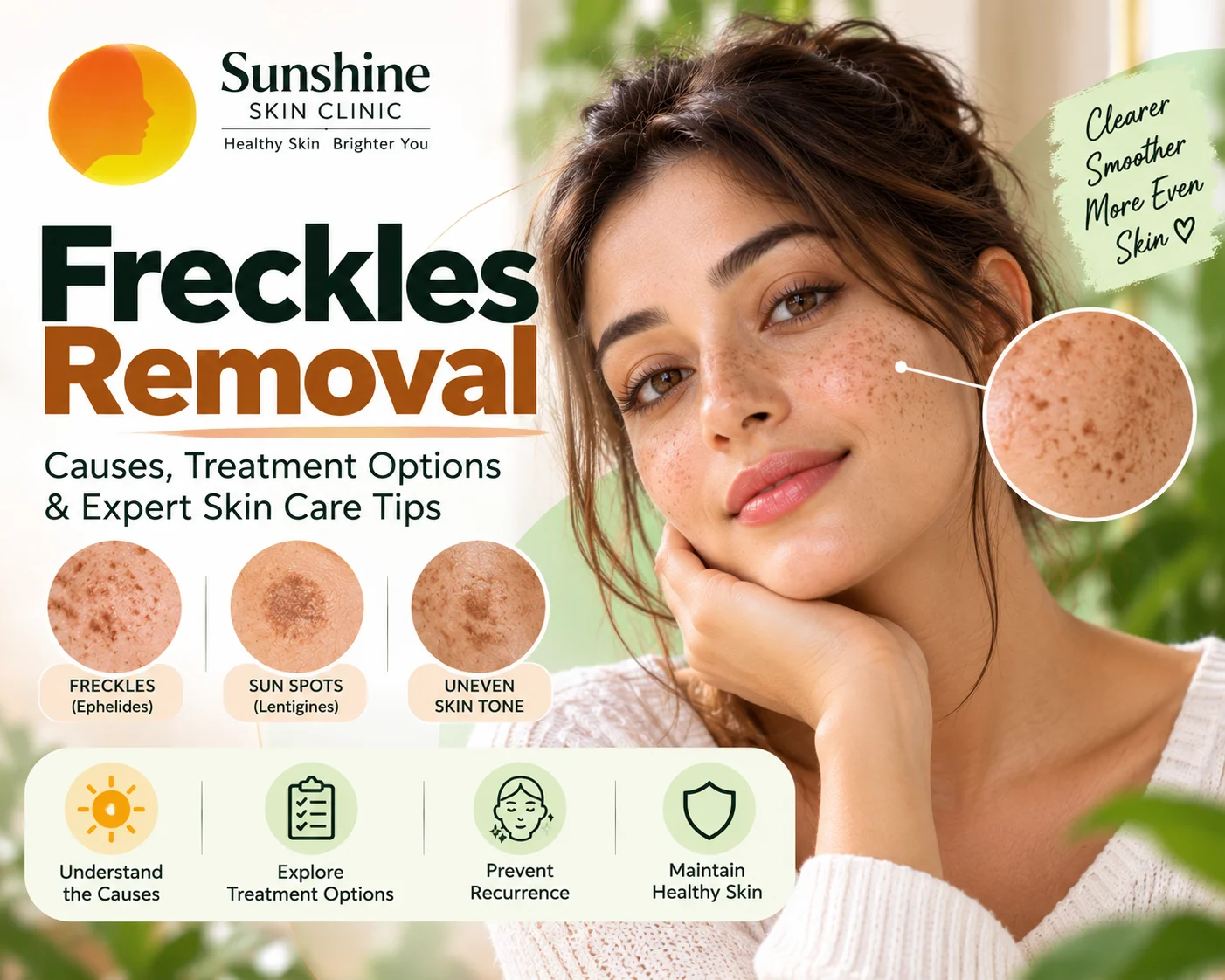
Freckles may be small, but they can become surprisingly noticeable when they multiply across the nose, cheeks, forehead, shoulders, or other sun-exposed areas.
Some people simply want to understand why they appear. Others look for freckles removal because the spots become darker during sunny months or because they have become more visible over time.
The important thing to know is that freckles are not simply “dirt,” damaged skin, or a problem caused by poor skincare.
True freckles, medically known as ephelides, are related to genetics and increased melanin production in response to ultraviolet exposure. They commonly become more noticeable during periods of high sun exposure and may fade during the winter months.
However, not every brown spot that looks like a freckle is an ephelis. Solar lentigines, moles, certain forms of pigmentation, and some other lesions can look similar. That makes correct identification the first step before attempting removal.
This guide explains what freckles are, how they differ from other brown spots, what treatments may help, why freckles can return, and how to approach treatment more safely.
What Are Freckles?
Freckles, or ephelides, are small, flat, light-brown to dark-brown macules that usually develop on areas exposed to sunlight.
They are particularly common on:
- The nose
- Cheeks
- Forehead
- Shoulders
- Upper back
- Forearms
Freckles are influenced by genetics, including variations involving the MC1R pathway, and sunlight can make them darker and more numerous. Unlike some other pigmented lesions, freckles are associated with increased melanin production without an increase in the number of melanocytes.
Freckles often become visible during childhood or adolescence and may become less noticeable with age in some individuals.
Although freckles are generally harmless, some people seek treatment for cosmetic reasons.
8 Important Ideas to Understand Before Choosing Freckles Removal
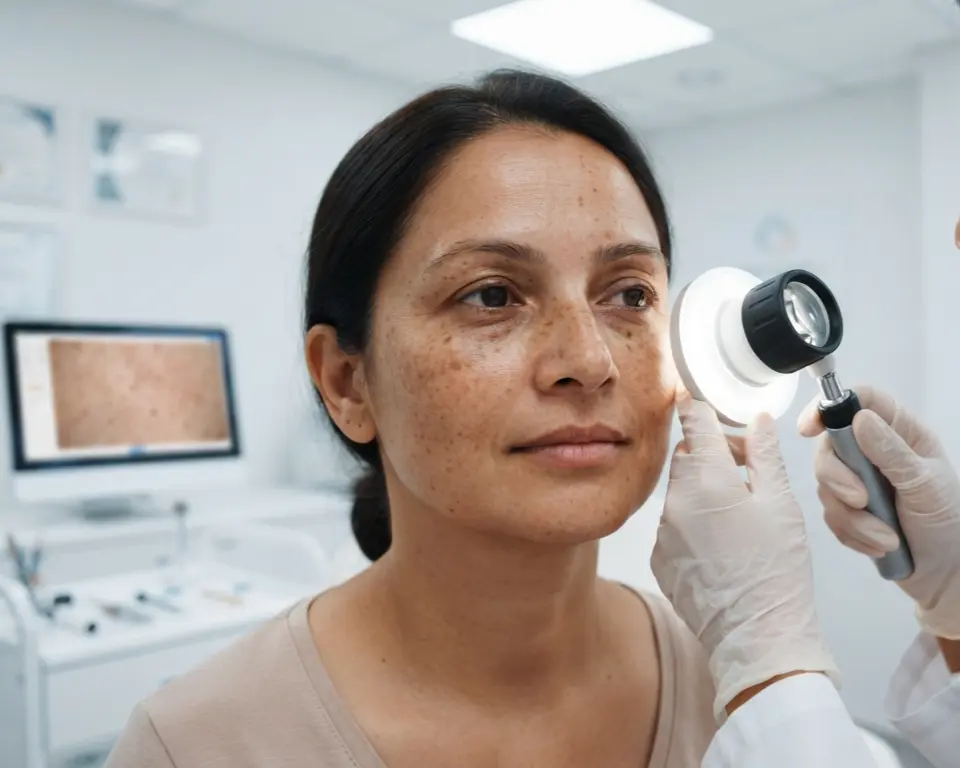
1. The First Step Is Not Removal — It Is Identification
The word “freckle” is often used for many different brown spots.
But a true ephelis is different from a solar lentigo, and both are different from a mole or another pigmented lesion.
Freckles (Ephelides)
They tend to:
- Appear from childhood or early life
- Become darker after sun exposure
- Be more noticeable in summer
- Fade considerably during winter in many people
- Occur as multiple small spots
Solar Lentigines
These are usually more persistent.
Unlike freckles, they tend to remain visible even when ultraviolet exposure decreases. They may be larger, more sharply defined, and more common with cumulative sun exposure and age.
Why does this distinction matter?
Because the treatment strategy can change.
A treatment that may be appropriate for an uncomplicated epidermal freckle may not be the right approach for another pigmented lesion.
And if a lesion looks unusual, changing, bleeding, or otherwise suspicious, the priority is diagnosis—not cosmetic removal. Dermatology references emphasize clinical examination and, when necessary, dermoscopy or biopsy for atypical pigmented lesions.
2. Freckles Have a “Seasonal Calendar”
This is one of the simplest but most useful ways to understand freckles.
A person may notice that freckles become darker or more numerous after spending more time outdoors and then appear less noticeable months later.
That is not necessarily a sign that the skin has suddenly developed a new disease.
It reflects how ephelides respond to ultraviolet exposure.
DermNet notes that freckles commonly become more prominent in summer and fade during winter, while some may also become less obvious with age.
A useful idea: compare the same spots across seasons
Instead of asking only:
“Why do I have freckles?”
also ask:
“How does my freckling change with sun exposure?”
This can reveal a pattern.
For some people, prevention during high-exposure months may make a noticeable difference even if they never undergo a procedure.
3. Sun Protection Is Part of Treatment — Not Just Prevention
Freckles are strongly linked to ultraviolet exposure.
That means removing visible freckles without changing sun habits can produce an incomplete result.
A person may lighten the existing spots and then notice them becoming darker again after significant sun exposure.
DermNet recommends broad-spectrum high-SPF sunscreen and other sun-protective measures for people with freckles. The goal is not only to protect already treated skin but also to reduce further UV-driven pigment change.
A practical sun-protection plan
Use:
Broad-spectrum sunscreen
plus, when appropriate:
Hat + protective clothing + shade
This is particularly important during prolonged outdoor exposure.
Sunscreen also needs to be used correctly. Applying a very thin amount or using it only occasionally is unlikely to provide the intended protection.
The important idea
Freckles can be treated, but their biological trigger cannot be ignored.
4. “Removal” Does Not Always Mean “Permanent Disappearance”
This is one of the most important expectations to set.
Pigment-targeting treatments can lighten freckles, sometimes substantially. But freckles are influenced by genetics and ultraviolet exposure, so new freckling or darkening can occur again.
DermNet specifically notes that laser treatment may produce temporary lightening and that continued sun protection is important because pigmentation may recur with renewed UV exposure.
Clinical studies of laser treatment also demonstrate that recurrence can occur in some patients after initial improvement.
So a realistic goal is not:
“I will never have a freckle again.”
A more realistic goal is:
“I want to reduce the visibility of existing freckles and minimise new darkening.”
That difference is important when deciding whether treatment is worthwhile.
What Treatments Can Be Used for Freckles?
Treatment depends on the diagnosis, skin type, number of spots, location, and cosmetic goals.
Pigment-Specific Laser Treatment
Certain lasers can selectively target melanin in pigmented lesions.
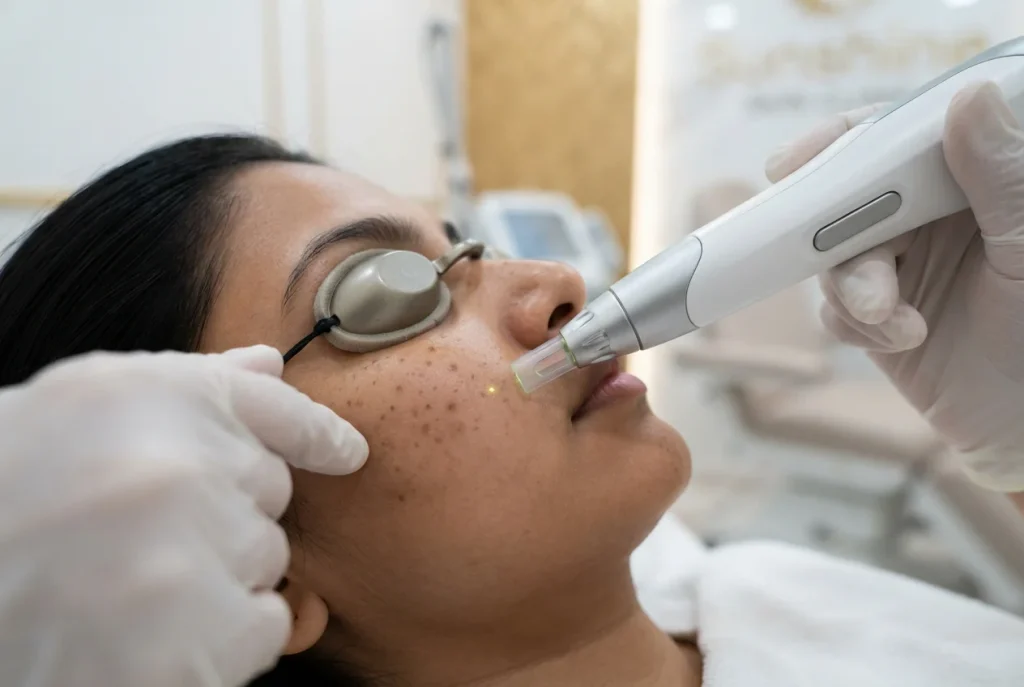
Pigment-specific laser systems have been used for freckles and other epidermal pigmented lesions. Different wavelengths interact differently with melanin, and the choice depends on factors such as pigment depth and skin characteristics.
Several studies have reported improvement in freckles after laser treatment, including research involving Asian skin.
However, treatment should not be selected simply by asking:
“Which laser is the strongest?”
The more useful question is:
“Which wavelength and treatment approach is appropriate for this lesion and this skin?”
Intense Pulsed Light (IPL)
IPL uses a broad range of light rather than a single laser wavelength.
Research has reported improvement in facial freckles after IPL, including studies involving Asian patients.
However, IPL is not universally appropriate for every pigmented condition.
The diagnosis, skin type, settings, and operator experience all influence the result.
Chemical Peels
Superficial chemical peels may be used for some superficial pigmentation problems, including selected freckles or lentigines.
Possible peeling agents include formulations containing alpha-hydroxy acids or other appropriate chemicals.
But a peel intentionally affects the skin surface, so excessive strength or inappropriate use can create irritation and sometimes post-inflammatory pigmentation.
This consideration becomes especially important in skin of color.
Topical Creams
Cream-based treatments containing ingredients such as retinoids, vitamin C, azelaic acid, hydroquinone, cysteamine, or other pigment-modulating agents may sometimes help reduce the appearance of certain brown spots.
However, creams are generally not equivalent to a procedure specifically targeting an individual pigment lesion.
DermNet lists several topical options for brown spots and freckles but also notes that laser or light-based treatment can remove some lesions more rapidly.
One important rule
Do not assume that a product sold as a “freckle remover” will work equally well for every pigmented lesion.
The diagnosis still comes first.
5. Skin Tone Changes the Risk-Benefit Calculation
Freckles are often associated with fair skin, but they can also occur in people with darker skin types.
When pigment-targeting procedures are considered for people with more melanin-rich skin, another issue becomes important:
the possibility of unwanted pigment changes after treatment.
Depending on the technology and settings, laser and light treatments can sometimes result in:
- Temporary hyperpigmentation
- Hypopigmentation
- Uneven pigmentation
- Prolonged colour changes
- Rarely, more persistent pigmentary complications
DermNet specifically advises caution with laser treatment in skin of colour because hypopigmentation or depigmentation can occur.
Research in Asian skin has also documented pigmentary side effects after some pigment-targeting treatments.
The smarter question
Instead of asking:
“Will the freckles disappear?”
also ask:
“What is the risk of creating an uneven pigment pattern while treating them?”
That is particularly relevant when several freckles are being treated across a large area.
6. Treating Every Brown Spot at Once Is Not Always the Best Strategy
If someone has twenty or thirty small brown marks, it may seem logical to treat the entire face aggressively.
But a dermatologist may first determine whether all of the spots are actually the same type of lesion.
Some may be freckles.
Others may be solar lentigines.
Another spot may be a mole.
And an atypical lesion may require examination rather than cosmetic treatment.
A global consensus on melanin hyperpigmentation disorders emphasizes treatment algorithms that take disease subtype, skin type, photobiological behaviour, severity, and pigmentation depth into account.
A useful concept: “treat by diagnosis, not by colour”
Two spots can look similarly brown while behaving completely differently biologically.
That is why accurate classification can be more valuable than simply counting spots.
7. The “Irritation Trap” Can Make Pigment Problems Harder to Manage
People sometimes try to fade freckles by combining:
- Strong exfoliating acids
- Retinoids
- Scrubs
- Brightening serums
- Peels
- Home remedies
all at once.
The intention is understandable.
The problem is that repeated irritation can cause inflammation, and inflammation itself can contribute to post-inflammatory pigmentation, particularly in susceptible skin.
This is especially relevant when freckles coexist with acne, sensitive skin, eczema, or another inflammatory condition.
A treatment may therefore be counterproductive if it causes significant irritation.
Signs that the skin is being over-treated
Burning
Persistent redness
Peeling
Stinging
Increasing sensitivity
These should not automatically be interpreted as “the treatment is working.”
When pigmentation is the concern, maintaining a calm and healthy skin barrier is part of the treatment strategy.
8. Use a “Spot Diary” to Decide Whether Treatment Is Actually Helping
Freckle improvement can be difficult to judge because changes may be subtle and seasonal.
A very simple tracking system can make the process more objective.
Take standardised photographs
Use:
- Similar lighting
- The same camera
- The same facial angle
- Similar distance
- No filters
Take photographs at planned intervals rather than every day.
Record sun exposure
For example:
High outdoor exposure → freckles darker
Consistent sun protection → less darkening
Track the pattern
Note:
Number of visible spots
Overall darkness
New spots appearing
Pigment changes after treatment
Any irritation
This creates a timeline rather than relying on memory.
It is particularly helpful because clinical studies have used objective measures and standardized photographic assessment to evaluate freckle severity and treatment response.
How Do You Know Whether a Brown Spot Is a Freckle?
There are some general clues, but self-diagnosis is not always reliable.
Typical ephelides are:
- Small
- Flat
- Tan or brown
- More visible after sun exposure
- Often concentrated on sun-exposed areas
- Commonly present in multiples
They frequently fade or become less visible during periods of lower UV exposure.
Solar lentigines tend to be more persistent and sharply defined.
A mole or another pigmented lesion can look different again.
Seek medical assessment if a spot:
- Changes noticeably
- Grows
- Develops irregular borders
- Changes colour
- Bleeds
- Becomes persistently itchy
- Looks different from your other spots
- Does not behave like your usual freckles
A dermatologist may use dermoscopy and, when necessary, biopsy to investigate an uncertain lesion.
Can Freckles Be Prevented?
You cannot completely prevent genetically influenced freckles from developing.
However, you can reduce the degree to which UV exposure causes them to darken and may reduce additional sun-induced pigmentation.
Useful measures include:
Daily broad-spectrum sunscreen
Sun-protective clothing
Hats
Shade during strong sun exposure
Avoiding unnecessary prolonged direct sunlight
DermNet specifically notes that while ephelides themselves cannot be completely prevented because of their inherited nature, careful sun protection can reduce their seasonal darkening.
Does Freckles Removal Hurt?
The answer depends on the treatment used.
Laser and light-based procedures may cause sensations such as:
- Warmth
- Stinging
- Snapping or prickling sensations
- Temporary redness
Chemical peels can cause burning or tingling, depending on the formulation and depth.
Pain and recovery can also vary according to treatment settings and the individual.
The procedure should therefore be discussed in terms of:
comfort + downtime + expected improvement + risk
rather than focusing only on the treatment name.
How Many Sessions Are Needed?
There is no universal number.
Some freckles may respond after a small number of treatments, while others may require multiple sessions.
The number depends on factors such as:
- Number of freckles
- Pigment intensity
- Skin type
- Treatment modality
- Device settings
- Individual response
- Whether freckles are being treated alongside other pigmentary conditions
Published studies have reported improvement after varying treatment schedules, which reinforces the point that there is no single session count that applies to everyone.
A treatment plan should therefore be based on the person’s actual skin rather than a fixed package.
What Happens After Freckles Are Treated?
Immediately after a pigment-targeting procedure, treated areas may change in colour or appearance before they settle.
Depending on the method, temporary redness, crusting, darkening, or other short-term reactions can occur.
Aftercare is important because the treated skin may be more vulnerable to irritation and unwanted pigmentation.
Sun protection becomes especially important.
A person who returns to significant UV exposure soon after treatment may increase the chance of pigment returning or new spots becoming noticeable.
The exact aftercare depends on the procedure used, so patients should follow the specific instructions provided by their treating clinician.
Are Freckles Dangerous?
Typical freckles are generally harmless.
However, not every pigmented spot should automatically be assumed to be a freckle.
This distinction matters because some pigmented lesions can mimic harmless brown spots.
DermNet recommends clinical assessment of atypical lesions, and dermatological references emphasize that changing or suspicious pigmented lesions may require dermoscopy or pathological examination.
This is why cosmetic removal should never come before diagnosis when the appearance of a lesion is uncertain.
Freckles Removal vs. Freckles Management
This distinction can make expectations much more realistic.
Removal focuses on:
Reducing the visibility of existing lesions
Management focuses on:
Reducing UV-triggered darkening
Protecting the skin
Monitoring new or changing lesions
Treating recurrence when appropriate
Because freckles are genetically influenced and sunlight-sensitive, these two goals often need to work together.
A treatment may successfully lighten existing freckles while ongoing sun exposure causes new or darker freckles later.
That does not necessarily mean the original procedure “failed.”
It may mean that the underlying tendency remains.
A Practical Freckles Treatment Roadmap
A sensible approach can be thought of in seven steps:
Step 1: Identify
Confirm that the spots are actually freckles.
Step 2: Differentiate
Consider freckles, lentigines, moles, melasma, and other possibilities.
Step 3: Assess skin type
Consider the person’s tendency toward post-inflammatory or procedural pigment changes.
Step 4: Protect
Begin consistent sun protection.
Step 5: Choose the treatment
Depending on the diagnosis, options may include topical care, superficial peels, IPL, or pigment-specific laser treatment.
Step 6: Recover
Follow post-treatment care and minimise unnecessary irritation.
Step 7: Maintain
Continue photoprotection and monitor the skin over time.
This approach is more useful than thinking about freckles as a problem that begins and ends with one procedure.
Who May Want Freckles Removal?
Treatment is usually a personal choice.
Some people like their freckles and do not want to change them.
Others seek treatment because:
- Freckles have become darker.
- There are many visible spots across the face.
- The person prefers a more even-looking complexion.
- Freckles have become more noticeable after sun exposure.
- Makeup no longer provides the desired coverage.
- The person simply feels more comfortable with less visible pigmentation.
There is no medical requirement to remove ordinary freckles.
The decision is largely cosmetic unless a lesion needs evaluation for another reason.
What Should You Ask Before Starting Treatment?
Before undergoing any procedure, ask:
Are these definitely freckles?
Could any of these spots be lentigines or another lesion?
What treatment is being recommended and why?
What improvement is realistic?
What are the risks for my skin type?
Could treatment cause hyperpigmentation or hypopigmentation?
What downtime should I expect?
How will recurrence be managed?
What should I do about sun exposure after treatment?
These questions encourage a treatment plan based on diagnosis and risk rather than on advertising claims.
Final Thoughts
Freckles are a normal pigmentary feature for many people, but their appearance can change with sunlight, age, and individual biology.
If you are considering freckles removal, the most useful starting point is not choosing a laser or buying a cream.
It is determining what the spots actually are.
True freckles, or ephelides, commonly become darker with UV exposure and may fade during periods of lower sun exposure. Solar lentigines are more persistent, while other pigmented lesions can sometimes resemble both.
Once the diagnosis is clear, treatment may include topical approaches, chemical peels, IPL, or pigment-specific laser procedures in appropriately selected cases. Research supports the use of several light and laser technologies for freckles, but outcomes vary, and pigmentary complications can occur—especially when treatment is poorly matched to the skin.
For people with darker or more pigment-reactive skin, the goal should be particularly balanced:
reduce unwanted pigment without creating unwanted pigment.
And even when treatment works well, freckles may become visible again because their tendency is influenced by genetics and sun exposure.
That is why the most realistic long-term strategy is:
Identify → Treat → Protect → Monitor → Maintain.
The goal does not have to be perfectly freckle-free skin.
It can simply be healthier, more even-looking skin with pigmentation that is managed safely and realistically.
Frequently Asked Questions About Freckles Removal
Can freckles be permanently removed?
Treatment can substantially lighten freckles, but permanent removal cannot be guaranteed. Freckles are influenced by genetics and UV exposure, so they may darken again or new freckles may appear.
What is the most effective treatment for freckles?
There is no single treatment that is best for everyone. Depending on the confirmed diagnosis and skin type, treatment may include pigment-specific lasers, IPL, chemical peels, or topical approaches.
Does laser treatment work for freckles?
Pigment-targeting lasers can significantly lighten freckles in selected patients, and published studies have reported good responses. However, treatment results and risks vary by laser type, skin type, settings, and lesion characteristics.
Can IPL remove freckles?
IPL has been studied for facial freckles and can improve their appearance in selected patients. It is not appropriate for every pigmented lesion, so diagnosis and skin-type assessment remain important.
Do freckles come back after laser treatment?
They can. Continued UV exposure can cause freckles to darken again or new ones to appear. Long-term sun protection is therefore important after treatment.
Can creams remove freckles?
Some topical ingredients may help lighten certain superficial pigmented spots, but creams do not necessarily produce the same degree or speed of change as pigment-targeting procedures. The appropriate treatment depends on what the spots actually are.
Are freckles dangerous?
Typical freckles are generally harmless. However, a changing or atypical brown or pigmented lesion should be examined rather than automatically treated as a freckle.
Is freckles removal safe for Indian skin?
Treatment may be possible, but skin type matters. Laser and light-based procedures can sometimes cause unwanted pigmentation or lightening, so treatment parameters and patient selection should be individualized.
How many treatments are required?
There is no fixed number. The number of sessions depends on the treatment used, number and intensity of freckles, skin type, and individual response. Clinical studies have used different treatment schedules.
Can sunscreen prevent freckles?
Sun protection cannot completely prevent genetically influenced freckles, but it can reduce UV-driven darkening and may help limit new sun-related pigmentation.