

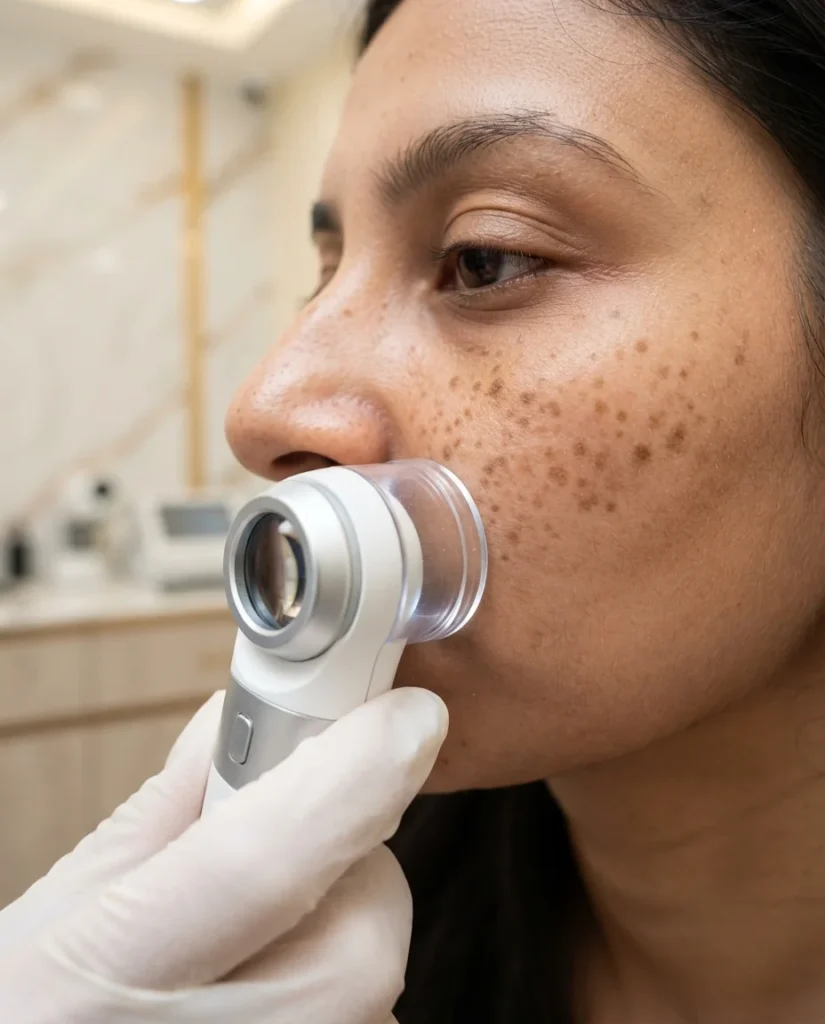
They are commonly:
- Light to dark brown
- Flat rather than raised
- Small in size
- More noticeable on sun-exposed skin
- Commonly seen around the nose and cheeks
Why Do Freckles Develop?
Freckles develop through a combination of genetic tendency and sun exposure.
Genetic Factors
Some individuals naturally have a greater tendency to develop freckles. Genetic variation, including variants involving the MC1R gene, has been associated with freckling.
Sun Exposure
UV exposure stimulates pigmentation and can make existing freckles darker and more noticeable.
This is why freckles frequently become more prominent during periods of greater sun exposure.
Skin Characteristics
Freckles are often associated with lighter skin, but they are not exclusive to one ethnic group or skin colour and can occur in people with darker hair or darker skin as well.
Where Do Freckles Usually Appear?
Freckles most commonly appear in areas that receive regular sunlight.
Face
The nose, cheeks, forehead, and other facial areas may develop freckles.
Shoulders
Freckles may become noticeable on the shoulders after repeated sun exposure.
Arms
The forearms and other exposed areas can also develop freckles.
Other Sun-Exposed Areas
Freckles may occur anywhere that receives repeated UV exposure.
Their distribution and appearance can help a dermatologist determine whether the pigmentation is consistent with freckles.
Freckles vs Dark Spots
The term “dark spots” is broad, while freckles are one specific type of pigmentation.
Freckles
Usually small, flat, relatively uniform pigmented spots that become more noticeable with UV exposure.
Dark Spots
Can have many causes, including post-acne pigmentation, inflammation, sun-related pigmentation, medication-related pigmentation, lentigines, or other skin conditions.
Because different pigmentation disorders may require different treatments, correct identification is important.
Freckles vs Solar Lentigines
This distinction is particularly important for anyone looking for “freckles removal.”
Freckles / Ephelides
Freckles commonly become darker with sun exposure and may fade considerably when UV exposure decreases. They often develop earlier in life.
Solar Lentigines
Solar lentigines are often more persistent and may remain visible even when sun exposure decreases. They are associated with cumulative UV exposure and may become more common with age.
These conditions can look similar to an untrained eye, so professional evaluation is useful before treatment.
Are Freckles Harmful?
Typical freckles are benign and generally do not require medical treatment. Some people seek treatment for cosmetic reasons rather than because freckles pose a health problem.
However, not every brown spot on the skin is necessarily a freckle.
A pigmented lesion should be professionally examined if it is:
- New and unusual
- Changing in size
- Changing in colour
- Irregular in appearance
- Bleeding
- Crusting
- Persistently itchy
- Painful
A dermatologist may use clinical or dermoscopic examination to determine whether a lesion is likely to be a benign pigmentation or requires further investigation.
When Should You Consider Freckles Treatment?
Freckles do not have to be treated medically.
You may nevertheless consider a professional consultation if you:
- Want to reduce the visibility of prominent freckles
- Have many freckles across the face
- Feel that freckles have become darker
- Want a more even-looking complexion
- Are unsure whether a brown spot is a freckle
- Have tried skincare without satisfactory improvement
The first step should be determining exactly what type of pigmentation you have.
Our Approach to Freckles Removal
At Sunshine Skin Clinic, freckles treatment starts with assessment rather than immediately choosing a laser or peel.
We may consider:
- Size of the freckles
- Number of lesions
- Location
- Colour
- Skin type
- Sun exposure
- Pigmentation history
- Previous treatments
- Sensitivity
- Tendency toward post-inflammatory pigmentation
- Individual cosmetic goals
This allows treatment to be selected according to the patient’s skin rather than using one protocol for everyone.
Freckles Removal Treatment Options
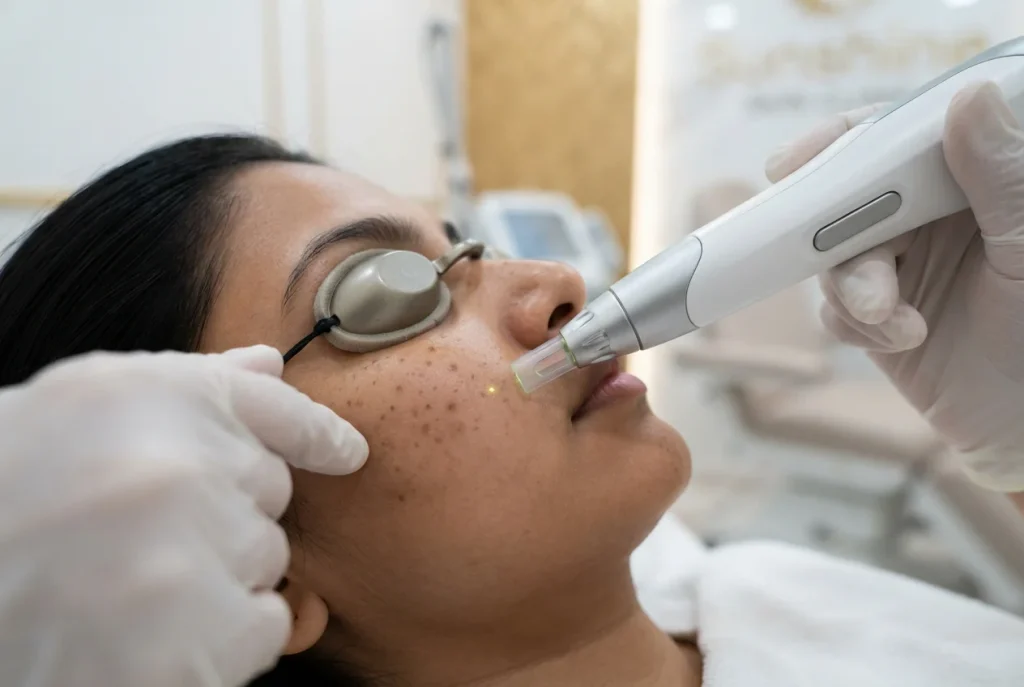
Not every treatment is appropriate for every patient. The selected approach depends on whether the pigmentation is truly freckles, the patient’s skin characteristics, and the desired outcome.
Dermatologist-Guided Skincare
Sun protection and appropriate skincare form an important foundation for managing freckles.
Certain pigment-targeting or skin-renewing ingredients may sometimes be recommended depending on the patient’s skin type and goals.
Skincare may help improve the overall appearance of pigmentation, but it may not remove established freckles as quickly as certain procedures.
Sun Protection
Sun protection is particularly important when managing freckles because UV exposure can make them darker and more noticeable. DermNet recommends broad-spectrum SPF 50+ protection for affected areas.
A comprehensive approach may include:
- Broad-spectrum sunscreen
- Regular reapplication
- Sun-protective clothing
- Hats when appropriate
- Seeking shade during intense sunlight
- Reducing prolonged direct UV exposure
Sun protection also plays an important role in reducing the development of additional sun-related pigmentation.
Chemical Peels for Freckles
Selected superficial chemical peels may be considered for certain superficial pigmentation concerns, including freckles.
Peels work by producing controlled exfoliation of the skin and can help improve uneven pigmentation and overall skin tone.
However, the choice of peel, strength, and treatment frequency should be based on the patient’s skin type and pigmentation.
A peel is not automatically appropriate for every patient, particularly when there is a significant tendency toward post-inflammatory pigmentation.
Explore Chemical Peel →
Laser Treatment for Freckles
Pigment-targeting laser treatments can be used for selected freckles and other superficial pigmented lesions. Different laser technologies target melanin at different depths, so treatment selection depends on the pigmentation and individual skin characteristics.
Laser treatment may produce temporary or significant lightening, but results vary and freckles may become more visible again with subsequent sun exposure.
Explore Laser Treatments →
Intense Pulsed Light for Freckles
IPL is a light-based treatment that can target melanin in selected superficial pigmented lesions, including freckles and some other forms of skin discoloration.
Whether IPL is appropriate depends on the pigmentation, skin type, treatment area, and the device and protocol being used.
A professional assessment should take place before treatment.
Combination Freckles Treatment
Some patients may benefit from a combination approach rather than relying on a single treatment.
Depending on the assessment, the plan may include:
- Sun Protection
- Dermatologist-Guided Skincare
- Chemical Peels
- Pigment Laser Treatment
- IPL When Appropriate
- Maintenance Skincare
The objective is not to perform multiple procedures unnecessarily. It is to select the most appropriate approach for the individual’s pigmentation and skin characteristics.
Freckles Treatment for Indian Skin
Freckles can occur in Indian skin, although their appearance and visibility may differ from person to person. More importantly, pigmentation can sometimes develop or become more noticeable after inflammation or certain procedures.
Laser and light-based treatments require particular care in skin of colour because pigment changes such as hypopigmentation or depigmentation can occur in some circumstances.
For this reason, your dermatologist may consider:
- Natural Skin Tone
- Pigmentation History
- Previous Treatment Response
- Skin Sensitivity
- Tendency Toward Pigmentation Changes
- Treatment Area
- Type of Pigmentation
The aim is to select treatment appropriate for both the freckles and the surrounding skin.
Can Freckles Be Completely Removed?
Treatment may make freckles significantly lighter, but permanent complete removal cannot be guaranteed.
Freckles are influenced by genetics and can become darker again with UV exposure. Even after successful cosmetic treatment, new freckles or recurrence of pigmentation may occur.
This is why sun protection and maintenance remain important even after a successful procedure.
How Many Sessions Are Needed?
There is no fixed number of sessions for freckles treatment.
The number may depend on:
- Number of Freckles
- Pigmentation Depth
- Skin Type
- Treatment Selected
- Previous Treatment
- Response to Treatment
- Individual Cosmetic Goals
Some pigment-targeting treatments are performed as a series, while selected superficial pigmentation may respond after fewer sessions. Treatment response varies between individuals.
What Results Can You Expect?
The goal of treatment is generally to reduce the visibility of freckles and create a more even-looking complexion.
Results vary according to the treatment and individual skin characteristics.
It is important to understand that:
- Freckles may not disappear completely
- Multiple sessions may sometimes be needed
- Some pigmentation may return
- New freckles can develop
- Sun exposure can make freckles darker again
A realistic treatment plan focuses on improvement rather than promising permanent clearance.
Freckles Removal Treatment Journey
Step 1 — Consultation
We discuss your concerns, when the freckles appeared, previous treatments, sun exposure, skincare routine, and what type of improvement you are looking for.
Step 2 — Pigmentation Assessment
The dermatologist examines the freckles and surrounding skin to determine whether the pigmentation is consistent with freckles or another type of pigmented lesion.
Step 3 — Treatment Selection
An appropriate approach is selected based on your skin type, pigmentation, treatment history, and goals.
Step 4 — Treatment Session
The selected procedure, if appropriate, is performed according to the individualized treatment plan.
Step 5 — Aftercare
Specific post-treatment skincare and sun-protection instructions are provided according to the procedure performed.
Step 6 — Follow-Up
The skin response is assessed and further treatment or maintenance is discussed when appropriate.
Freckles Treatment Aftercare
Aftercare varies according to the procedure.
Your dermatologist may recommend:
- Gentle Skin Cleansing
- Moisturization
- Strict Sun Protection
- Avoiding Excessive Heat or Sun Exposure When Advised
- Temporary Avoidance of Irritating Products
- Following Prescribed Skincare
- Follow-Up as Recommended
Sun protection is particularly important because UV exposure can contribute to re-darkening of freckles.
What Should You Avoid?
When treating pigmentation, aggressive home treatments can sometimes cause irritation and subsequent discoloration.
Avoid:
- Unsupervised Strong Bleaching Products
- Excessive Scrubbing
- Harsh Exfoliation
- Picking Pigmented Spots
- Unregulated Skin-Lightening Products
- Randomly Combining Multiple Active Ingredients
- Unprotected Prolonged Sun Exposure
A gentle, consistent skincare routine is generally more appropriate than repeated irritation.
Why Choose Sunshine Skin Clinic for Freckles Removal?
Freckles may look straightforward, but not every brown spot is necessarily a freckle.
At Sunshine Skin Clinic, our approach begins by identifying the pigmentation before deciding whether treatment is appropriate.
Professional Pigmentation Assessment
We evaluate the appearance, distribution, and characteristics of the pigmentation.
Personalized Treatment Selection
Treatment options are selected according to skin type, pigmentation pattern, and individual goals.
Multiple Treatment Approaches
Depending on suitability, treatment may include skincare, chemical peels, pigment-targeting laser procedures, or IPL-based approaches.
Attention to Skin Type
We consider pigmentation tendency and previous treatment response when planning procedures.
Realistic Expectations
We focus on reducing visible pigmentation rather than promising guaranteed permanent removal.
Long-Term Sun Protection
Because UV exposure can make freckles darker and contribute to recurrence, sun protection forms an important part of ongoing care.
Frequently Asked Questions
What is the best treatment for freckles?
There is no single treatment that is appropriate for every patient. Depending on the confirmed diagnosis and skin characteristics, options may include sun protection, skincare, chemical peels, pigment-targeting lasers, or IPL.
Can freckles disappear naturally?
Freckles often become less noticeable when UV exposure decreases and may fade during periods with less sunlight.
Can freckles come back after laser treatment?
Yes. Treatment can lighten freckles, but recurrence or darkening may occur, particularly with continued UV exposure.
Are freckles and age spots the same?
No. Freckles (ephelides) and solar lentigines can look similar but behave differently. Freckles are commonly more responsive to changes in sun exposure, while lentigines tend to persist.
Are freckles dangerous?
Typical freckles are benign and generally do not require medical treatment. However, any pigmented lesion that changes, bleeds, crusts, or appears unusual should be professionally evaluated.
Is laser treatment suitable for Indian skin?
Laser and light-based pigmentation treatments can be used in selected patients, but skin type is an important consideration because pigmentary complications can occur in skin of colour. Treatment should therefore be individualized.
How many sessions are required for freckles removal?
The number of sessions varies according to the treatment selected, pigmentation characteristics, skin type, and treatment response. Some pigment lasers are commonly used in a series rather than as a single universal treatment.
Can skincare alone remove freckles?
Skincare and sun protection may help reduce the appearance of pigmentation, but established freckles may respond differently from superficial or more persistent pigmented lesions.
Should every brown spot be treated as a freckle?
No. Brown spots can represent freckles, lentigines, post-inflammatory pigmentation, melasma, or other lesions. Proper assessment is important before cosmetic treatment.