


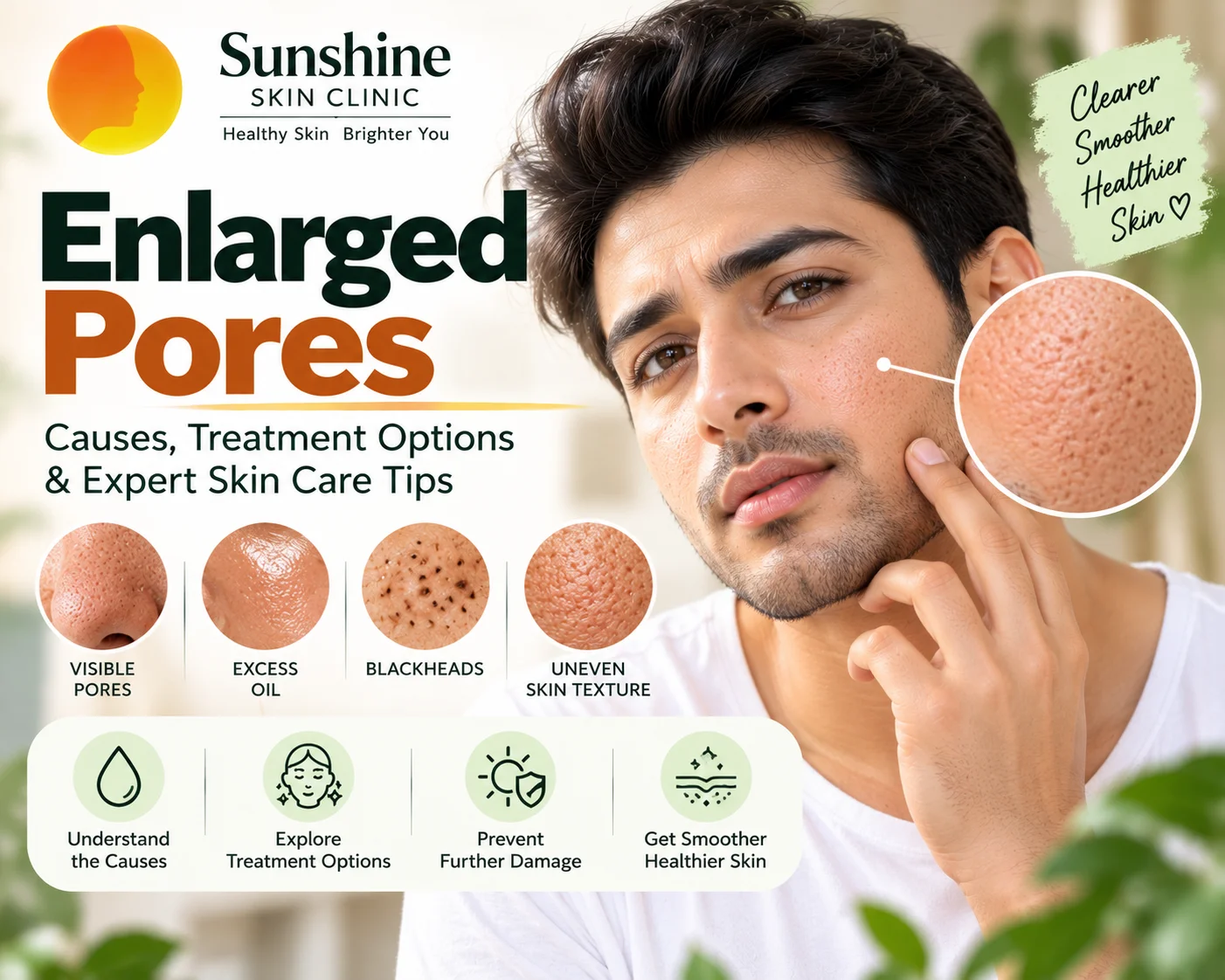
Have you ever noticed that the pores on your nose or cheeks look much larger when you look closely in a mirror, even when your skin seems smooth from a distance?
Visible pores are a common skin concern, particularly for people with oily or acne-prone skin. They can become more noticeable with excess oil, clogged follicles, changes in skin firmness, and sun-related skin damage. Genetics also plays an important role in determining how visible your pores naturally are.
The good news is that there are ways to make enlarged pores less noticeable. The important distinction is that pores cannot be permanently erased, but their appearance can often be improved with suitable skincare and, in selected cases, dermatological treatments.
The most effective approach depends on why the pores look enlarged in the first place. A person with excess oil and blackheads may need a different routine from someone whose pores have become more prominent as the skin loses firmness.
This guide explains eight important ideas about enlarged pores, including how to understand their causes, choose suitable ingredients, avoid common mistakes, and evaluate treatment options realistically.
What Are Enlarged Pores?
Pores are small openings in the skin. Facial pores commonly serve as openings for hair follicles and their associated oil-producing sebaceous glands.
Sebum, the natural oil produced by your skin, helps maintain the skin’s protective surface. Pores are therefore a normal part of healthy skin, not a defect that needs to be eliminated.
When these openings become more visible, they are commonly described as enlarged pores or open pores.
They are especially noticeable around the nose, forehead, and inner cheeks, where oil-producing glands can be more prominent.
According to dermatological reviews, three major factors associated with visible facial pores are increased sebum production, reduced elasticity around the pore, and the size of the hair follicle. Genetics, acne, age, and sun exposure can also influence their appearance.
8 Important Things to Understand About Enlarged Pores

1. Your Pores Are Not Actually Opening and Closing
The term “open pores” can create the impression that pores open when the skin is oily and close when you use cold water, ice, or a pore-minimising product.
That is not how pores work.
Pores are anatomical openings. Their visibility can change, but ordinary skincare cannot permanently close them.
When oil, dead skin cells, and other material accumulate around a follicle, its opening can become more noticeable. Similarly, changes in the surrounding skin’s firmness can make pores stand out more.
Cold water or an ice cube may produce a short-lived tightening sensation, but this does not permanently reduce pore size. The effect, when noticeable, fades as the skin returns to its usual temperature.
What this means for your skincare: Focus on reducing pore congestion, controlling excess oil when necessary, and maintaining skin health rather than trying to close every visible opening.
A realistic goal is smoother-looking skin with less prominent pores—not pore-free skin.
2. Enlarged Pores, Blackheads, and Sebaceous Filaments Are Different
One reason people struggle with pore care is that they sometimes treat every small dot on the nose or cheek as a clogged pore.
However, several different features can look similar.
Enlarged pores
These are visible openings whose appearance can be influenced by oil production, follicle characteristics, skin firmness, and other factors.
Blackheads
Blackheads are open comedones, a form of acne in which material accumulates inside a follicle. Their dark appearance is not simply dirt sitting on the skin.
Sebaceous filaments
These are normal structures that help move sebum through the follicle. They often appear as tiny, relatively uniform greyish or yellowish dots, particularly on the nose. They are not the same as blackheads.
Why does the distinction matter?
Trying to remove normal sebaceous filaments repeatedly can irritate the skin without eliminating them permanently. Aggressive squeezing and extraction can also cause inflammation and potentially scarring.
If the main issue is blackheads, an acne-focused approach may be more appropriate. If the pores are visible because of oil production or reduced skin firmness, the strategy may be different.
Understanding what you are seeing is more useful than buying a product simply because it promises to shrink pores.
3. The Cause of Visible Pores Can Differ Across Your Face
Not everyone has enlarged pores for the same reason.
In fact, the cause can differ between areas of the same person’s face.
For example, pores around the nose may look prominent because of oil production and follicular congestion, while pores on the cheeks may be more noticeable because of changes in skin texture or firmness.
Several factors can contribute:
Genetics: Your inherited skin characteristics influence the natural appearance of pores.
Excess sebum: More oil can make the openings appear more prominent.
Acne and clogged follicles: Blackheads and recurring acne can make the pore surface look uneven.
Age-related changes: Reduced collagen and elastin support can make pores appear larger.
Sun exposure: Accumulated ultraviolet damage can reduce skin firmness over time.
Skincare products: Products that contribute to clogged follicles may make pores appear more noticeable.
These factors often overlap rather than occurring independently.
A useful idea: Make a facial pore map
Instead of describing your entire face as oily or textured, observe the areas separately.
Ask yourself:
- Are pores mainly visible on the nose?
- Is there also oiliness across the forehead?
- Do the cheeks show enlarged pores along with uneven texture?
- Are blackheads or active acne present?
- Has the appearance changed over time?
This simple observation cannot diagnose a skin condition, but it can help you understand which concerns need attention.
A dermatologist can assess whether the main issue is congestion, excess sebum, loss of skin firmness, acne, or a combination of these factors.
4. Your Skin May Not Need Stronger Products—It May Need a Better-Tolerated Routine
Many people try to minimise pores by washing their face more frequently, scrubbing harder, or layering several exfoliating products.
Unfortunately, excessive cleansing and irritation can make the skin look rougher and pores more noticeable.
A sensible routine begins with a gentle cleanser, appropriate moisturisation, and products suited to your skin type.
Gentle cleansing
Wash your face gently, commonly in the morning and evening, and after heavy sweating when appropriate. Use lukewarm water rather than very hot water.
Avoid vigorous scrubbing. The goal is to remove excess oil, sunscreen, makeup, and everyday buildup without damaging the skin barrier.
Non-comedogenic products
Look for moisturisers, sunscreen, and makeup labelled non-comedogenic or “won’t clog pores,” especially if you have oily or acne-prone skin.
Appropriate moisturisation
Oily skin can still become dehydrated or irritated. Using a suitable moisturiser may help maintain skin comfort while you manage excess oil.
Avoid constant product switching
Introducing several new active ingredients simultaneously can make it difficult to identify which product is helping and which is causing irritation.
A simple routine that you can use consistently is often more practical than a complicated one that repeatedly upsets your skin.
5. Choose Pore-Care Ingredients According to the Problem
No single serum works equally well for every type of enlarged pore.
The best ingredient to consider depends on whether the main concern is excess oil, blackheads, acne, or changes in skin texture.
Salicylic acid
Salicylic acid is a beta-hydroxy acid used in acne care. It can help loosen the buildup of dead skin cells and oil associated with clogged pores.
It may be particularly useful when blackheads and congestion are contributing to the appearance of visible pores.
However, excessive use can lead to dryness or irritation. If your skin becomes uncomfortable, reduce use or stop the product and reassess your routine.
Retinoids
Retinoids influence skin-cell turnover and are used for acne and other skin concerns. Certain topical retinoids may help reduce follicular congestion and improve the appearance of pores, while some also support changes in skin texture over time.
They can cause dryness, peeling, and irritation, especially when introduced too quickly.
Important: Topical retinoids should not be used during pregnancy or when planning pregnancy without appropriate medical advice. Seek professional guidance about treatment safety, particularly if pregnant, breastfeeding, or using prescription skin medications.
Niacinamide
Niacinamide is used in skincare formulations that aim to support the skin barrier and may help with oil-related concerns. The evidence for its direct effect on pore appearance is more limited than for some established acne treatments.
It may be a reasonable ingredient to consider in a well-tolerated routine, but it should not be treated as a guaranteed pore-shrinking solution.
Moisturisers and sunscreen
These may not directly shrink a pore, but they support the overall routine.
Suitable moisturisation helps maintain skin comfort, while sunscreen helps protect against UV-related loss of skin firmness.
How should you choose?
If blackheads are the main issue, an acne-focused ingredient may be useful. If your skin is sensitive, a simpler routine may be preferable before introducing stronger actives.
You do not need salicylic acid, a retinoid, exfoliating toner, pore serum, and several masks all at once.
Choose according to your skin’s needs and tolerance—not according to the number of ingredients in the product.
6. Sunscreen Is Relevant Even When Your Main Concern Is Pore Size
Sunscreen is usually associated with sunburn, pigmentation, and premature ageing. However, it also has a role in managing the appearance of enlarged pores.
Repeated ultraviolet exposure can damage collagen and elastin, which contribute to skin firmness. As that supporting structure changes, pores may become more prominent.
A practical daytime routine includes a broad-spectrum sunscreen with SPF 30 or higher, alongside other sun-protective measures when appropriate.
Choose a formulation that suits your skin and allows you to apply enough product comfortably.
Sunscreen does not permanently shrink enlarged pores, but regular use helps limit additional UV-related skin damage that can make them more noticeable over time.
7. Professional Treatments Can Help, but Their Evidence and Suitability Vary
When skincare alone does not provide the improvement someone is looking for, a dermatologist may discuss procedural options.
The appropriate choice depends on the underlying cause, skin type, degree of textural change, previous treatments, and tolerance for recovery time.
Chemical peels
Selected chemical peels can help remove surface buildup and improve some aspects of texture. They may also be useful when clogged pores or acne are contributing to the appearance of the skin.
However, treatment depth and formulation matter. Excessive or unsuitable peeling can irritate the skin and cause pigmentary changes.
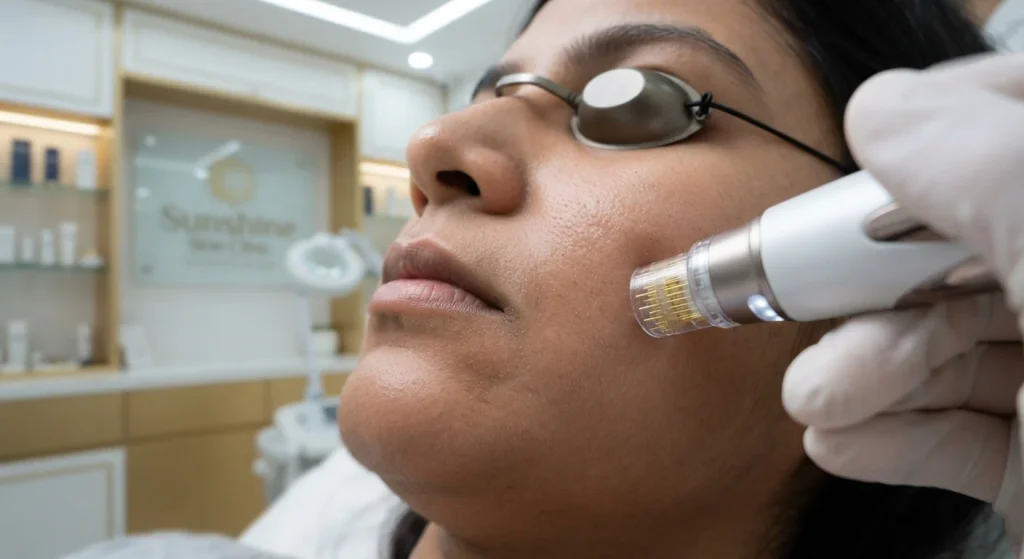
Microneedling
Microneedling creates controlled micro-injuries that stimulate the skin’s wound-healing response. It may improve selected textural concerns, including the appearance of pores, although outcomes vary.
Temporary redness, sensitivity, and other side effects can occur.
Radiofrequency microneedling
This combines microneedling with radiofrequency energy. It may be considered when both texture and skin firmness are relevant concerns.
It is a medical aesthetic procedure, not an automatic next step for everyone with visible pores. Proper assessment, technique, and treatment settings are important.
Laser and light-based treatments
Some laser and light-based procedures have been studied for visible facial pores. Their effects depend on the technology used and the individual’s skin characteristics.
Side effects can include temporary redness and irritation, and some treatments carry a risk of unwanted pigmentation or other complications.
How strong is the evidence?
A review published in the Journal of Cosmetic Dermatology evaluated 19 clinical trials involving 591 participants. It reported that several treatments showed potential to reduce the appearance or measured area of facial pores, but the studies used different assessment methods and often had small sample sizes, making direct comparisons difficult.
The review also reported mild, reversible burning and redness among commonly observed adverse effects.
This means that some procedures are promising, but it is difficult to identify one treatment as universally best for enlarged pores.
A consultation should therefore focus on what a treatment is expected to improve, the likely number of sessions, its risks, and realistic outcomes—not simply on whether it is described as advanced.
8. Track Visible Improvement Instead of Expecting Pores to Disappear
Pore treatments are often marketed using expressions such as “poreless skin” or “permanently closed pores.”
These are unrealistic expectations for a normal skin structure.
The more useful goal is to reduce how prominent pores look by addressing contributing factors such as congestion, excess oil, and changes in skin firmness.
Try a consistent photo method
Take photographs at planned intervals using:
- Similar lighting
- The same camera
- The same distance
- The same facial angle
- No beauty filters
Avoid relying on extreme close-up photographs or magnifying mirrors. These can make normal skin texture appear more dramatic than it looks in everyday life.
Also note whether oiliness, blackheads, redness, or irritation changes during treatment.
This helps distinguish between a genuinely useful improvement and a temporary cosmetic effect caused by different lighting, makeup, or skin hydration.
If your skin becomes irritated or your acne worsens, review the routine rather than automatically adding another product.
A Simple Daily Routine for Skin With Enlarged Pores
A practical routine does not need to contain many products.
Morning
Gentle cleanser → suitable moisturiser if needed → broad-spectrum sunscreen
Evening
Gentle cleanser → an appropriate treatment product if needed → moisturiser
If clogged pores or blackheads are present, a product containing salicylic acid may be useful. If another skin concern is involved, a dermatologist may recommend a different approach.
Introduce active ingredients gradually and avoid combining multiple irritating products without guidance.
People with persistent acne, sensitive skin, or significant texture changes may benefit from an individual assessment rather than trying several treatments independently.
Common Mistakes That Make Pores Look More Noticeable
Scrubbing too hard
Aggressive friction can irritate the skin and make texture appear more prominent.
Squeezing or extracting repeatedly
Repeated pressure can damage surrounding skin and potentially cause inflammation or scarring.
Using too many active ingredients
Overuse of acids or retinoids may lead to dryness and irritation.
Skipping moisturiser because the skin is oily
A suitable moisturiser may help maintain comfort and support the skin barrier.
Using products that clog pores
Rich or unsuitable formulations can worsen congestion in some individuals. Non-comedogenic products may be a useful starting point.
Expecting instant results
Improvement generally requires consistent care, and the extent of improvement depends on the factors contributing to visible pores.
Can Enlarged Pores Be Reduced Permanently?
There is no reliable way to guarantee that pores will remain permanently smaller or invisible.
Genetics, sebum production, hair follicle characteristics, ageing, and sun exposure can continue to influence how prominent they look.
Skincare may help manage oiliness and congestion, while selected procedures may improve some aspects of skin texture and pore appearance. The degree and duration of improvement vary.
The sensible goal is to make pores less noticeable while maintaining healthy skin, rather than trying to remove a normal skin structure.
When Should You Consult a Dermatologist?
Consider professional guidance when:
- Your pores remain very noticeable despite consistent skincare.
- Blackheads or acne keep returning.
- You have oily skin alongside persistent inflammation.
- Your skin becomes irritated from pore-care products.
- You are considering peels, microneedling, radiofrequency, or laser procedures.
- You are unsure whether the problem is enlarged pores, blackheads, acne, or another skin condition.
A dermatologist can evaluate the main contributing factors and help determine whether routine adjustments or a professional treatment may be useful.
Final Thoughts
Enlarged pores are a common skin concern, but they are not a problem that can be solved simply by buying the strongest serum or using more exfoliating products.
The first step is to understand why they are visible.
Excess oil, clogged follicles, acne, genetics, and reduced skin firmness can all contribute, and different causes may require different approaches.
For many people, a gentle routine, non-comedogenic products, appropriate management of blackheads or acne, and daily sun protection can help reduce the appearance of pores.
Professional procedures may provide additional improvement in selected cases, but the evidence is variable, treatment must be individualized, and complete or permanent pore elimination should not be expected.
The best pore-care strategy is not about achieving poreless skin. It is about improving skin texture, controlling the problems that make pores more noticeable, and maintaining results without unnecessarily irritating the skin.
Frequently Asked Questions About Enlarged Pores
What causes enlarged pores?
Common contributing factors include genetics, excess sebum, hair follicle characteristics, acne, clogged follicles, age-related changes in skin firmness, and sun damage.
Can enlarged pores be closed permanently?
No. Pores are normal skin openings and cannot be permanently erased through routine skincare. Their appearance can sometimes be reduced.
Which ingredient is useful for enlarged pores?
Salicylic acid may help when blackheads and clogged pores contribute to the problem. Retinoids may help selected patients with acne and textural concerns. The suitable ingredient depends on the skin condition and individual tolerance.
Is niacinamide useful for enlarged pores?
Niacinamide is used in skincare formulations aimed at supporting the skin barrier and managing oil-related concerns. However, it should not be considered a guaranteed pore-shrinking treatment.
Does oily skin cause large pores?
Excess oil can make pores more noticeable, but it is not the only cause. Genetics, follicular structure, acne, ageing, and sun exposure can also play a role.
Can enlarged pores be treated with laser?
Certain laser treatments have been studied for improving the appearance of facial pores. Suitability, outcomes, downtime, and risks depend on the device and individual skin characteristics.
Do chemical peels help enlarged pores?
Selected peels may help improve congestion and skin texture. They can also cause irritation or pigmentary changes, so the treatment needs to be appropriate for the individual’s skin.
Does ice reduce pore size?
Ice may temporarily change how tight the skin feels, but it does not permanently shrink pores.
How long does it take to improve the appearance of pores?
The timeline varies according to the cause, the routine, and the treatment used. Consistent care and an appropriate review period are more useful than repeatedly changing products in search of instant results.
Is it normal to have visible pores on the nose?
Yes. Pores are often more prominent around the nose because oil-producing glands can be more noticeable there. Their visibility does not automatically indicate unhealthy skin.