

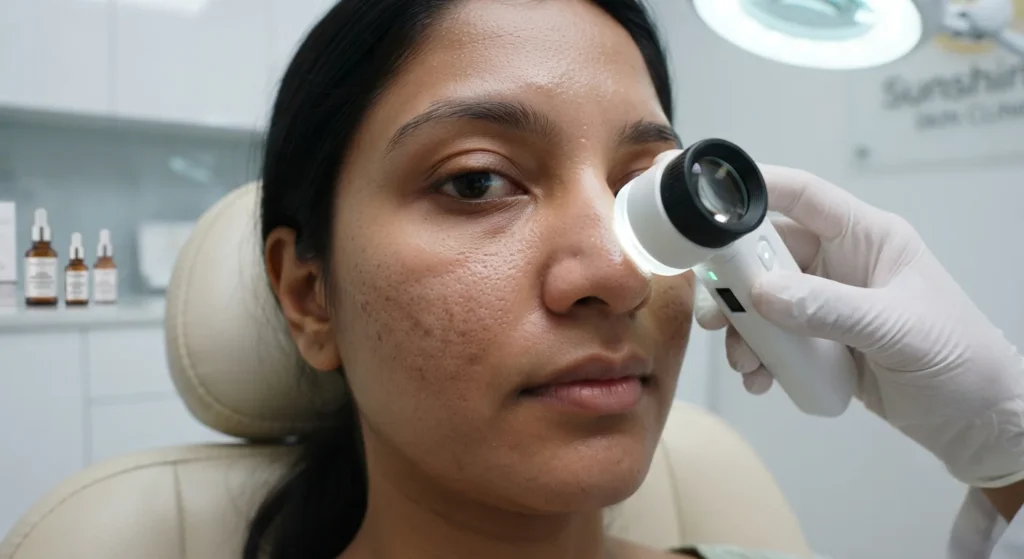
Why Do Facial Pores Look Larger?
There is usually no single cause.
Excess Sebum
When the skin produces more sebum, pores may appear more prominent. Oily skin can also be more prone to congestion, which can make pore openings look more noticeable.
Clogged Pores & Blackheads
Oil, dead skin cells, and other material can accumulate inside a follicle. Blackheads and other forms of congestion can make the opening appear larger.
Acne
Acne is associated with enlarged pores, particularly when comedones or inflammation affect the follicular openings.
Sun Damage
Cumulative sun exposure can reduce skin firmness and contribute to a more noticeable appearance of pores.
Age-Related Skin Changes
As skin gradually loses elasticity and firmness, pores may become more visible.
Comedogenic Products
Products that contribute to clogged pores can make pores appear larger or more prominent. Dermatologists commonly recommend non-comedogenic skincare for people concerned about clogged pores.
Enlarged Pores on Different Areas of the Face
Pore visibility is not necessarily uniform across the face.
Nose
Pores around the nose can become particularly noticeable because of oil production and congestion.
Cheeks
Pores on the cheeks may be influenced by previous acne, sun exposure, loss of skin firmness, or overall texture.
Forehead
Oiliness and congestion can make forehead pores more visible.
Chin
The chin can show a combination of visible pores, blackheads, and acne-related congestion.
The treatment approach should therefore consider the specific area being treated rather than assuming that all facial pores have the same cause.
Are Enlarged Pores Permanent?
Pores themselves are a normal anatomical feature, so they cannot be permanently removed.
However, their appearance can sometimes be reduced or made less noticeable through appropriate skincare and selected dermatological treatments. The American Academy of Dermatology specifically describes treatment in terms of making large pores “less noticeable,” rather than permanently eliminating them.
The degree of visible improvement varies according to the underlying cause and the individual’s skin characteristics.
Enlarged Pores & Oily Skin
Oily skin and visible pores often occur together, but having oily skin does not automatically mean that someone will have significantly enlarged pores.
The goal is to manage excess oil without unnecessarily stripping or irritating the skin.
Dermatologists generally recommend gentle cleansing and non-comedogenic products for oily or acne-prone skin; excessive scrubbing can irritate the skin and make pores look more noticeable.
Enlarged Pores & Acne
Acne and enlarged pores can overlap.
When pores become congested with oil and dead skin cells, blackheads and whiteheads may develop. Acne-related inflammation can also affect the appearance of follicular openings.
When both acne and enlarged pores are present, treatment planning may need to address the active acne first or alongside pore-focused care.
Explore Acne Treatment →
Enlarged Pores vs Acne Scars
These are not the same thing.
Enlarged Pores
Pores are normal follicular openings that appear larger or more prominent.
Acne Scars
Acne scars involve structural changes in the skin, such as depressed or raised areas that develop following inflammatory acne.
Some people have both enlarged pores and acne scars, but they may require different treatment approaches.
Explore Acne Scar Treatment →
When Should You See a Dermatologist for Enlarged Pores?
Enlarged pores are generally a cosmetic skin concern, but professional assessment can be particularly useful when they occur alongside:
- Persistent acne
- Frequent blackheads
- Excessive oiliness
- Uneven texture
- Acne scars
- Significant sun damage
- Irritated or sensitive skin
- Rapid changes in skin appearance
A dermatologist can help determine whether the visible pores are primarily related to congestion, acne, oil production, skin laxity, or another skin concern.
Our Approach to Enlarged Pores Treatment
At Sunshine Skin Clinic, we do not treat pore visibility as an isolated cosmetic issue.
During consultation, we may evaluate:
- Skin Type
- Sebum Production
- Pore Distribution
- Blackheads or Congestion
- Acne Activity
- Skin Texture
- Acne Scarring
- Sun Exposure
- Skin Elasticity
- Current Skincare Routine
- Previous Treatments
This helps determine whether skincare, a procedure, acne management, or a combination approach is more appropriate.
Enlarged Pores Treatment Options
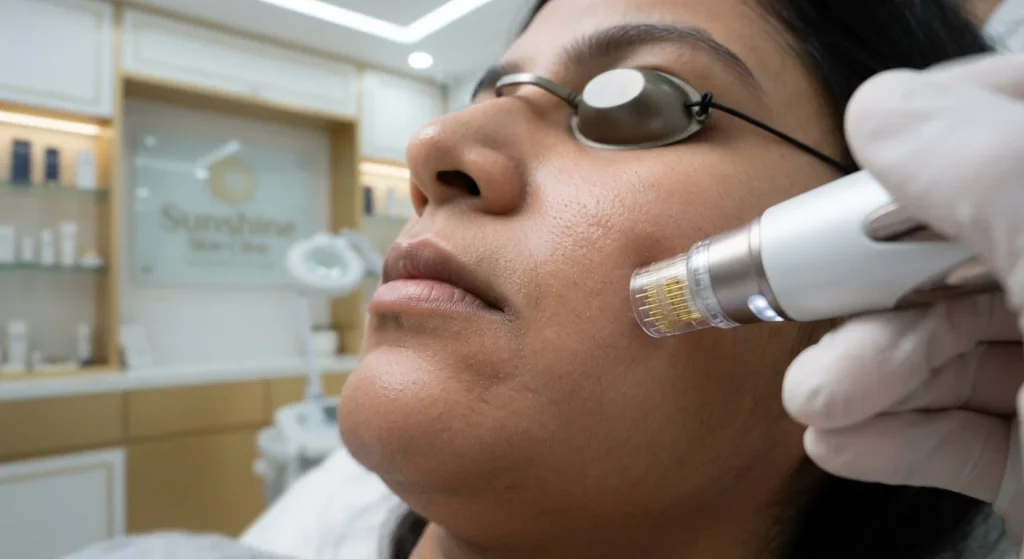
There is no single treatment that works for every pore concern. Treatment selection depends on what is making the pores appear enlarged.
Dermatologist-Guided Skincare
A well-planned skincare routine can help manage oiliness and congestion and may make pores appear less noticeable.
Depending on the patient’s condition, a dermatologist may consider ingredients such as salicylic acid, topical retinoids, or other appropriate formulations. The choice depends on skin type, sensitivity, acne, current medications, and individual circumstances. AAD guidance notes that retinoids and appropriate acne care can help with clogged pores, while gentle, non-comedogenic skincare can reduce factors that make pores more noticeable.
Explore Medical Skincare →
Salicylic Acid & Pore Congestion
Salicylic acid can help exfoliate and unclog pores and is commonly used in acne-prone skin care.
It may be considered when visible pores are associated with blackheads or congestion.
However, frequent or excessive exfoliation can irritate the skin. Treatment should therefore be appropriate for the individual’s skin tolerance.
Retinoid-Based Skin Care
Topical retinoids can help with clogged pores and acne and may be useful for selected patients whose pore visibility is associated with congestion or acne-prone skin.
Retinoid use should be professionally guided when necessary, particularly for sensitive skin or when other treatments are being used.
Chemical Peels
Selected chemical peels may be considered to improve surface congestion and overall skin texture.
Depending on the peel and the skin condition, treatment may help make pore appearance less noticeable by addressing superficial buildup and uneven texture.
The appropriate peel and strength depend on skin type and individual treatment needs.
Explore Chemical Peel →
Laser Treatments
Certain laser-based treatments may be considered when visible pores are associated with textural changes, acne-related concerns, or reduced skin firmness.
DermNet lists laser treatment among physical approaches that may help enlarged pores.
The appropriate laser and treatment protocol depend on the patient’s skin characteristics and clinical goals.
Explore Laser Treatments →
Radiofrequency Microneedling
Radiofrequency microneedling combines controlled microneedling with radiofrequency energy and may be considered for selected patients with enlarged pores, acne scars, uneven texture, or mild skin laxity.
DermNet includes radiofrequency microneedling among physical treatments that may help with enlarged pores.
Treatment should be individualized according to skin type, treatment area, acne activity, pigmentation tendency, and other clinical factors.
Explore MNRF Treatment →
Skin Rejuvenation Procedures
Sometimes visible pores occur together with:
- Dull Skin
- Uneven Texture
- Fine Lines
- Mild Skin Laxity
- Acne Marks
- Sun-Related Skin Changes
In such situations, pore management may form part of a broader skin-rejuvenation plan rather than being treated independently.
Explore Skin Rejuvenation Procedures →
Combination Treatment for Enlarged Pores
Some patients have multiple contributing factors at the same time.
For example:
Oily Skin + Blackheads + Enlarged Pores
may require a different approach from:
Enlarged Pores + Acne Scars + Reduced Skin Firmness
Depending on the assessment, a personalized plan may include:
- Medical Skincare
- Acne Management
- Chemical Peels
- Laser Treatments
- Radiofrequency Microneedling
- Sun Protection
- Long-Term Maintenance
The aim is to address the factors contributing to visible pores without unnecessarily combining procedures.
Enlarged Pores & Indian Skin
Skin type is an important consideration when planning procedures for texture and pore concerns.
Patients with a tendency toward pigmentation after inflammation or procedures may require carefully selected treatment settings and appropriate aftercare.
Your dermatologist may therefore consider:
- Natural Skin Tone
- Pigmentation History
- Sensitivity
- Previous Procedure Response
- Acne Activity
- Current Inflammation
- Treatment Area
The goal is to improve pore appearance while maintaining the health of the surrounding skin.
Can Skincare Shrink Pores?
Skincare cannot permanently eliminate pores because pores are normal structures of the skin.
However, appropriate skincare can make them less noticeable by addressing factors such as oiliness, congestion, acne, and irritation. The AAD specifically recommends non-comedogenic products, gentle cleansing, appropriate retinoid use, acne management, exfoliation when suitable, and daily sun protection as ways to reduce the appearance of large pores.
Daily Skin Care for Less Noticeable Pores
A dermatologist may recommend a routine that includes:
Gentle Cleansing
Cleanse without aggressive scrubbing. Excessive mechanical irritation can make pores appear more noticeable.
Non-Comedogenic Products
Choose products designed not to clog pores.
Appropriate Exfoliation
Exfoliation may help some people, but it should be used carefully to avoid irritation.
Moisturization
Oily skin still needs appropriate hydration. The goal is to maintain the skin barrier rather than excessively drying the skin.
Sun Protection
Daily broad-spectrum sun protection can help protect skin firmness and reduce factors that can make pores look more noticeable over time.
What Should You Avoid?
Trying to “close” pores aggressively can sometimes make the skin more irritated.
Avoid:
- Excessive Scrubbing
- Picking at Blackheads
- Squeezing Pores
- Harsh Exfoliation
- Excessive Use of Alcohol-Based Products
- Randomly Combining Strong Acids and Retinoids
- Unsupervised Strong Treatments
AAD guidance specifically advises against scrubbing, picking, squeezing, or digging into pores because irritation can make them look more noticeable.
Your Enlarged Pores Treatment Journey
Step 1 — Skin Consultation
We discuss your skin type, pore concerns, acne history, skincare routine, and previous treatments.
Step 2 — Detailed Skin Assessment
The dermatologist evaluates oiliness, congestion, pore distribution, texture, acne, scars, and skin firmness.
Step 3 — Identify the Main Contributing Factors
The focus is on understanding whether pore visibility is mainly associated with oil production, congestion, acne, skin texture, sun damage, reduced firmness, or a combination.
Step 4 — Personalized Treatment Plan
Appropriate skincare and, when suitable, in-clinic procedures are discussed.
Step 5 — Treatment & Monitoring
Selected treatments are performed according to the plan, and the skin’s response is monitored over time.
Step 6 — Maintenance
Appropriate skincare, sun protection, and maintenance treatment may help support longer-term improvement in pore appearance.
How Many Sessions Are Needed?
There is no universal number of sessions for enlarged pores.
The treatment plan depends on:
- Severity of Pore Visibility
- Underlying Cause
- Skin Type
- Selected Procedure
- Acne Activity
- Skin Response
- Treatment Goals
Some patients may focus primarily on skincare and congestion control, while others may be considered for a series of in-clinic procedures.
A personalized consultation is therefore more useful than quoting a fixed number of sessions for everyone.
What Results Can You Expect?
The goal of enlarged-pore treatment is generally to make pores less noticeable and improve the overall appearance of skin texture.
Results vary according to the underlying cause and treatment approach.
It is important to understand that:
- Pores are normal skin structures
- They cannot be permanently erased
- Improvement is usually about appearance rather than elimination
- Results may be gradual
- Oily skin and congestion may continue to influence pore visibility
- Aging and sun exposure can affect the appearance of pores over time
This realistic approach helps avoid the common expectation that a treatment can permanently “close” every pore.
Why Choose Sunshine Skin Clinic for Enlarged Pores?
Enlarged pores can have several contributing factors, so treatment should begin with understanding the skin rather than immediately selecting a procedure.
At Sunshine Skin Clinic, we focus on:
Personalized Skin Assessment
We evaluate pore appearance along with oiliness, acne, congestion, texture, and skin firmness.
Cause-Based Treatment Planning
Treatment is selected according to the factors contributing to visible pores.
Multiple Treatment Options
Depending on suitability, options may include skincare, chemical peels, laser-based treatments, and radiofrequency microneedling.
Skin-Type Consideration
Your pigmentation history and sensitivity are considered when planning procedures.
Realistic Expectations
We aim for visible improvement rather than promising permanent pore elimination.
Long-Term Skin Care
Maintenance is considered because oiliness, acne, sun exposure, and skin aging can continue to affect pore appearance.
Frequently Asked Questions
Can enlarged pores be permanently removed?
No. Pores are normal structures of the skin and cannot be permanently eliminated. Treatment aims to make them less noticeable.
What causes enlarged pores?
Common contributing factors include sebum production, follicle size, clogged pores, acne, sun damage, and age-related loss of skin elasticity.
Can oily skin make pores look larger?
Yes. Excess oil and congestion can make pore openings appear more noticeable.
Does acne cause enlarged pores?
Acne and clogged follicles can contribute to more noticeable pores, particularly when blackheads or inflammation are present.
Is chemical peel useful for enlarged pores?
Selected chemical peels may be considered to improve congestion and skin texture. Suitability depends on the individual’s skin and treatment goals.
Can laser treatment improve enlarged pores?
Selected laser treatments may help improve pore appearance, but the appropriate technology and protocol depend on skin type and the factors contributing to visible pores.
Can MNRF help enlarged pores?
Radiofrequency microneedling is among the physical treatments that may help with enlarged pores and is also used for selected texture and acne-scar concerns.
Is retinol useful for large pores?
Retinoid-based skincare may help in people whose visible pores are associated with oily skin, acne or reduced firmness. Professional guidance can help determine whether it is appropriate for your skin.
Should I scrub my pores to make them smaller?
No. Aggressive scrubbing can irritate the skin and make pores look more noticeable.
Does sunscreen matter for enlarged pores?
Yes. Sun damage can reduce skin firmness and make pores more noticeable, so daily sun protection is an important part of long-term skin care.
When should I see a dermatologist for enlarged pores?
Consider a consultation when visible pores are accompanied by persistent acne, blackheads, significant oiliness, uneven texture, acne scars, or when home skincare is not helping.