

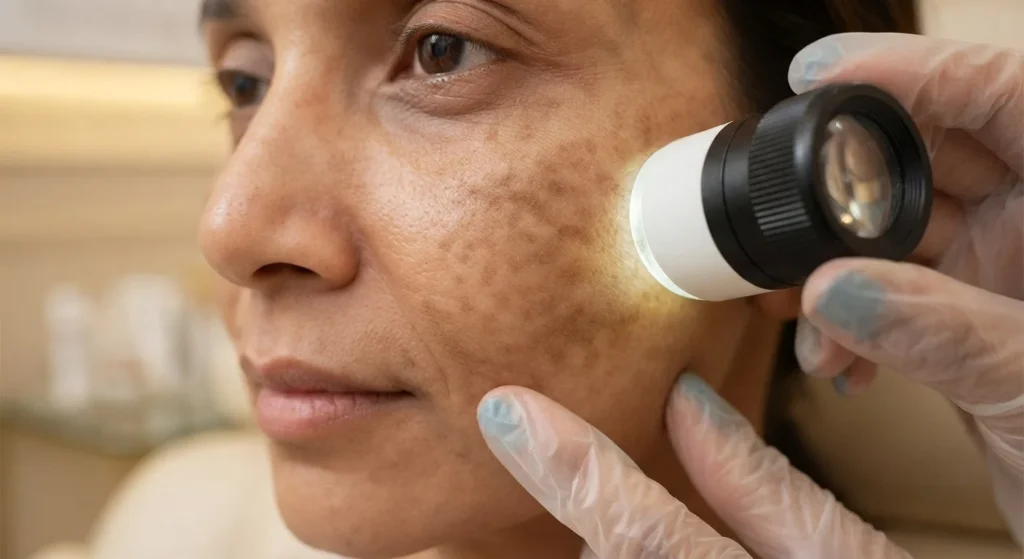
It often appears as:
- Brown or grey-brown patches
- Symmetrical facial pigmentation
- Cheek pigmentation
- Forehead pigmentation
- Upper-lip pigmentation
- Nose pigmentation
Where Does Melasma Usually Appear?
Melasma most commonly affects areas of the face that receive significant sun exposure.
Cheeks
Symmetrical pigmentation across the cheeks is a common presentation.
Forehead
Brown patches may appear on the forehead, sometimes extending toward the temples.
Upper Lip
Some individuals develop noticeable pigmentation around the upper lip.
Nose
Pigmentation can also affect the bridge or sides of the nose.
Combined Facial Areas
Many patients have pigmentation affecting several areas at the same time.
The distribution and appearance help the dermatologist assess whether the pattern is consistent with melasma or whether another pigmentation condition should be considered.
Why Does Melasma Develop?
Melasma is usually influenced by more than one factor.
Sun Exposure
Ultraviolet exposure is one of the most important factors associated with melasma and can contribute to worsening or recurrence.
Even after treatment has improved pigmentation, continued sun exposure can make long-term control more difficult.
Hormonal Influences
Hormonal changes can contribute to melasma in some individuals. This is one reason facial pigmentation may appear or become more noticeable during certain periods of hormonal change.
Genetics
Some people have a greater tendency to develop melasma because of genetic and individual skin characteristics.
Visible Light & Environmental Exposure
Certain environmental factors may also contribute to pigmentation in susceptible skin. Sun-protection strategies therefore remain an important part of ongoing management.
Skin Irritation
Repeated irritation or inappropriate skincare may worsen pigmentation in some individuals.
Is Melasma Only a Women’s Skin Condition?
No.
Melasma is more commonly recognized in women, particularly during periods of hormonal change, but it can also occur in men.
Regardless of gender, treatment should be based on the pigmentation pattern, skin type, possible triggers, and individual clinical assessment.
Melasma During Pregnancy
Melasma can appear or become more noticeable during pregnancy, which is why it is sometimes referred to as the “mask of pregnancy.”
Hormonal changes during pregnancy can influence pigmentation.
Treatment recommendations during pregnancy require particular care because not every pigmentation treatment or active skincare ingredient is appropriate during pregnancy.
If you are pregnant or planning pregnancy, inform your dermatologist before beginning any treatment.
How Is Melasma Diagnosed?
Melasma is primarily diagnosed through a detailed clinical examination.
During consultation, your dermatologist may assess:
- Pigmentation pattern
- Location
- Symmetry
- Skin type
- Duration
- Previous treatments
- Sun exposure
- Hormonal factors
- Current skincare routine
In selected situations, additional examination techniques may be helpful in assessing the depth or characteristics of pigmentation.
The goal is to make sure the pigmentation is consistent with melasma and not another skin condition requiring a different approach.
Melasma vs Other Pigmentation
Not every brown patch on the face is melasma.
Facial pigmentation can also be associated with:
- Post-Acne Pigmentation
- Sun-Induced Dark Spots
- Post-Inflammatory Hyperpigmentation
- Freckles
- Other Pigmentary Conditions
These conditions may require different management.
This is why diagnosing the pattern before starting treatment is important.
Explore Pigmentation Treatment →
When Should You See a Dermatologist for Melasma?
Consider professional evaluation if:
- Facial pigmentation is persistent
- Brown patches are becoming more noticeable
- Pigmentation repeatedly returns
- Multiple areas of the face are affected
- Home skincare has not helped
- Pigmentation worsens with sun exposure
- You are unsure whether the pigmentation is melasma
- Previous treatments produced little improvement
Professional assessment can help identify the pattern and create a treatment plan suited to your skin.
Our Approach to Melasma Treatment
At Sunshine Skin Clinic, we do not use the same pigmentation routine for every patient.
Before recommending treatment, we consider:
- Type and Pattern of Pigmentation
- Skin Type
- Severity
- Depth
- Sun Exposure
- Hormonal Factors
- Previous Procedures
- Current Skincare
- Pigmentation History
- Sensitivity and Irritation
- Long-Term Maintenance Needs
The treatment plan may focus on controlling pigmentation while also minimizing factors that can contribute to recurrence.
Melasma Treatment Options
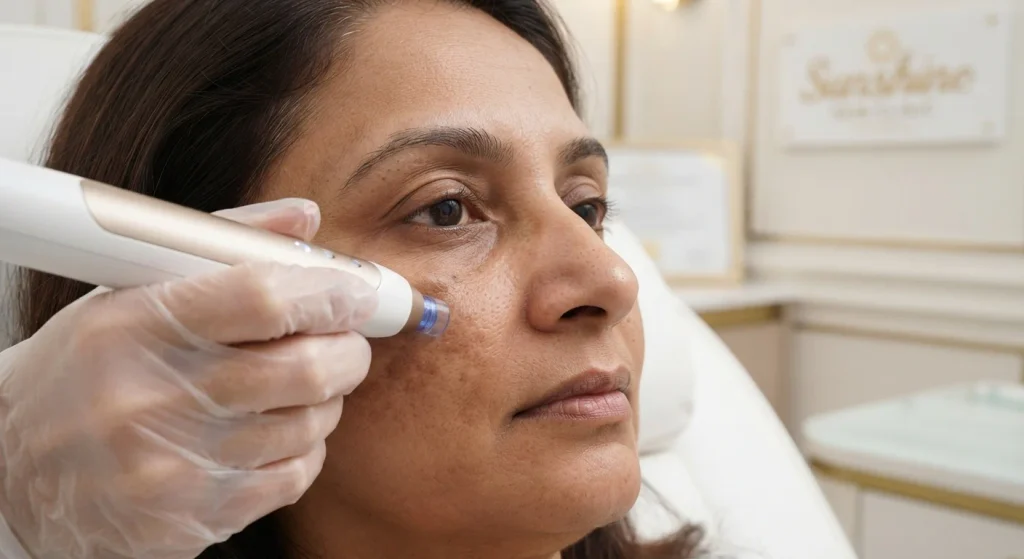
Treatment is usually individualized and may involve one or more approaches.
Dermatologist-Guided Skincare
A carefully selected skincare routine can form the foundation of melasma management.
Depending on individual needs, a dermatologist may recommend products designed to support pigmentation control while protecting the skin barrier.
The exact ingredients and routine should be selected according to skin type, sensitivity, pregnancy status where relevant, and other individual factors.
Sun Protection
Sun protection is one of the most important components of melasma management.
A dermatologist may recommend:
- Broad-spectrum sunscreen
- Consistent daily sunscreen use
- Reapplication when appropriate
- Physical protection such as hats
- Limiting prolonged direct sun exposure
Treatment without adequate photoprotection may make long-term control more difficult.
Chemical Peels for Melasma
Selected chemical peels may be considered as part of a melasma treatment plan.
The peel type, strength, frequency, and suitability depend on the patient’s skin characteristics and pigmentation pattern.
Because some skin types are more prone to post-inflammatory pigmentation, professional treatment selection is important.
Explore Chemical Peel →
Laser-Based Treatment
Certain laser technologies may be considered for selected melasma patients.
However, laser treatment is not automatically appropriate for every person with melasma. The choice depends on factors such as skin type, pigmentation pattern, treatment history, and response to previous therapies.
Careful treatment selection is particularly important because inappropriate treatment can sometimes worsen pigmentation.
Explore Laser Treatments →
Laser Toning
Laser toning may be considered in selected pigmentation-management plans.
The treatment protocol is individualized based on skin characteristics, pigmentation pattern, and previous treatment response.
The objective is gradual improvement rather than an aggressive approach designed to produce an immediate change in pigmentation.
Explore Laser Toning →
Combination Melasma Treatment
Some patients may benefit from a combination approach rather than relying on a single treatment.
Depending on clinical assessment, a treatment plan may include:
- Dermatologist-Guided Skincare
- Sun Protection
- Chemical Peels
- Selected Laser Treatments
- Laser Toning
- Maintenance Therapy
The exact combination depends on the patient’s skin and response to treatment.
The aim is to use the minimum appropriate combination necessary to manage the pigmentation, rather than simply increasing the number of procedures.
Melasma and Indian Skin
Melasma treatment requires particular attention to individual skin characteristics.
In Indian skin, pigmentation can sometimes become more noticeable after inflammation or skin irritation. Because certain procedures can themselves trigger pigmentation in susceptible individuals, treatment intensity and procedure selection should be carefully considered.
Your dermatologist may therefore evaluate:
- Natural Skin Tone
- Pigmentation History
- Sensitivity
- Previous Procedure Response
- Tendency Toward Post-Inflammatory Pigmentation
- Current Skin Condition
This helps create a treatment plan that takes both melasma and the surrounding skin into account.
Why Melasma Can Come Back
One of the most important things to understand about melasma is that improvement does not always mean permanent clearance.
Pigmentation may recur because of:
- Sun Exposure
- Hormonal Influences
- Inconsistent Sun Protection
- Skin Irritation
- Individual Genetic Susceptibility
- Environmental Exposure
For this reason, melasma treatment often has two phases:
Improvement
Reducing the visibility of existing pigmentation.
Maintenance
Supporting long-term control and reducing factors associated with recurrence.
What Results Can You Expect?
The goal of melasma treatment is generally to reduce the appearance of pigmentation and create a more even-looking complexion.
The degree and speed of improvement vary from person to person.
Some patients may notice gradual improvement with consistent skincare and sun protection, while others may require a combination of in-clinic procedures and maintenance treatment.
Because melasma can recur, it is more realistic to think in terms of long-term management rather than guaranteed permanent removal.
How Many Sessions Are Needed?
There is no universal number of sessions for melasma.
The treatment schedule depends on:
- Severity
- Pigmentation Pattern
- Skin Type
- Treatment Selected
- Previous Treatment History
- Skin Response
- Maintenance Requirements
Some patients may require a series of procedures, while others may primarily benefit from consistent medical skincare and photoprotection.
Your dermatologist can determine the appropriate treatment schedule after examining your skin.
Your Melasma Treatment Journey
Step 1 — Consultation
We discuss when your pigmentation started, whether it changes with seasons or sun exposure, previous treatments, skincare routine, and relevant hormonal or lifestyle factors.
Step 2 — Pigmentation Assessment
The dermatologist examines the pattern, distribution, colour, and overall characteristics of the pigmentation.
Step 3 — Personalized Plan
A suitable combination of skincare, sun protection, procedures, and maintenance strategies is discussed.
Step 4 — Treatment
Selected treatments are performed according to the individualized plan.
Step 5 — Follow-Up
Your skin response is monitored and the treatment plan can be adjusted when appropriate.
Step 6 — Maintenance
Once pigmentation improves, maintenance care and photoprotection remain important to support longer-term control.
Melasma Aftercare
Depending on the treatment performed, your dermatologist may recommend:
- Gentle Cleansing
- Regular Moisturization
- Consistent Sunscreen
- Avoiding Excessive Sun Exposure
- Avoiding Unnecessary Skin Irritation
- Following Prescribed Skincare
- Temporary Avoidance of Certain Active Products
Aftercare varies according to the procedure, so always follow the specific instructions provided after treatment.
What Should You Avoid During Melasma Treatment?
Aggressive or inconsistent skincare can make pigmentation management more difficult.
It is generally sensible to avoid:
- Unsupervised strong bleaching products
- Excessive exfoliation
- Frequent switching between active ingredients
- Aggressive home remedies
- Unnecessary skin irritation
- Picking or scratching irritated skin
- Prolonged unprotected sun exposure
Your dermatologist can help create a routine that balances pigmentation management with skin-barrier care.
Why Choose Sunshine Skin Clinic for Melasma Treatment?
Melasma often requires more thoughtful management than simply performing a pigmentation procedure.
At Sunshine Skin Clinic, our approach focuses on understanding the pattern and possible triggers before choosing treatment.
Personalized Melasma Assessment
We evaluate your pigmentation, skin characteristics, previous treatment history, and relevant contributing factors.
Multiple Treatment Approaches
Depending on your condition, management may involve medical skincare, chemical peels, laser-based procedures, or a combination approach.
Careful Treatment Selection
Treatment intensity and procedure choice are considered according to your skin type and pigmentation tendency.
Long-Term Maintenance
We recognize that melasma can recur and therefore include maintenance and photoprotection as part of the overall strategy.
Realistic Expectations
Our goal is meaningful improvement rather than promising permanent or guaranteed clearance.
Frequently Asked Questions
What is the best treatment for melasma?
There is no single treatment that is best for everyone. Melasma management may involve dermatologist-guided skincare, sun protection, chemical peels, selected laser-based treatments, or a combination depending on the individual.
Can melasma be permanently cured?
Melasma can often be improved, but it may recur. Long-term maintenance and protection from contributing triggers are often important.
Does sunscreen help melasma?
Photoprotection is an important part of melasma management because sun exposure can contribute to worsening and recurrence.
Can laser treatment make melasma worse?
In some susceptible patients, inappropriate or overly aggressive treatment can potentially worsen pigmentation. This is why laser selection, settings and patient suitability require professional assessment.
Can melasma be treated during pregnancy?
Treatment during pregnancy requires special consideration because some medications and procedures may not be appropriate. Inform your dermatologist if you are pregnant or planning pregnancy.
Is melasma the same as normal pigmentation?
No. Melasma has a characteristic pattern and can be influenced by hormonal and environmental factors. Other forms of pigmentation may have different causes and treatments.
How long does melasma treatment take?
The timeline varies according to severity, treatment approach, skin response and maintenance. Improvement is generally gradual rather than immediate.
Can melasma return after treatment?
Yes. Recurrence is possible, especially with sun exposure and other contributing factors. Long-term maintenance is therefore important.