


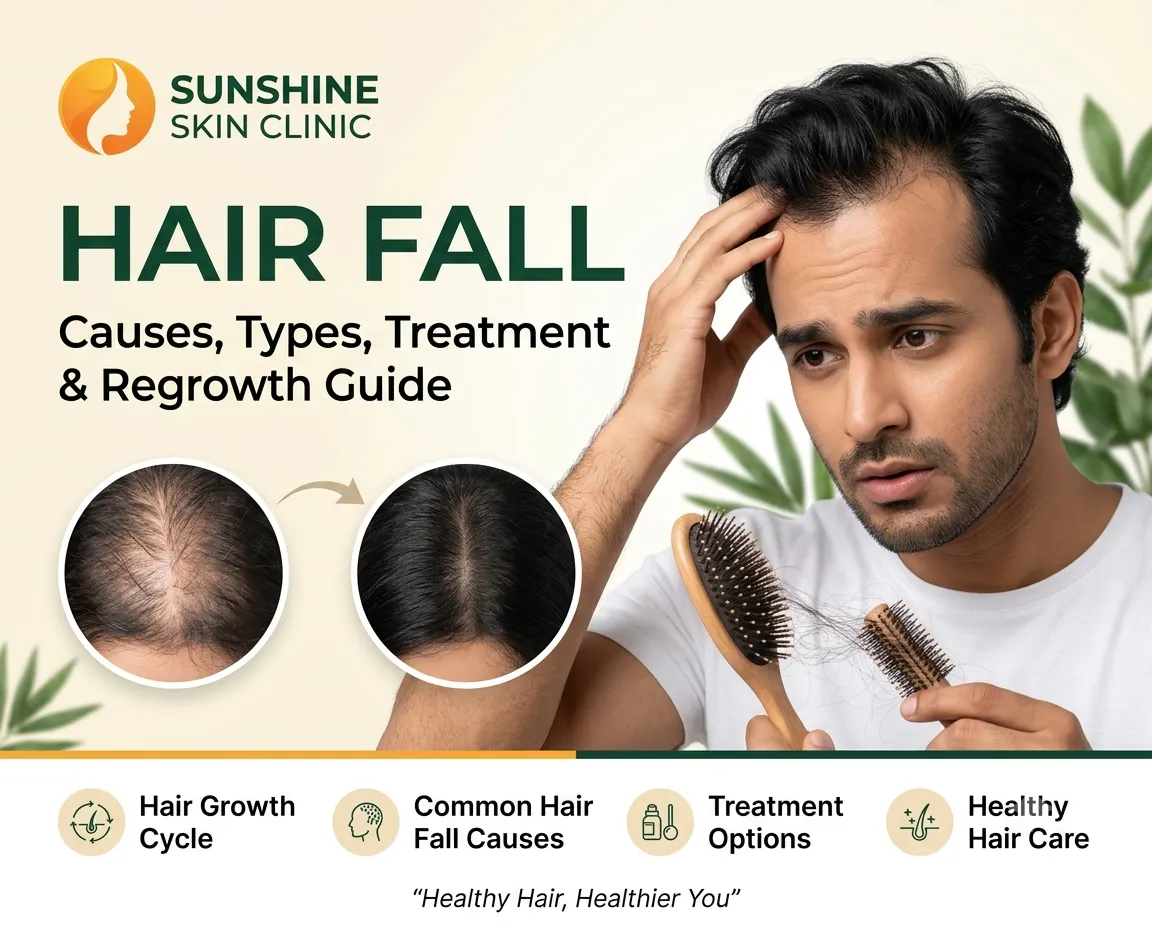
Finding more hair than usual on your pillow, comb, bathroom floor, or shower drain can be worrying. For some people, hair fall begins suddenly, while others gradually notice a wider hair parting, a thinner ponytail, or more visible scalp.
The first reaction is often to change shampoo, purchase a hair-growth serum, or start taking supplements. But these steps do not always address the actual problem.
Hair fall is not a single condition. It is a symptom that can have several different causes, and the right treatment depends on identifying which one is responsible.
Some forms of hair shedding are temporary and may improve once the underlying trigger is addressed. Others are associated with hereditary hair loss, hormonal influences, autoimmune conditions, or disorders affecting the scalp and hair follicles.
Understanding the difference is important because the treatment that helps one type of hair loss may not help another.
This guide explores eight important ideas about hair fall, including the hair growth cycle, common causes, nutritional factors, scalp health, medical evaluation, treatment options, and realistic expectations about regrowth.
What Is Hair Fall?
Hair fall generally refers to the shedding of hair from the scalp. The medical term for hair loss is alopecia, although different types of alopecia have different causes and clinical features.
Hair naturally grows, rests, sheds, and is replaced by new growth. Therefore, losing some hair every day is a normal part of the hair growth cycle.
The American Academy of Dermatology (AAD) estimates that people typically lose around 50–100 hairs daily as part of this natural process. However, this is an approximate range rather than a strict diagnostic threshold.
Hair fall becomes more concerning when shedding increases noticeably, hair density decreases, the hairline changes, or bald patches begin to develop.
8 Important Ideas to Understand Before Choosing Hair Fall Treatment
1. Understand the Difference Between Normal Hair Shedding and Actual Hair Loss
Seeing hair in your comb or shower does not automatically mean that you have a medical hair-loss condition.
Your hair follicles continuously move through different stages of growth and rest. As part of this process, older hairs are naturally released and replaced by new ones.
The three main phases are:
Anagen – Growth Phase
During this stage, the hair follicle actively produces a growing hair strand. This phase lasts for several years and largely determines the length that hair can achieve.
Catagen – Transition Phase
This is a relatively short transitional period during which active hair growth slows and the follicle begins to shrink.
Telogen – Resting Phase
During this stage, the hair remains in the follicle before eventually being released as part of the natural shedding process.
These stages do not occur simultaneously in every follicle. That is why people normally shed hair without becoming visibly bald.
When should you become concerned?
Pay attention to changes such as:
- A noticeable increase in daily shedding.
- A gradually receding hairline.
- A widening parting in women.
- Reduced hair density around the crown.
- A thinner ponytail.
- New bald patches.
- Hair that appears progressively weaker or finer.
One useful distinction is that hair shedding and reduced hair density are not always the same problem.
A person may experience heavy temporary shedding without developing permanent thinning, while someone with hereditary hair loss may gradually lose density without noticing large amounts of hair falling every day.
Understanding this distinction makes the next steps much clearer.
2. Hair Fall Can Actually Be Hair Breakage
This is one of the most overlooked reasons people believe they are experiencing excessive hair loss.
Sometimes the hair is not falling from the root. Instead, the hair shaft is breaking.
Hair breakage and hair shedding can look similar, particularly when you notice short strands on your clothes, pillow, or comb.
However, their causes can be different.
What can cause hair breakage?
Excessive heat styling: Frequent use of straighteners, curling irons, and high-temperature hair dryers can weaken the hair shaft.
Chemical processing: Repeated colouring, bleaching, relaxing, or other harsh chemical treatments can damage hair structure.
Rough brushing: Aggressive brushing, especially when hair is wet and fragile, can increase breakage.
Tight hairstyles: Repeated tension from tight ponytails, braids, buns, or extensions can damage hair and sometimes lead to traction alopecia.
Dry and fragile hair: Hair that is already damaged may become more vulnerable to splitting and breaking.
How can you distinguish the two?
Hair shedding generally involves a complete hair strand released from the follicle.
Breakage produces shorter or uneven fragments of hair, often without the same appearance as naturally shed hairs.
This observation alone cannot establish a diagnosis, but it can help identify whether the main problem involves the scalp, hair follicles, or the hair shaft.
The AAD recommends assessing hair health and checking for breakage during a hair-loss evaluation.
3. Hair Fall Can Start Months After the Event That Triggered It
Imagine experiencing a high fever in July, recovering completely, and then noticing excessive hair shedding in September or October.
It may seem as though the hair fall has appeared without a reason.
However, some forms of hair shedding are delayed because of the natural hair growth cycle.
This is particularly relevant to a condition called Telogen Effluvium.
Telogen effluvium occurs when a larger-than-usual number of hair follicles enter the resting phase, followed by increased shedding.
Common triggers can include:
- High fever.
- Severe infections.
- Major surgery.
- Physical or emotional stress.
- Childbirth.
- Significant weight loss.
- Crash dieting.
- Nutritional deficiencies.
- Certain medications.
- Thyroid-related conditions.
In many cases, increased shedding becomes noticeable around two to three months after the triggering event.
A practical idea: Look back 90 days
When evaluating sudden hair shedding, do not focus only on what happened last week.
Think about the previous three months.
Ask yourself:
- Did you experience a high fever or serious illness?
- Did you undergo surgery?
- Did you give birth?
- Did you lose weight rapidly?
- Did you significantly change your diet?
- Did you start or stop medication?
- Did you experience an unusually stressful period?
This historical timeline can provide valuable clues.
An important distinction is that telogen effluvium is often temporary, but persistent or recurring shedding needs appropriate evaluation. It should not automatically be assumed that every case will resolve without treatment.
4. The Pattern of Hair Loss Can Reveal Important Clues About Its Cause
Not all hair loss appears in the same way.
The location, speed, and distribution of thinning can provide valuable information during a dermatological examination.
Here are some important patterns.
Male Pattern Hair Loss
Androgenetic alopecia is a hereditary form of hair loss commonly associated with a gradually receding hairline and thinning around the crown.
It usually develops progressively rather than causing sudden heavy shedding.
Female Pattern Hair Loss
Women may initially notice a widening central parting, reduced hair density around the top of the scalp, or a thinner ponytail.
The frontal hairline may remain relatively preserved, although patterns vary.
Telogen Effluvium
This commonly produces diffuse shedding across the scalp. People may notice much more hair falling during washing, brushing, or styling.
Alopecia Areata
This is an autoimmune condition that can cause sudden, well-defined patches of hair loss. It can affect the scalp, eyebrows, eyelashes, beard, and other body areas.
Traction Alopecia
This develops when repeated pulling or tension damages hair follicles, commonly around areas exposed to tight hairstyles.
Scarring Alopecia
Certain inflammatory disorders can damage hair follicles and replace them with scar tissue, potentially causing permanent hair loss in affected areas.
These conditions require different approaches. Recognising the pattern is therefore an essential part of accurate diagnosis.
5. Your Scalp Health Matters Just as Much as Your Hair
People often concentrate entirely on the hair strands while ignoring the scalp.
However, some scalp conditions can contribute to inflammation, hair shedding, breakage, or even permanent follicular damage.
Common scalp concerns include:
Dandruff and Seborrhoeic Dermatitis
These conditions can cause visible flakes, itching, oiliness, redness, and irritation.
Scalp Fungal Infections
Certain fungal infections can cause scaling, inflammation, broken hairs, and localised hair loss. Some infections require prompt treatment to reduce the risk of scarring.
Scalp Psoriasis
This inflammatory condition can cause thick scales and irritation. Scratching and inflammation may contribute to temporary hair loss.
Folliculitis
Inflammation around hair follicles can produce red bumps, pustules, tenderness, and sometimes hair loss.
Warning signs you should not ignore
Seek timely dermatological assessment if hair loss is accompanied by:
- Persistent scalp pain or burning.
- Intense itching.
- Redness and swelling.
- Pus-filled bumps.
- Thick or spreading scales.
- Smooth or shiny areas where hair follicles appear absent.
- Rapidly developing bald patches.
- Loss of eyebrow or beard hair.
These symptoms can suggest conditions that need specific treatment rather than ordinary hair-growth products.
The AAD identifies several scalp and hair-loss patterns that require medical assessment, especially when inflammation, tenderness, or sudden hair loss is present.
6. Nutritional Deficiencies Should Be Investigated, Not Guessed
Nutrition is an important part of healthy hair growth.
Hair follicles require adequate energy, protein, and essential nutrients to maintain normal functioning.
In some people, nutritional deficiencies may contribute to increased shedding or changes in hair quality.
Potential contributors include:
- Iron deficiency.
- Inadequate protein intake.
- Zinc deficiency.
- Certain vitamin deficiencies.
- Inadequate overall calorie intake.
This is particularly relevant for people following restrictive diets, experiencing rapid weight loss, or dealing with conditions that affect nutrient absorption.
What about iron and thyroid levels?
Iron deficiency and thyroid disorders are among the medical factors that may be considered when evaluating unexplained diffuse hair loss.
Depending on symptoms and medical history, a dermatologist may recommend selected investigations such as:
Complete Blood Count (CBC)
May help identify anaemia or other blood-related abnormalities.
Ferritin and Iron Studies
May help assess iron stores and iron deficiency.
Thyroid Function Tests
May help identify thyroid disorders that can contribute to hair changes.
Other tests may be appropriate when the history or physical examination suggests a particular deficiency, hormonal condition, or medical problem.
Why you should not take supplements blindly
Buying biotin, iron, zinc, or hair-growth supplements without knowing whether you have a deficiency is not a reliable treatment strategy.
Excessive supplementation can cause harm, and some supplements may interfere with laboratory testing.
The AAD advises using certain supplements, including iron and zinc, when an appropriate assessment confirms a deficiency rather than taking them routinely for hair loss.
The smarter approach is to identify a nutritional problem before trying to correct it.
7. Your Daily Hair-Care Habits Can Either Protect or Damage Hair
Healthy hair care is not necessarily about using more expensive shampoos or applying multiple oils.
Sometimes, reducing physical and chemical stress on the hair can make a meaningful difference.
Avoid repeated mechanical damage
Try to avoid excessively tight hairstyles, forceful brushing, and frequent pulling.
If a hairstyle causes discomfort or repeated tension, it may be placing unnecessary stress on the follicles.
Be careful with heat
Frequent high-temperature styling can weaken hair and increase breakage.
Use heat cautiously and avoid applying excessive temperature repeatedly to the same strands.
Do not overuse chemical treatments
Frequent bleaching, relaxing, or colouring may weaken the hair shaft.
Allow the hair sufficient time to recover between intensive treatments.
Wash according to your scalp needs
There is no universal washing schedule suitable for everyone.
Oily scalps may require more frequent cleansing, while dry or sensitive scalps may need a different routine.
Choose a suitable shampoo and avoid aggressive scratching or scrubbing.
Pay attention to diet and weight changes
Crash diets and insufficient protein intake can contribute to hair problems.
A balanced eating pattern is generally more sensible than relying on products promising rapid regrowth.
The important point is that hair-care habits may reduce preventable damage, but they cannot treat every medical cause of hair loss.
8. Hair Fall Treatment Needs a Cause-Specific Plan and Realistic Timeline
This is perhaps the most important part of managing hair loss.
There is no single treatment that works for every type of hair fall.
A person with temporary telogen effluvium may need a very different approach from someone with hereditary hair loss or alopecia areata.
The treatment should therefore follow the diagnosis.
For Telogen Effluvium
Management generally involves identifying and addressing the trigger, correcting any confirmed underlying problem, and monitoring recovery.
In many cases, hair shedding gradually reduces as the hair cycle returns towards its usual pattern.
For Hereditary Hair Loss
Treatments such as topical minoxidil may be considered for suitable patients.
In selected men with male-pattern hair loss, a dermatologist may also discuss prescription medicines such as finasteride.
These treatments have different safety considerations and are not appropriate for everyone. Potential side effects, reproductive considerations, and the need for ongoing use should be discussed before starting treatment.
For Alopecia Areata
Treatment depends on the extent and activity of the condition. Dermatologists may consider topical or injectable corticosteroids and other medical therapies according to the individual presentation.
For Scalp Infections and Inflammatory Disorders
Treatment is directed at the underlying infection or inflammatory condition. A hair-growth serum alone cannot resolve an untreated scalp infection.
For Nutritional or Medical Causes
Management focuses on correcting confirmed deficiencies or addressing the relevant underlying condition.
What about PRP Hair Treatment?
Platelet-Rich Plasma (PRP) involves collecting a small amount of a person’s blood, processing it to obtain a platelet-rich component, and administering it into selected areas of the scalp.
PRP has been studied for certain forms of hair thinning, particularly pattern hair loss.
However, results and treatment protocols vary, and it is not a universal treatment for every cause of hair fall.
It should be considered only after assessing whether the underlying condition is appropriate for this approach.
What about Hair Transplant?
Hair transplantation may be considered for selected people with hereditary pattern hair loss.
It is a surgical procedure that transfers hair follicles from a suitable donor area to areas affected by thinning or baldness.
However, it is not a treatment for every type of hair shedding.
A person experiencing temporary telogen effluvium, an active scalp infection, or untreated inflammatory hair loss generally needs the underlying condition evaluated before considering surgical restoration.
The AAD explains that hair loss treatment may include medicines, procedures, and supportive approaches depending on the diagnosed condition.
How Is Hair Fall Diagnosed?
A proper diagnosis generally begins with a detailed medical and hair history rather than immediately selecting a procedure.
A dermatologist may evaluate:
1. Duration: How long has the shedding or thinning been happening?
2. Pattern: Is the loss diffuse, patchy, or concentrated around the hairline or crown?
3. Scalp Health: Is there itching, scaling, inflammation, or infection?
4. Family History: Are close relatives experiencing similar patterns of thinning?
5. Medical History: Have there been recent illnesses, surgeries, hormonal changes, or medication changes?
6. Nutrition: Have there been significant changes in body weight, eating habits, or dietary intake?
7. Hair-Care Habits: Are heat styling, chemical treatments, or tight hairstyles contributing to damage?
What Is Trichoscopy?
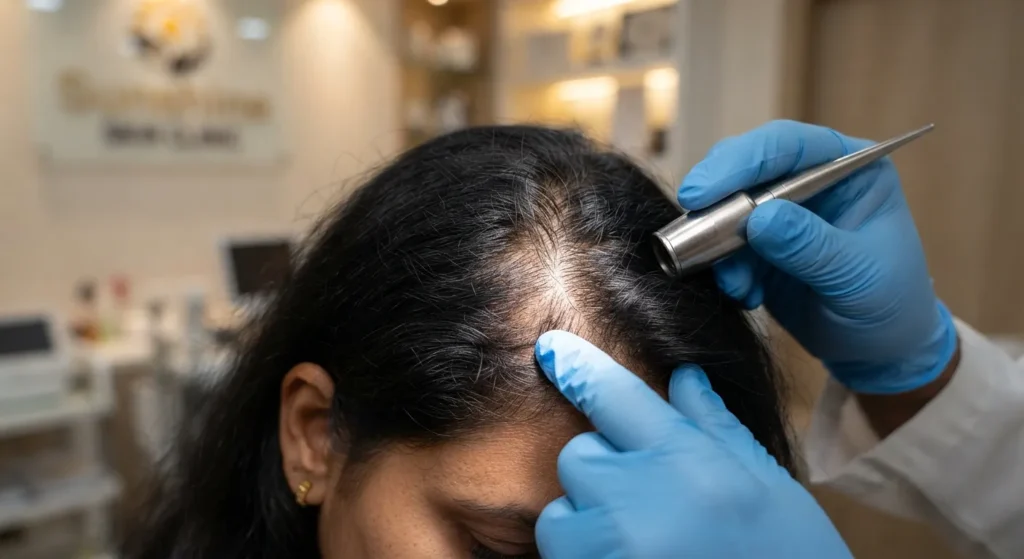
Trichoscopy is a non-invasive diagnostic method that uses magnification and specialised imaging to examine the scalp and hair.
It can help a dermatologist evaluate:
- Hair follicle characteristics.
- Hair shaft thickness.
- Variations in hair diameter.
- Scalp inflammation.
- Signs associated with different types of alopecia.
- Changes in hair density.
Depending on the findings, additional investigations or a scalp biopsy may sometimes be required.
However, not everyone with hair fall needs every available test.
A good evaluation selects investigations according to the patient’s history and examination.
How Long Does Hair Fall Treatment Take to Show Results?
Hair growth is a gradual biological process.
Even when the underlying cause is identified and appropriately managed, visible improvement usually takes time.
The timeline varies according to the type of hair loss, severity, duration, treatment, and individual response.
For example:
- Temporary shedding may gradually reduce after the triggering factor is addressed.
- Hereditary hair loss may require several months of ongoing treatment before improvement can be evaluated.
- Some inflammatory or infectious conditions require treatment of the underlying disease before hair recovery becomes apparent.
- Hair transplantation involves a separate healing and growth timeline.
The AAD notes that many people using minoxidil may need approximately 6–12 months to assess meaningful results, and continued use is generally necessary to maintain its benefits.
This is why a treatment should not be judged only after a few days or weeks.
Common Hair Fall Myths You Should Stop Believing
Myth 1: Every shampoo can stop hair fall
Shampoo helps cleanse the scalp and hair, but ordinary shampoos do not treat every medical cause of hair loss.
Myth 2: Applying more hair oil guarantees regrowth
Hair oil may improve lubrication and reduce friction for some hair types, but it cannot reverse every form of follicular hair loss.
Myth 3: Cutting hair makes it grow faster
Haircuts can improve the appearance of damaged ends, but cutting the hair shaft does not change follicle activity or the biological growth rate.
Myth 4: Hair fall always means nutritional deficiency
Nutritional deficiencies are one possible cause, but hereditary, hormonal, autoimmune, inflammatory, infectious, and medication-related factors can also contribute.
Myth 5: PRP or hair transplant is necessary for everyone
Neither procedure is appropriate for every type of hair loss. Treatment should be matched to the diagnosis.
Myth 6: Daily hair shedding means baldness is developing
Normal hair shedding is part of the hair growth cycle. The overall pattern, duration, and change in density matter more than isolated hairs found on a comb.
When Should You See a Dermatologist for Hair Fall?
Occasional shedding is normal, but some patterns deserve professional evaluation.
Consider a dermatological assessment if you experience:
- Persistent or increasing hair shedding.
- A progressively receding hairline.
- A widening central parting.
- Noticeable thinning around the crown.
- Sudden bald patches.
- Hair loss affecting the eyebrows or beard.
- Scalp pain, redness, itching, or scaling.
- Hair loss accompanied by significant fatigue or other unexplained symptoms.
- Shedding that continues without an identifiable explanation.
Sudden or rapidly spreading hair loss, especially with scalp inflammation, pain, sores, or signs of infection, should be assessed promptly because some conditions can cause permanent follicular damage if treatment is delayed.
Building a Healthy Long-Term Hair-Care Routine
A practical hair-care routine should support the scalp, protect the hair shaft, and avoid unnecessary damage.
A balanced approach may include:
Gentle scalp cleansing: Use a suitable shampoo according to scalp oiliness and condition.
Conditioning: Use conditioner on the lengths of the hair to improve manageability and reduce friction.
Careful drying: Avoid vigorous towel rubbing and excessive heat.
Balanced nutrition: Maintain adequate protein and a varied diet.
Protective hairstyles: Avoid repeated tension from tight hairstyles.
Reasonable chemical use: Avoid excessive bleaching, relaxing, and repeated harsh processing.
Medical follow-up: Continue appropriate monitoring when a medical hair-loss condition is present.
The objective is not to create an unnecessarily complicated routine. It is to maintain healthy hair and scalp conditions while addressing the actual cause of hair fall.
Final Thoughts
Hair fall can be temporary, progressive, or associated with a specific scalp or medical condition.
The most important step is understanding which type of hair loss you are experiencing.
A sudden increase in shedding may have a different explanation from a gradually receding hairline. Hair breakage is different from follicular hair loss, and scalp inflammation may require an entirely different treatment approach.
For some people, addressing a temporary trigger and correcting a confirmed nutritional or medical problem may be enough. Others may benefit from specific medical treatments, PRP in selected cases, or carefully planned hair restoration procedures.
The best approach is not to start with the strongest serum, the most expensive supplement, or the latest hair-growth procedure. It is to identify the cause, choose an appropriate treatment, and monitor progress realistically.
Healthy hair begins with a healthy scalp, appropriate care, and a treatment plan that matches the individual’s condition.
Frequently Asked Questions About Hair Fall
What is the most common cause of hair fall?
Hair fall has several causes. Common examples include hereditary pattern hair loss, telogen effluvium, hormonal influences, nutritional deficiencies, scalp disorders, autoimmune conditions, and certain medications. The most likely cause depends on the pattern and medical history.
How much hair fall is normal in a day?
The American Academy of Dermatology estimates that losing approximately 50–100 hairs per day is common. However, this varies between people, and counting individual hairs is not a reliable way to diagnose hair loss.
Can stress cause hair fall?
Yes. Significant physical or emotional stress may trigger telogen effluvium, a type of diffuse hair shedding. The increase in shedding often becomes noticeable around two to three months after the triggering event.
Does hair fall after fever grow back?
In many cases, increased shedding after a high fever is associated with temporary telogen effluvium. Hair recovery is possible as the normal growth cycle resumes, although persistent or unusual loss should be evaluated.
Can iron deficiency cause hair fall?
Iron deficiency can contribute to hair shedding in some people. A clinician may recommend iron studies and other investigations when the history and examination suggest a possible deficiency.
Which vitamin deficiency causes hair fall?
Several nutritional deficiencies may contribute to hair problems, including inadequate iron and certain other nutrients. However, there is no single vitamin deficiency responsible for all hair loss. Testing should be guided by clinical findings rather than assumptions.
Does oiling reduce hair fall?
Oiling may help lubricate hair strands and reduce dryness or friction. However, it does not treat every medical cause of hair loss and should not replace appropriate evaluation.
Is minoxidil effective for hair loss?
Minoxidil is an established treatment option for certain types of pattern hair loss. Results usually take several months, and continued use may be needed to maintain improvement. It is not suitable for every type of hair fall.
What is the difference between hair fall and telogen effluvium?
Hair fall is a general description of shedding. Telogen effluvium is a specific type of diffuse hair shedding caused by a disruption in the normal hair growth cycle, often following physical or emotional stress.
Is PRP effective for hair fall?
PRP may help selected patients with certain forms of hair thinning, but results vary and treatment protocols differ. It is not an appropriate solution for every cause of hair loss.
Can hair fall be permanently stopped?
There is no universal way to guarantee that hair fall will never occur again. Some temporary causes can resolve, while hereditary and chronic conditions may require ongoing management. The outcome depends on the underlying diagnosis.
Does dandruff cause hair fall?
Dandruff itself does not usually cause permanent hair loss. However, associated inflammation, scratching, or other underlying scalp conditions may contribute to temporary shedding or hair damage.
When should I consult a dermatologist?
Seek evaluation if hair fall becomes persistent, severe, sudden, patchy, or is accompanied by scalp pain, redness, scaling, or other unusual symptoms. Early diagnosis can help identify conditions that need specific treatment.