


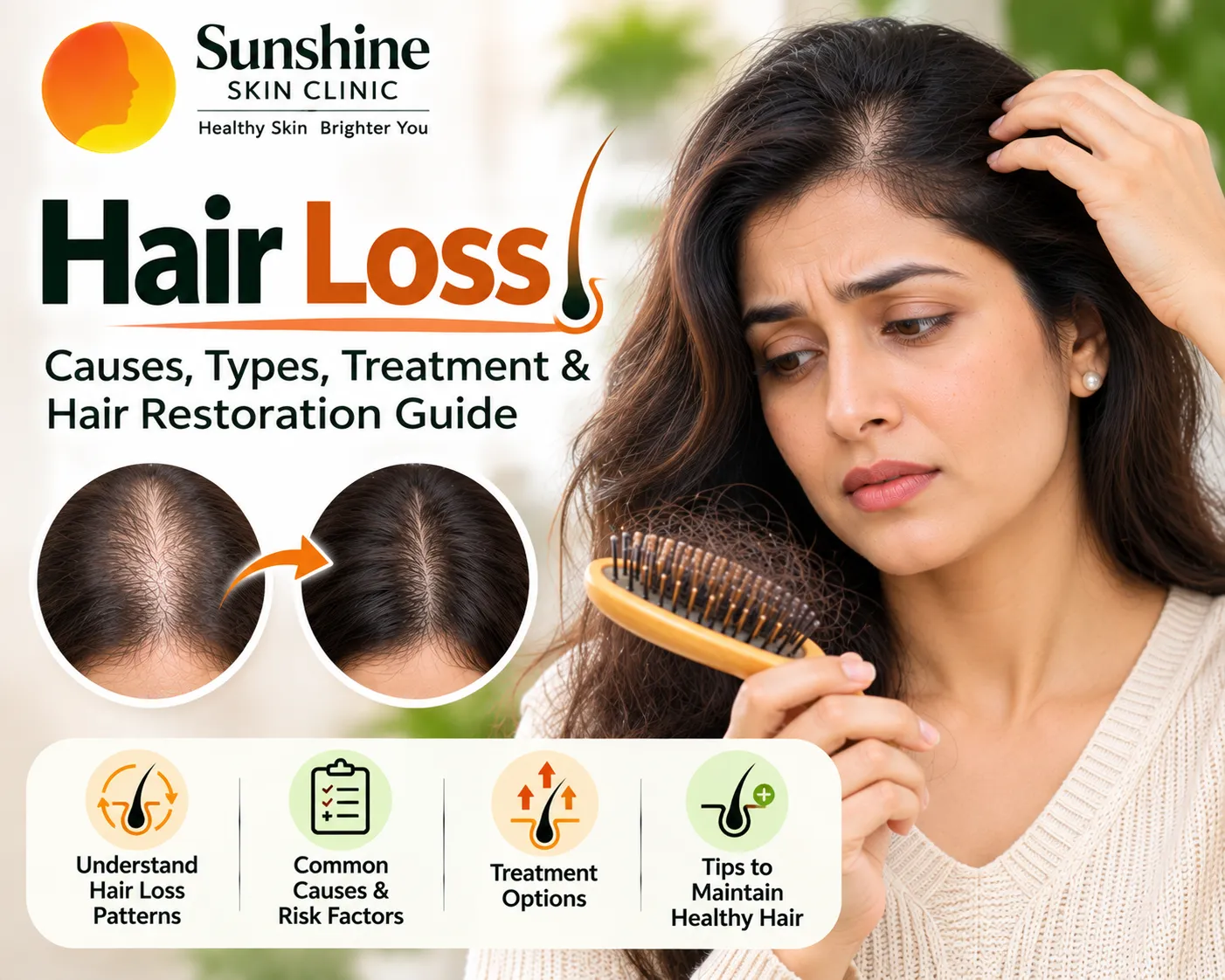
Hair loss can be difficult to notice in its early stages. It may begin with a slightly receding hairline, a wider parting, reduced hair density around the crown, or a gradual change in the thickness of individual strands.
Unlike sudden hair shedding, progressive hair loss often develops slowly. Because the changes can be subtle, many people do not recognise the problem until more of their scalp becomes visible.
One important reason is that hair loss is not always about losing more hair. Sometimes, the hair follicles themselves gradually become less productive.
This distinction is particularly important in hereditary hair loss, where follicles may progressively produce shorter, finer, and thinner hair.
However, hereditary pattern hair loss is only one possibility. Autoimmune conditions, inflammatory scalp disorders, medication-related problems, nutritional deficiencies, infections, and certain medical conditions can also affect hair growth.
Understanding the underlying cause is essential because different types of hair loss require different treatment approaches.
This guide explores eight important ideas about hair loss, how dermatologists evaluate it, what treatment options may be considered, and what realistic hair restoration involves.
What Is Hair Loss?
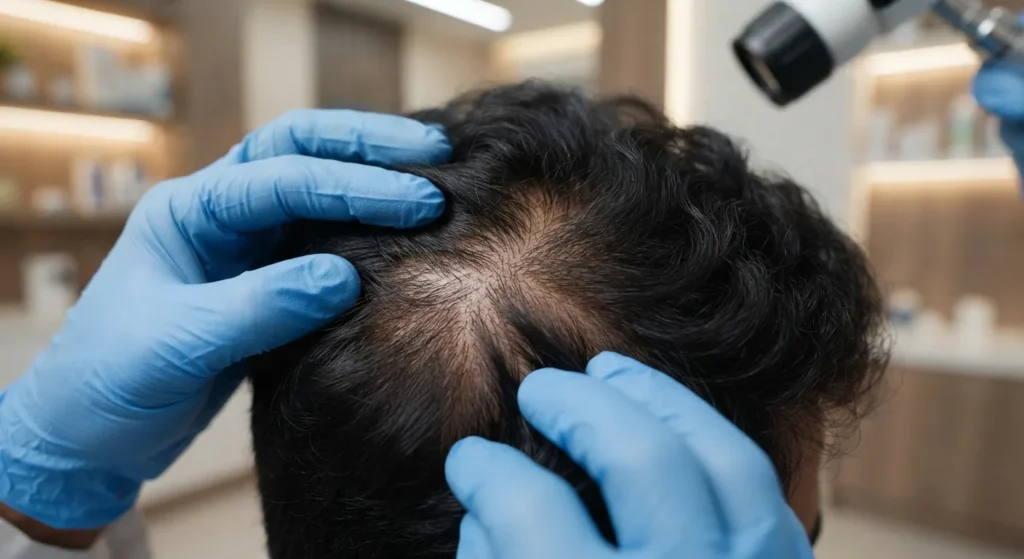
Hair loss, medically known as alopecia, refers to a reduction in hair coverage or density in one or more areas of the scalp or body.
It may develop gradually or appear suddenly.
Common signs include:
- Receding hairline.
- Thinning around the crown.
- Widening of the central hair parting.
- Reduced hair density.
- Visible scalp through the hair.
- Circular bald patches.
- Loss of eyebrow, eyelash, or beard hair.
- Persistent thinning in specific areas.
Hair loss may be temporary, progressive, or permanent depending on its cause.
For example, some forms of temporary hair loss improve when the underlying trigger is addressed. In contrast, certain hereditary conditions require long-term management, while scarring alopecia can permanently damage hair follicles.
Understanding which category applies is the first step towards appropriate treatment.
8 Important Ideas to Understand About Hair Loss
1. Hair Shedding and Progressive Hair Loss Are Not Always the Same Problem
One of the most important distinctions is between losing individual hairs and gradually losing overall hair density.
People commonly use the expressions hair fall and hair loss interchangeably, but the underlying patterns can differ.
Hair shedding
Shedding refers to the release of individual hairs from their follicles.
An increase in shedding may occur after illness, childbirth, significant stress, rapid weight loss, or other triggers.
A condition such as telogen effluvium can cause temporary, widespread shedding.
Progressive hair loss
Progressive hair loss involves a gradual reduction in the number, thickness, or productivity of hairs in particular areas.
For example, hereditary pattern hair loss may cause follicles to produce progressively finer hairs over time.
Can both happen together?
Yes.
A person may have underlying hereditary hair thinning and also experience temporary shedding after an illness.
In this situation, the sudden shedding can make an existing hair-density problem much more noticeable.
This is one reason why treating every hair-loss complaint as simple excessive shedding can lead to an incomplete evaluation.
The useful question is not only how much hair you are losing, but whether the overall density and thickness of your hair are changing.
2. Hereditary Hair Loss Is About Follicle Sensitivity, Not Simply Having a Family History of Baldness
Androgenetic alopecia, commonly called hereditary or pattern hair loss, is one of the most common causes of progressive hair thinning in men and women.
It involves a combination of genetic susceptibility and biological responses within susceptible hair follicles.
One important factor is dihydrotestosterone (DHT), a hormone produced from testosterone through the action of the enzyme 5-alpha-reductase.
In genetically susceptible follicles, androgen signalling can contribute to a gradual process known as follicular miniaturisation.
Over successive growth cycles:
- Hair strands may become thinner.
- Individual hairs may become shorter.
- The growth phase may become shorter.
- Overall hair density may gradually decrease.
Eventually, some affected follicles may produce extremely fine hairs or stop producing visible hair.
The important point is that hereditary hair loss is not simply determined by how much testosterone someone has. The sensitivity of individual follicles and genetic factors also matter.
Does hair loss come only from your mother’s side?
No.
Genetic susceptibility can be inherited from either or both parents. There is no reliable rule that baldness must come exclusively from the mother’s family.
The International Journal of Dermatology’s review of androgenetic alopecia, published in 2025, discusses the inherited biological mechanisms and progressive nature of this condition.
Why early recognition matters
When follicles are still producing thinner hairs, appropriate treatment may help preserve or improve existing hair density in selected patients.
Once follicles have been permanently destroyed or replaced by scar tissue, regrowth becomes much more difficult or impossible.
This is why identifying the type of hair loss early can be more valuable than repeatedly trying different cosmetic products.
3. Male and Female Pattern Hair Loss Can Look Very Different
Hair loss does not follow the same distribution in everyone.
Understanding the difference between male and female pattern hair loss can help explain why some people notice a receding hairline while others experience gradual thinning across the top of the scalp.
Male Pattern Hair Loss
Male pattern hair loss commonly begins with:
- Receding temples.
- A gradually changing frontal hairline.
- Thinning around the crown.
- A combination of frontal and crown hair loss.
Over time, the areas of reduced density may expand.
It can begin relatively early in adulthood and may progress over many years.
The pattern is commonly associated with androgenetic alopecia.
Female Pattern Hair Loss
Female pattern hair loss often presents differently.
Common signs include:
- Widening of the central hair parting.
- Reduced density around the crown.
- Gradual thinning across the upper scalp.
- A thinner ponytail.
- Increased visibility of the scalp under bright light.
Unlike typical male pattern hair loss, the frontal hairline is often relatively preserved.
However, individual patterns vary, and not every woman with thinning hair has hereditary female pattern hair loss.
What about hormonal problems in women?
Some women with hair thinning may also have signs of androgen excess or conditions such as polycystic ovary syndrome (PCOS).
Additional symptoms such as irregular periods, increased facial hair, or persistent acne may justify further evaluation.
However, female pattern hair loss does not automatically mean that a woman has a hormonal disorder.
A dermatologist may recommend hormonal investigations when the clinical history and examination indicate that they are appropriate.
Sources: IADVL Hair Loss Guide and DermNet: Female Pattern Hair Loss.
4. The Thickness of Individual Hairs Can Reveal Changes Before Baldness Becomes Obvious
This is one of the most interesting aspects of diagnosing hereditary hair loss.
People usually look for visible bald patches or a receding hairline.
But changes can begin much earlier, when the affected follicles still produce hair but the strands gradually become finer.
This process is called follicular miniaturisation.
What does miniaturisation look like?
Imagine examining two areas of the same scalp.
In one area, most hair strands may have a relatively consistent thickness.
In another area, there may be a mixture of thick, medium, and very fine hairs.
This variation can provide clues about progressive follicular changes.
A dermatologist may use trichoscopy, a magnified examination of the scalp and hair, to identify these patterns.
Trichoscopy can help assess:
- Variation in hair-shaft diameter.
- The number of fine or miniaturised hairs.
- Follicular openings.
- Hair density.
- Scalp pigmentation.
- Signs of inflammation.
- Changes over successive examinations.
A systematic review published in September 2026 examined trichoscopic markers that may help assess androgenetic alopecia and monitor treatment response.
Why this matters
Visible baldness is not the only useful sign of hair loss.
Changes in hair thickness and follicular characteristics may provide earlier clues that density is gradually declining.
This is one reason a scalp examination can reveal information that an ordinary photograph or mirror cannot.
5. Not All Hair Loss Is Non-Scarring: Some Conditions Need Prompt Assessment
A very important distinction in dermatology is whether hair follicles are still structurally preserved.
Hair loss is broadly classified into two categories.
Non-scarring Hair Loss
In non-scarring hair loss, the hair follicles generally remain present, even if they are temporarily inactive or producing less hair.
Examples include:
- Androgenetic alopecia.
- Telogen effluvium.
- Alopecia areata.
- Some forms of traction alopecia.
Depending on the condition, treatment may help restore growth or slow further thinning.
Scarring Hair Loss
Scarring alopecia is different.
In these conditions, inflammation damages the hair follicles and may replace them with scar tissue.
Once a follicle has been permanently destroyed, it generally cannot produce new hair.
Examples include certain forms of:
- Lichen planopilaris.
- Frontal fibrosing alopecia.
- Discoid lupus erythematosus affecting the scalp.
- Folliculitis decalvans.
Warning signs that should not be ignored
Seek prompt dermatological evaluation if hair loss is accompanied by:
- Persistent scalp burning or pain.
- Redness around hair follicles.
- Scaling or crusting.
- Pustules or repeated scalp infections.
- Shiny areas where normal follicular openings are no longer visible.
- A progressively receding frontal hairline accompanied by inflammation.
- Eyebrow loss with frontal scalp thinning.
These signs can indicate inflammatory or scarring conditions that require early treatment.
This is particularly important because the aim of treatment in scarring alopecia is often to stop further follicular damage rather than simply encourage regrowth.
6. A Proper Diagnosis Does Not Mean Ordering Every Available Blood Test
Hair loss can sometimes be associated with internal medical conditions, but not everyone needs a large collection of laboratory tests.
A good evaluation starts with the history and clinical examination.
A dermatologist may ask about:
- When the problem began.
- Whether thinning is gradual or sudden.
- Which parts of the scalp are affected.
- Family history.
- Recent medical conditions.
- Previous treatments.
- Medication history.
- Diet and major weight changes.
- Menstrual or hormonal symptoms where relevant.
- Scalp itching, pain, or inflammation.
The examination may include a hair-pull test, assessment of hair-shaft quality, scalp inspection, and trichoscopy.
Which tests may be considered?
Depending on the suspected cause, investigations can include:
Complete Blood Count (CBC)
May help identify anaemia or other blood-related abnormalities.
Ferritin and Iron Studies
May help assess iron stores when iron deficiency is suspected.
Thyroid Function Tests
May be considered when thyroid disease is a possible contributor.
Additional Nutritional Tests
Vitamin B12, vitamin D, zinc, or other tests may be appropriate in selected patients depending on dietary history and symptoms.
Hormonal Investigations
May be considered when clinical features suggest an androgen-related disorder or another endocrine condition.
Scalp Biopsy
May be recommended in selected cases where the diagnosis is uncertain or scarring alopecia is suspected.
The Mayo Clinic’s February 2026 guidance explains that diagnosis may involve examination, blood tests, pull tests, hair microscopy, or scalp biopsy according to the suspected cause.
What about trichoscopy?
Trichoscopy is particularly useful because it allows a closer examination of the scalp without requiring a surgical procedure.
It can provide additional information about follicular changes and help distinguish between different hair-loss patterns.
The main principle is:
Tests should answer a clinical question rather than being ordered simply because they are available.
7. Hair Loss Treatments Work Differently, and Long-Term Commitment Can Matter
There is no single treatment that works for every type of hair loss.
Some treatments aim to stimulate growth. Others reduce the progression of hereditary thinning, manage inflammation, correct a contributing medical problem, or restore hair surgically.
The appropriate approach depends on the diagnosis.
Topical Minoxidil
Minoxidil is an established treatment option for selected forms of androgenetic alopecia.
It is applied directly to the scalp and may help:
- Stimulate hair growth.
- Increase the thickness of some existing hairs.
- Slow further thinning.
- Improve hair density in some patients.
However, results vary.
Some people develop scalp irritation, dryness, itching, or unwanted hair growth outside the intended treatment area.
Visible improvement may take approximately six to twelve months, and ongoing use is generally required to maintain the benefits.
Stopping treatment can lead to gradual loss of the improvement.
Finasteride
Finasteride is a prescription medicine that reduces the conversion of testosterone into DHT by inhibiting 5-alpha-reductase.
It may be considered for selected men with androgenetic alopecia.
However, it is not suitable for everyone.
Possible adverse effects include sexual side effects and mood-related symptoms. Pregnancy-related safety is also important because exposure can harm the development of a male fetus.
Its suitability, risks, and expected benefits should be discussed with a qualified clinician before use.
Treatments for Female Pattern Hair Loss
Topical minoxidil is an established option for many women with female pattern hair loss.
In selected cases, dermatologists may also consider prescription medicines such as spironolactone or other hormonal approaches.
These treatments have specific safety considerations, especially regarding pregnancy and other medical conditions.
They should not be started independently.
Treatment for Alopecia Areata
Alopecia areata is an autoimmune condition and requires a different treatment approach from hereditary hair loss.
Depending on the severity and distribution, a dermatologist may consider corticosteroid injections, topical treatments, or selected systemic therapies.
Treatment for Scalp Disorders
When hair loss is associated with fungal infection or another inflammatory scalp disorder, treatment should address that underlying condition.
A general hair-growth serum cannot replace appropriate treatment for an infection or inflammatory disease.
Why long-term consistency matters
For chronic hereditary hair loss, treatment is usually about maintaining existing follicles and slowing progression.
A short course of treatment may not provide lasting results.
The AAD’s hair-loss treatment guidance explains that treatment selection depends on diagnosis, health history, age, treatment goals, and safety considerations.
8. Hair Restoration Is More Than a Hair Transplant: Plan for the Hair You Have Today and the Hair You May Lose Tomorrow
Hair transplantation is an important option for selected people with significant hereditary pattern hair loss.
However, it is not simply a procedure that fills every bald area with new hair.
It involves redistributing healthy hair follicles from a suitable donor area to areas experiencing hair loss.
What should be evaluated before a transplant?
A proper assessment may consider:
- The type of hair loss.
- Whether the condition is progressing.
- Donor-area density.
- Hair-shaft characteristics.
- Scalp condition.
- Age and long-term expectations.
- Existing medication or medical treatment.
- The number of grafts that can be used safely.
Why donor hair matters
The donor area is not an unlimited supply of hair.
A transplant uses a finite number of follicles, so careful distribution is important.
An excessively low hairline or unrealistic density target may compromise future restoration options.
This becomes particularly important for younger patients whose hair loss may continue progressing after surgery.
Can a transplant stop future hair loss?
No.
A transplant restores hair to selected areas, but it does not automatically stop the underlying hereditary process in the surrounding non-transplanted follicles.
Medical management may still be needed, depending on the diagnosis and suitability.
What about PRP?
Platelet-Rich Plasma (PRP) involves collecting a small blood sample, processing it to concentrate platelets, and administering the resulting preparation into selected scalp areas.
It has been studied as an adjunct for certain forms of hair thinning.
However, protocols vary, and the evidence is not uniform across all types of hair loss.
PRP should not be presented as a universal replacement for established medical treatment.
What about low-level laser therapy?
Some low-level light devices have been studied for hereditary hair loss. Research suggests potential benefits in selected patients, although results, device protocols, and long-term evidence vary.
These treatments may be considered as additional options rather than guaranteed replacements for medical care.
The AAD discusses hair transplantation, PRP, microneedling, and low-level laser therapy as possible options in appropriately selected cases.
What Is the Difference Between Hair Transplant and Medical Hair Restoration?

These two approaches have different purposes.
| Medical hair restoration | Hair transplantation |
|---|---|
| Uses medical or supportive treatments | Uses a surgical procedure |
| May slow progressive hair loss | Redistributes existing donor follicles |
| Can help selected existing follicles | Creates coverage in selected areas |
| Usually requires ongoing management | Requires surgery and recovery |
| Does not create unlimited new follicles | Is limited by donor-hair availability |
Some individuals may benefit from medical management alone, while others may be considered for transplantation after an appropriate evaluation.
The two approaches may also be used together in selected circumstances.
Can Hair Loss Be Reversed?
The answer depends on what has happened to the hair follicles.
Temporary or reversible hair loss: Some forms of shedding associated with illness, nutritional problems, or other triggers may improve after the underlying cause is addressed.
Hereditary pattern hair loss: It can often be managed, and some people experience improvement in density, but results depend on treatment response and the stage of the condition.
Alopecia areata: Hair may regrow in some cases, although recurrence is possible.
Scarring alopecia: Hair follicles that have been permanently destroyed generally cannot regenerate. Early treatment focuses on preventing further damage.
This is why it is important not to judge all types of hair loss by the same expectations.
How Long Does Hair Restoration Take?
Hair grows gradually, so visible improvement is not immediate.
The time required depends on:
- The diagnosis.
- Duration of hair loss.
- Follicle condition.
- Treatment selected.
- Consistency.
- Individual response.
- Other contributing medical conditions.
For example, topical minoxidil may require six to twelve months before its benefits can be properly assessed.
Hair transplantation has its own recovery and regrowth stages, and the final cosmetic result takes considerably longer than the initial surgical recovery.
A treatment plan should therefore include realistic milestones rather than promises of rapid regrowth.
Common Hair Loss Myths
Myth 1: Hair loss always comes from the mother’s side
Genetic susceptibility can be inherited from either parent or both.
Myth 2: Everyone with hair loss needs PRP
PRP is not suitable for every type of hair loss and should not be considered a universal treatment.
Myth 3: Hair transplant cures hereditary baldness
A transplant redistributes donor follicles but does not stop the underlying progression of hereditary hair loss.
Myth 4: A normal scalp appearance means the follicles are healthy
Some forms of miniaturisation are not obvious during an ordinary visual examination. Trichoscopy can provide additional information.
Myth 5: Hair-growth supplements work for everyone
Supplements are most useful when an appropriate deficiency or nutritional problem has been identified.
Myth 6: Women do not experience hereditary hair loss
Female pattern hair loss is a recognised and common condition. It often presents as gradual thinning around the central scalp.
Myth 7: Stronger treatment always means better results
Treatment needs to match the diagnosis. Unnecessary or inappropriate medication and procedures can produce side effects without solving the underlying problem.
When Should You Consult a Dermatologist?
A professional assessment is particularly important if you notice:
- Progressive thinning over several months.
- A receding frontal hairline.
- Reduced density around the crown.
- A widening central hair parting.
- Sudden bald patches.
- Eyebrow, eyelash, or beard hair loss.
- Persistent scalp inflammation.
- Pain, itching, or burning.
- Shiny or scar-like areas on the scalp.
- Hair loss that continues despite appropriate treatment.
Do not delay assessment when hair loss is sudden, rapidly progressing, or accompanied by signs of inflammation.
Some conditions can permanently damage follicles, and early intervention may help prevent additional loss.
Building a Long-Term Hair Loss Management Plan
A sensible plan should focus on more than how many hairs appear on a comb.
It should consider:
1. Diagnosis: Identify the exact type of hair loss.
2. Follicle health: Determine whether follicles are still producing hair or showing signs of miniaturisation or scarring.
3. Treatment: Select suitable medical or procedural options.
4. Safety: Review potential side effects, medical conditions, and pregnancy-related considerations.
5. Consistency: Follow the agreed treatment plan and understand how long it may take to show results.
6. Monitoring: Compare hair density and scalp appearance under consistent conditions.
7. Maintenance: Review the plan periodically as the condition changes.
This approach makes it easier to understand whether treatment is controlling progression, improving density, or whether a different strategy is needed.
Final Thoughts
Hair loss is not simply a matter of finding more hair on the pillow or in the shower.
It can involve progressive changes in follicle activity, hereditary susceptibility, hormonal influences, autoimmune conditions, inflammation, or damage to the scalp.
The most important step is to identify which process is responsible.
A receding hairline may indicate hereditary pattern hair loss. A widening parting may suggest female pattern hair loss. Sudden bald patches may point towards an autoimmune condition, while scalp inflammation and scarring may require prompt medical attention.
Treatment options include appropriate medication, management of underlying medical conditions, selected supportive procedures, and hair transplantation in suitable patients.
However, no single treatment works for everyone, and complete regrowth cannot be guaranteed.
The best hair restoration approach is the one that matches the type of hair loss, preserves healthy follicles where possible, manages the underlying condition, and sets realistic expectations for the future.
Healthy hair restoration begins with understanding the follicles you have—not simply trying to replace the hair you have lost.
Frequently Asked Questions About Hair Loss
What is the most common cause of progressive hair loss?
Hereditary pattern hair loss, also known as androgenetic alopecia, is one of the most common causes of gradual hair thinning in adults. It can affect both men and women.
What is the difference between hair fall and hair loss?
Hair fall commonly refers to individual hairs shedding from their follicles. Hair loss is a broader term that can include reduced hair density, progressive thinning, bald patches, and follicular damage.
Can hereditary hair loss be reversed?
Some patients experience improved density with appropriate treatment, especially when the condition is identified early. However, hereditary hair loss is generally a chronic condition that may require ongoing management.
Does hair loss affect women?
Yes. Female pattern hair loss commonly causes gradual thinning around the crown and widening of the central hair parting. It can occur with or without an identifiable hormonal disorder.
What is follicular miniaturisation?
It is a gradual process in which susceptible hair follicles produce progressively finer and shorter hairs. It is a characteristic feature of androgenetic alopecia.
Can minoxidil help with hereditary hair loss?
Topical minoxidil is an established treatment for selected forms of hereditary hair loss. Results vary, may take several months, and generally require continued use to maintain improvement.
Is finasteride safe for everyone?
No. Finasteride is a prescription medication with potential side effects and pregnancy-related safety concerns. It requires individual medical assessment before use.
Can PRP restore lost hair?
PRP may help selected patients with certain forms of hair thinning, but the evidence and treatment protocols vary. It cannot be considered a universal treatment for all types of hair loss.
Does a hair transplant permanently stop hair loss?
A transplant moves existing follicles into selected areas. It does not stop the underlying progressive process in all remaining non-transplanted hair.
Can hair grow again after scarring alopecia?
Hair generally cannot regrow from follicles that have been permanently destroyed by scarring. Early diagnosis and treatment aim to prevent further follicular damage.
Which tests are needed for hair loss?
Tests depend on the suspected diagnosis. A dermatologist may consider blood count, iron studies, thyroid testing, hormonal investigations, trichoscopy, or a scalp biopsy in selected circumstances.
How long does hair loss treatment take to show results?
The timeline varies by diagnosis and treatment. Some treatments require six to twelve months or longer before their effectiveness can be assessed properly.
When should I see a dermatologist?
Consider an assessment when hair thinning is progressive, a bald patch develops, scalp inflammation is present, or eyebrow, eyelash, or beard hair begins to disappear.