

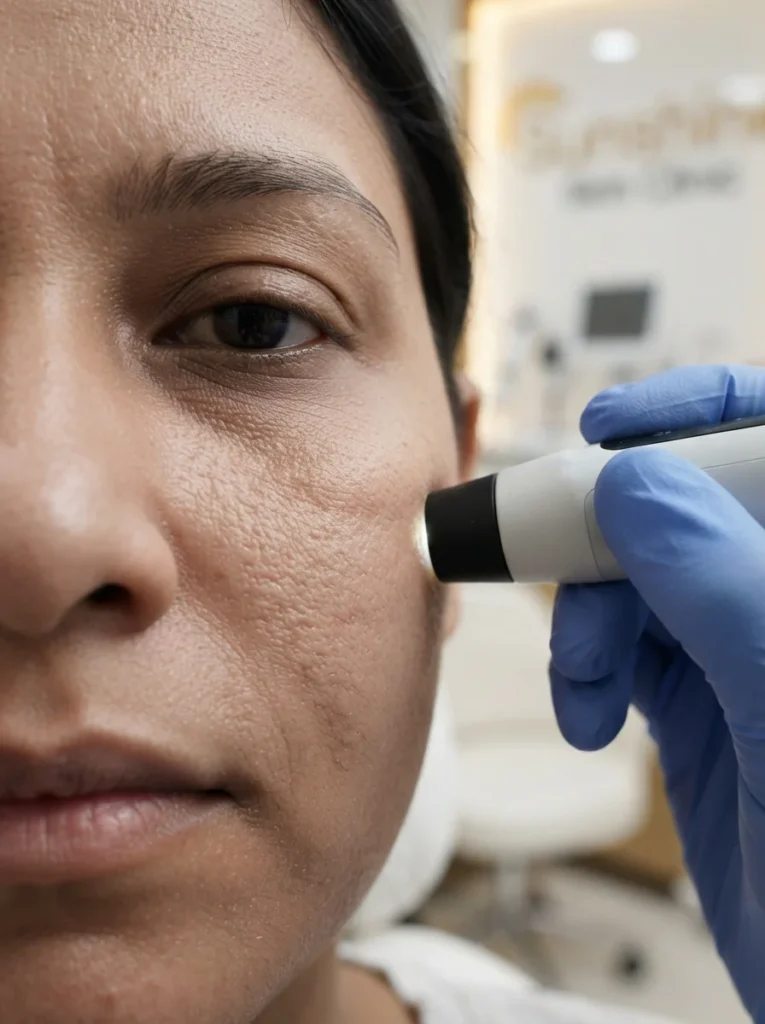
- Dry or dehydrated skin
- Rough texture
- Uneven-looking skin tone
- Surface buildup
- Pigmentation
- Sun-related changes
- Loss of skin smoothness
- Visible fine lines
- Congested or oily skin
Common Signs of Dull-Looking Skin
You may notice one or several of the following:
Reduced Radiance
The skin appears less bright or fresh than usual.
Dryness
The skin may feel tight, rough, flaky, or uncomfortable. Dry skin occurs when the skin loses too much water.
Uneven Texture
The skin surface may feel rough or look less smooth.
Uneven Skin Tone
Localized pigmentation or other colour variations can make the complexion appear less uniform.
Fine Lines Appearing More Noticeable
Dehydrated skin can make fine lines more visible.
Tired Appearance
Dark circles, dryness, or other changes around the eyes can sometimes contribute to a tired-looking appearance.
Why Can Skin Look Dull and Tired?
There is rarely one universal reason.
Dehydration & Dryness
When skin loses too much moisture, it may become dry, rough, flaky, and less comfortable. Dehydrated skin can also make fine lines appear more prominent.
Sun Exposure
Cumulative ultraviolet exposure can contribute to pigmentation, wrinkles, uneven skin tone, loss of elasticity, and other signs of skin aging.
Skin-Care Habits
Over-cleansing, harsh products, excessive exfoliation, or irritating skincare routines can compromise skin comfort and make dryness or irritation more noticeable. Dermatologists recommend gentle cleansing and appropriate moisturization, particularly for dry or sensitive skin.
Environmental Exposure
Pollution, dry climate, heat, air conditioning, and repeated outdoor exposure may contribute to changes in skin comfort and appearance.
Age-Related Changes
As skin ages, it tends to become drier and changes in elasticity, fine lines, and texture may become more visible.
Lifestyle Factors
Sleep deprivation can be reflected in the appearance of the skin, particularly around the eyes, while smoking is associated with a paler or sallower complexion and premature skin aging.
Dull Skin vs Dehydrated Skin
These terms are often used together, but they are not exactly the same.
Dull Skin
Describes how the complexion looks—less radiant, fresh, or even.
Dehydrated Skin
Describes a condition in which the skin has lost too much moisture and may feel dry, tight, flaky, or rough.
A person can have dull-looking skin without significant dehydration, and dehydrated skin may be one contributor to a dull appearance.
Dull Skin vs Pigmentation
Pigmentation can make skin appear uneven or less radiant, but dull-looking skin does not necessarily mean pigmentation is the underlying cause.
A person may have:
- Dullness without pigmentation
- Pigmentation without dryness
- Pigmentation and dehydration together
- Dullness caused by rough texture
- Multiple concerns occurring at the same time
When pigmentation is significant, it may be useful to evaluate it separately.
Explore Pigmentation Treatment →
Dull Skin & Enlarged Pores
Oily or congested skin can make pores more noticeable and may contribute to an uneven-looking complexion.
If dullness is accompanied by:
- Enlarged pores
- Blackheads
- Excess oil
- Acne
- Uneven texture
then pore and acne management may form part of the overall treatment plan.
Explore Enlarged Pores Treatment →
Explore Acne Treatment →
When Should You See a Dermatologist?
Dull-looking skin is often a cosmetic concern, but professional assessment may be useful when the change is persistent or accompanied by other symptoms.
Consider a consultation when you experience:
- Persistent dryness
- Significant flaking
- Itching or burning
- Persistent redness
- Sudden changes in complexion
- Recurrent pigmentation
- Acne or congestion
- Significant uneven texture
- Skin changes that do not improve with basic skincare
Very dry skin can sometimes be associated with medications or underlying conditions, so persistent or worsening dryness may warrant dermatological evaluation.
Our Approach to Dull & Tired-Looking Skin
At Sunshine Skin Clinic, we first identify what is making the skin look tired.
During consultation, we may assess:
- Hydration
- Dryness
- Skin Texture
- Pigmentation
- Pore Visibility
- Oil Production
- Acne Activity
- Sun Exposure
- Fine Lines
- Skin Sensitivity
- Current Skincare Routine
- Previous Treatments
This allows us to determine whether the priority should be hydration, texture improvement, pigmentation management, acne control, skin rejuvenation, or a combination of these approaches.
Treatment Options for Dull & Tired-Looking Skin
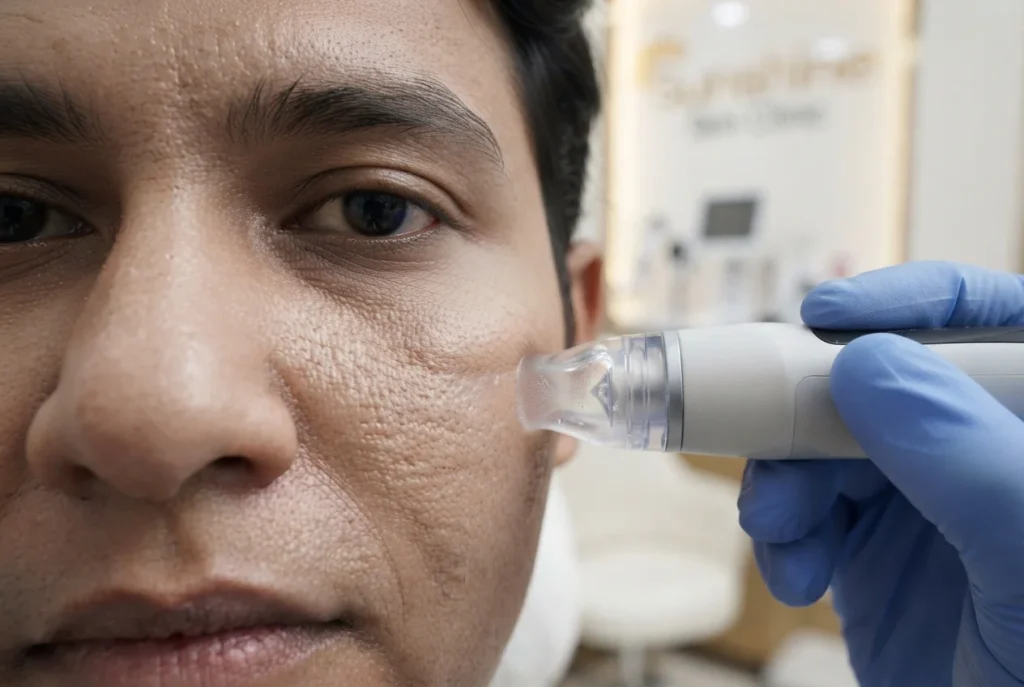
The appropriate treatment depends on the underlying skin concern.
Dermatologist-Guided Skincare
For many patients, a well-designed daily routine provides the foundation of skin care.
Depending on your skin condition, this may involve:
- Gentle Cleansing
- Appropriate Moisturization
- Sun Protection
- Carefully Selected Active Ingredients
- Skin-Barrier Support
Dermatologists commonly recommend gentle cleansing, regular moisturization, and broad-spectrum sun protection as part of healthy skin care.
Hydration-Focused Skin Care
When dryness or dehydration is contributing to a tired-looking complexion, restoring and maintaining skin moisture can be an important first step.
Moisturizers help support dry skin, and creams or ointments can be more effective than lotions for very dry skin. Ingredients such as ceramides and hyaluronic acid are commonly found in moisturizers designed to support hydration.
The right product depends on the individual’s skin type and sensitivity.
Hydra Facial
Hydra Facial is a non-invasive facial procedure involving cleansing, exfoliation and hydration-focused steps.
It may be considered when dullness occurs alongside surface congestion or dehydration and when a patient is looking for a non-surgical skin-refreshing treatment.
Treatment should still be customized according to skin type and individual needs.
Explore Hydra Facial →
Chemical Peels
Chemical peels are dermatologist-supervised procedures that can improve several aspects of skin appearance, including dull complexion, rough texture, uneven skin colour, and selected pigmentation concerns.
Different peels have different strengths and uses. The appropriate peel should therefore be selected according to:
- Skin Type
- Main Concern
- Sensitivity
- Pigmentation History
- Previous Treatments
- Desired Outcome
Professional consultation before a chemical peel is important, and the American Academy of Dermatology recommends dermatologist supervision, particularly because stronger peels can involve downtime and side effects.
Explore Chemical Peel →
Skin Rejuvenation Procedures
When dullness is associated with multiple concerns such as uneven texture, pigmentation, enlarged pores, dehydration, or early signs of aging, a broader skin-rejuvenation plan may be considered.
Depending on suitability, options may include:
- Chemical Peels
- Microneedling
- MNRF
- Laser-Based Treatments
- Skin Boosters
- Medical Facials
- Other Dermatologist-Guided Procedures
Explore Skin Rejuvenation Procedures →
Microneedling
Microneedling is a minimally invasive procedure that stimulates the body’s collagen production and is used by dermatologists for concerns including uneven skin texture and tone, large pores, dark spots, scars, and fine lines.
It may be considered when dull-looking skin is accompanied by uneven texture or other collagen-related concerns.
Results develop gradually as the skin responds and remodels collagen.
Explore Microneedling →
MNRF / Radiofrequency Microneedling
MNRF combines microneedling with radiofrequency energy and may be considered when dullness occurs alongside uneven texture, enlarged pores, acne scars, or mild skin laxity.
Because the treatment penetrates the skin using microneedles and applies heat, it should be selected and performed according to the individual’s skin condition.
Explore MNRF →
Skin Boosters
Skin boosters are injectable treatments designed to improve hydration and skin quality rather than significantly alter facial volume.
They may be considered for selected patients whose main concern is dehydrated, dull-looking skin.
Suitability depends on the patient’s skin condition, medical history, and treatment goals.
Explore Skin Boosters →
Laser & Light-Based Skin Rejuvenation
Certain laser and light-based procedures may be used to address sun-related changes, uneven complexion, pigmentation, or other skin-quality concerns. The appropriate technology depends on the specific problem being treated.
Laser treatment should not be automatically selected simply because the skin appears dull. Proper assessment helps determine whether the concern actually requires a laser-based procedure.
Explore Laser Treatments →
Medical Facial
A dermatologist-guided medical facial can be customized according to skin type and concern.
It may be considered when the main goal is improving skin freshness, hydration, cleansing, and surface texture without selecting a more intensive procedure.
Explore Medical Facial →
LED Light Therapy
LED Light Therapy is a non-invasive light-based treatment that may be incorporated into selected skincare and rejuvenation plans.
It can be considered as part of a broader treatment approach rather than being presented as a universal solution for dull skin.
Explore LED Light Therapy →
Combination Skin Rejuvenation
Dullness often occurs alongside several other concerns.
For example:
Dull + Dehydrated Skin
The focus may be hydration and barrier support.
Dull + Pigmented Skin
Pigmentation management may become a priority.
Dull + Enlarged Pores
Congestion and pore management may be included.
Dull + Uneven Texture
Exfoliation, microneedling, MNRF, or other appropriate procedures may be considered.
Dull + Early Signs of Aging
A broader rejuvenation plan may be discussed.
The goal is to identify the dominant concern rather than performing multiple procedures unnecessarily.
Why Sun Protection Matters
Sun exposure contributes to cumulative skin damage and can lead to pigmentation, uneven tone, loss of elasticity, wrinkles, and other visible changes.
For patients concerned about dull or tired-looking skin, daily sun protection can therefore be an important part of maintaining the improvements achieved through treatment.
Dermatologists generally recommend broad-spectrum sunscreen with SPF 30 or higher, along with other sun-protection measures.
Everyday Skincare for a Healthier-Looking Complexion
A professional treatment plan works best when supported by consistent daily care.
Depending on your skin type, your dermatologist may recommend:
Gentle Cleansing
Avoid aggressive scrubbing because irritation can make certain skin problems more noticeable.
Regular Moisturization
Moisturizers help reduce dryness and support skin comfort.
Sun Protection
Daily broad-spectrum sunscreen helps protect against ongoing UV-related skin damage.
Avoiding Excessive Exfoliation
Using too many active products or exfoliating too frequently can irritate the skin. AAD guidance emphasizes that more skincare is not necessarily better.
What Should You Avoid?
When the skin looks dull, it can be tempting to use multiple exfoliants, scrubs, masks, and active ingredients at once.
This can sometimes create irritation rather than improvement.
Avoid:
- Excessive Scrubbing
- Very Hot Water
- Over-Exfoliation
- Constantly Changing Skincare Products
- Combining Multiple Strong Actives Without Guidance
- Unprotected Sun Exposure
- Using Strong Home Chemical Peels Without Professional Supervision
The AAD specifically recommends gentle cleansing and warns that harsh or excessive skincare can irritate the skin. Chemical peels should also be used under appropriate professional supervision.
Your Dull Skin Treatment Journey
Step 1 — Skin Consultation
We discuss how long your skin has looked dull or tired and whether you have noticed dryness, pigmentation, acne, sensitivity, or texture changes.
Step 2 — Skin Assessment
The dermatologist evaluates hydration, texture, pigmentation, oiliness, pores, and other visible factors.
Step 3 — Identify the Main Concern
The focus is on understanding what is primarily responsible for the appearance of dullness.
Step 4 — Personalized Treatment Plan
A suitable skincare routine or in-clinic treatment is selected according to your skin and goals.
Step 5 — Treatment & Follow-Up
Your response is monitored and the treatment plan can be modified when appropriate.
Step 6 — Maintenance
A practical skincare and sun-protection routine helps maintain healthy-looking skin between professional treatments.
How Many Treatments Are Needed?
There is no fixed number of treatments for dull-looking skin.
The treatment schedule depends on what is causing the dull appearance.
Some patients may primarily need skincare and hydration support, while others may be considered for a series of chemical peels, microneedling treatments, or other rejuvenation procedures.
The number of sessions should therefore be determined after skin assessment rather than using a standard package for everyone.
What Results Can You Expect?
Treatment generally aims to improve the appearance, hydration, texture, smoothness, and radiance of the skin.
The degree and timing of improvement vary depending on:
- Underlying Cause
- Skin Type
- Treatment Selected
- Severity of Dryness or Texture Changes
- Pigmentation
- Sun Exposure
- Individual Skin Response
- Consistency of Home Care
Some approaches produce a temporary refreshed appearance, while collagen-focused treatments may take longer to show visible changes. For example, microneedling results develop gradually as collagen remodeling occurs.
Why Choose Sunshine Skin Clinic?
A tired-looking complexion can have several different causes, so simply adding another facial or exfoliant may not address the real concern.
At Sunshine Skin Clinic, our approach focuses on understanding your skin first.
Personalized Skin Assessment
We evaluate hydration, texture, pigmentation, pores, acne and other contributing factors.
Multiple Treatment Options
Depending on your needs, care may involve skincare, chemical peels, Hydra Facial, microneedling, MNRF, skin boosters, laser-based procedures, or medical facials.
Skin-Type Consideration
Treatment intensity and procedure choice are adapted to individual skin characteristics.
Long-Term Skin Health
We consider daily skincare and sun protection alongside in-clinic treatments.
Realistic Expectations
The aim is healthier-looking, more refreshed skin—not an artificial or permanently “perfect” appearance.
Frequently Asked Questions
What causes dull-looking skin?
Dullness can have several contributors, including dryness or dehydration, rough texture, sun-related changes, pigmentation, skin-care irritation, aging, and lifestyle factors.
Is dull skin the same as dry skin?
No. Dullness describes how the skin looks, while dry skin refers to insufficient moisture in the skin. Dryness can contribute to a dull-looking complexion.
Can Hydra Facial help dull-looking skin?
Hydra Facial may be considered for selected patients seeking a non-invasive skin-refreshing treatment, particularly when dullness occurs alongside surface congestion or dehydration. Suitability depends on the individual.
Is a chemical peel good for dull skin?
Selected chemical peels can improve dull complexion, rough skin, and uneven skin colour. The type and strength of peel should be chosen according to the patient’s skin and clinical needs.
Can microneedling improve dull skin?
Microneedling is used for uneven skin texture and tone and can stimulate collagen production. It may be appropriate when dullness occurs alongside textural concerns.
How quickly can dull skin improve?
The timeline depends on the underlying cause and treatment. Hydration and skincare-related changes can differ from the gradual improvement associated with collagen-stimulating treatments.
Does sunscreen matter for dull skin?
Yes. UV exposure contributes to cumulative skin damage, including uneven pigmentation, wrinkles and loss of elasticity. Daily sun protection is therefore an important part of maintaining skin health.
Can too much exfoliation make skin look worse?
Yes. Excessive exfoliation or harsh skincare can irritate the skin and aggravate dryness or sensitivity.
When should I consult a dermatologist?
Consider consultation when dullness is persistent, accompanied by significant dryness, itching, burning, redness, recurrent pigmentation, acne, or other unexplained skin changes.
Book a Dull Skin Consultation in Delhi
If your skin has started looking dull, dry, rough, uneven, or tired, the solution is not necessarily another cosmetic product.
At Sunshine Skin Clinic, we first look at the condition of your skin and identify the factors contributing to its appearance. From there, we can discuss whether you may benefit from dermatologist-guided skincare, hydration-focused care, chemical peels, Hydra Facial, microneedling, MNRF, skin boosters, laser-based procedures, or another suitable approach.
Schedule Your Skin Consultation
Book Appointment | Call Now | WhatsApp Us