

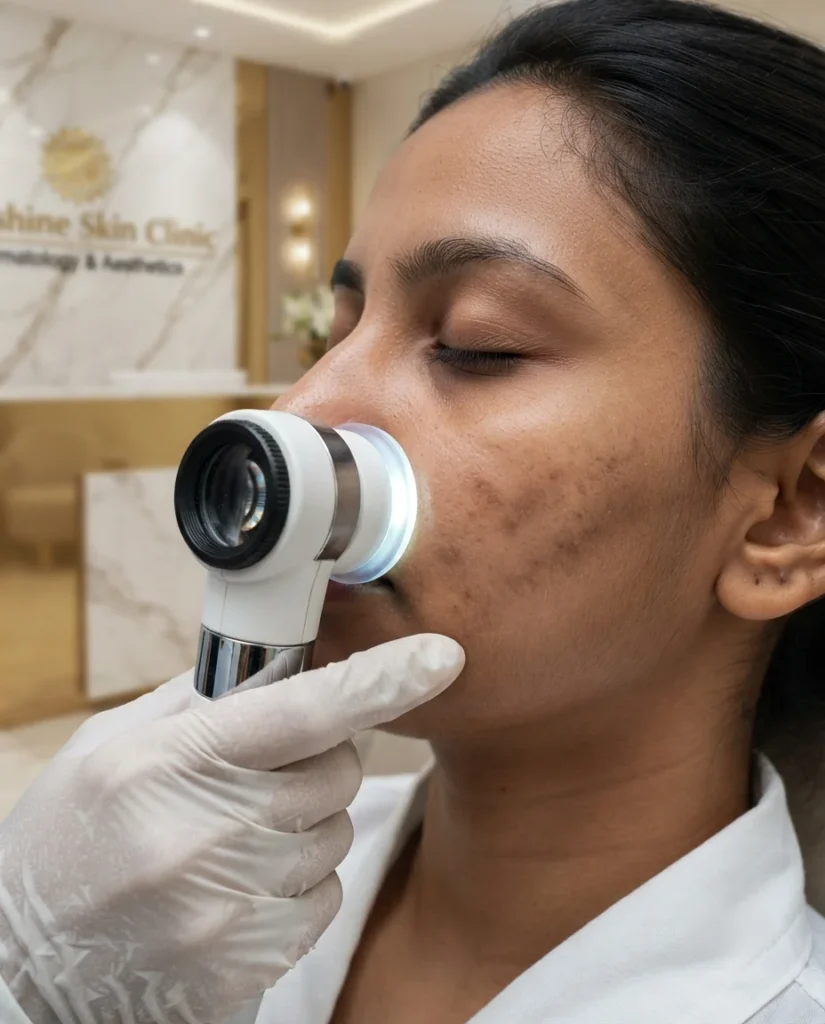
- Darker patches
- Post-acne marks
- Sun-related pigmentation
- Red or irritated areas
- Uneven facial complexion
- Areas of dullness
- Pigmentation around the mouth or cheeks
- Differences in tone between the face and neck
Uneven Skin Tone vs Pigmentation
The two terms are closely related, but they are not exactly the same.
Pigmentation
Pigmentation refers to a change in the skin’s colour, commonly involving increased or decreased melanin.
Uneven Skin Tone
Uneven skin tone is a broader description of how uniform the complexion looks. Pigmentation may be one contributor, but dryness, redness, texture and other skin changes can also affect the overall appearance.
For example, someone may have uneven skin tone because of post-acne pigmentation, while another person may have a combination of mild pigmentation and dehydration.
Explore Pigmentation Treatment →
Common Causes of Uneven Skin Tone
There is usually no single cause.
Post-Acne Pigmentation
Inflammation from acne can leave darker marks after a pimple has healed. This is a common form of post-inflammatory hyperpigmentation.
Explore Acne Treatment →
Explore Acne Scar Treatment →
Sun Exposure
UV exposure can stimulate pigmentation and contribute to uneven colour. Long-term sun exposure can also contribute to visible skin aging and changes in texture and elasticity.
Melasma
Melasma can produce patches of facial pigmentation, often in a relatively symmetrical pattern. Sun exposure and hormonal influences are important factors in its development and persistence.
Explore Melasma Treatment →
Freckles
Freckles can make the complexion appear uneven because small areas of increased pigmentation become more noticeable, particularly after sun exposure.
Explore Freckles Removal →
Skin Inflammation
Inflammatory skin conditions can be followed by pigmentation changes. Post-inflammatory pigmentation can occur after acne, eczema, infections, injury, or irritation.
Dryness & Dehydration
Dry or dehydrated skin can make the surface appear rough and less uniform, which may contribute to an uneven-looking complexion.
Skin Irritation
Repeated irritation from harsh skincare, aggressive exfoliation, or unsuitable products can contribute to inflammation and pigmentation in susceptible individuals. The AAD recommends gentle, fragrance-free skincare for people dealing with pigmentary concerns such as melasma because irritation can make dark spots more noticeable.
Where Can Uneven Skin Tone Appear?
Uneven tone can affect different parts of the body.
Face
The cheeks, forehead, nose, chin, and area around the mouth may show different shades or pigmentation.
Neck
A darker or uneven-looking neck may have several possible causes and should not automatically be assumed to be simple pigmentation.
Hands
Repeated sun exposure can contribute to localized discoloration on the hands.
Décolletage
The upper chest can develop sun-related pigmentation and visible changes in skin tone.
The treatment approach should be based on the specific area and likely cause.
Common Signs of Uneven Skin Tone
You may notice:
- Brown or darker patches
- Post-acne marks
- Uneven facial colour
- Sun spots
- Freckles
- Melasma-like patches
- Redness
- Dullness
- Areas of dryness
- Uneven texture
Some people experience only one of these concerns, while others have several at the same time.
Uneven Skin Tone on Indian Skin
Pigmentary changes can be particularly noticeable in skin of colour, and post-inflammatory pigmentation may persist longer after inflammation or injury.
This makes treatment planning particularly important.
A dermatologist may consider:
- Natural skin tone
- Pigmentation history
- Previous procedure response
- Sensitivity
- Tendency toward post-inflammatory pigmentation
- Active inflammation
- Current skincare
- Sun exposure
The aim is to improve the appearance of uneven tone without unnecessarily irritating the skin.
When Should You See a Dermatologist?
Uneven skin tone is often a cosmetic concern, but professional assessment is especially useful when the change is persistent, worsening, or associated with other symptoms.
Consider a consultation when:
- Pigmentation keeps returning
- New dark patches continue appearing
- Uneven tone developed suddenly
- Acne leaves persistent marks
- You have significant melasma
- Home skincare is not helping
- Skin becomes irritated after products
- A pigmented spot looks unusual or changes over time
A dermatologist can help distinguish routine pigmentation from conditions that may require a different approach.
Our Approach to Uneven Skin Tone Treatment
At Sunshine Skin Clinic, we don’t assume that every uneven complexion requires a pigment-removing procedure.
During consultation, we assess:
- Skin tone
- Pigmentation
- Skin texture
- Hydration
- Oil production
- Acne activity
- Redness or inflammation
- Sun exposure
- Current skincare routine
- Previous procedures
- Individual treatment goals
This helps us identify the main factors contributing to the uneven appearance.
Uneven Skin Tone Treatment Options
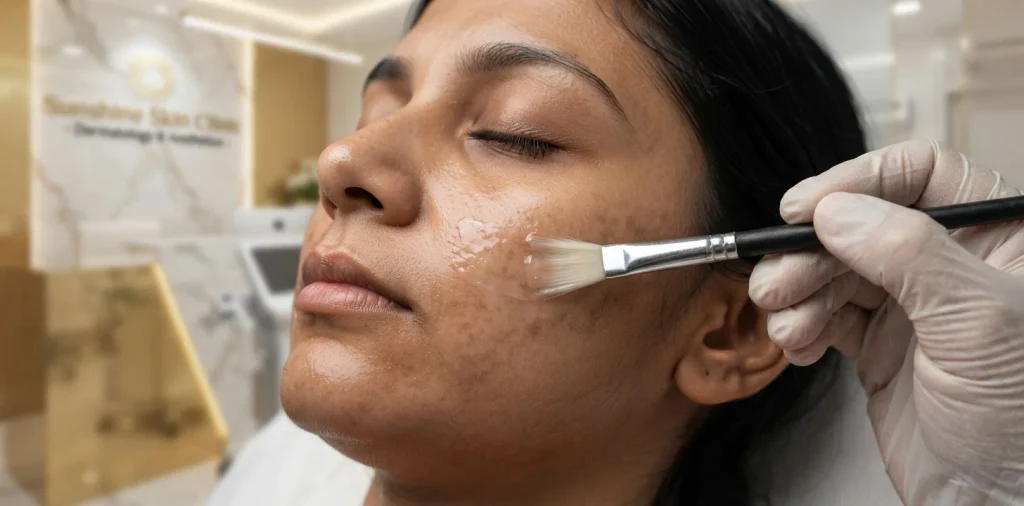
Treatment is selected according to the cause and the condition of the skin.
Dermatologist-Guided Skincare
A personalized skincare routine can address several contributors to uneven tone.
Depending on the individual’s needs, it may focus on:
- Pigmentation management
- Skin-barrier support
- Hydration
- Gentle exfoliation
- Acne control
- Sun protection
The exact products and active ingredients should be selected according to skin type, sensitivity and the underlying concern.
Sun Protection
Sun protection is one of the most important components of managing uneven pigmentation.
For hyperpigmentation and melasma, dermatology guidance emphasizes broad-spectrum sun protection; for darker skin tones and pigmentary conditions such as melasma, tinted sunscreens containing iron oxides may provide additional protection against visible light.
A personalized plan may include:
- Broad-spectrum sunscreen
- Regular reapplication
- Protective clothing
- Hats
- Seeking shade
- Reducing prolonged direct sun exposure
Chemical Peels
Selected chemical peels can be used to improve the appearance of superficial pigmentation and uneven skin tone.
However, procedures can also irritate the skin and potentially worsen pigmentation in susceptible individuals, so peel strength and type should be chosen carefully.
Explore Chemical Peel →
Laser Treatments
Certain laser treatments may be considered for selected pigmentation and skin-colour concerns.
Laser selection depends on:
- Type of pigmentation
- Skin type
- Pigment depth
- Treatment area
- Previous treatment response
- Individual risk of pigmentary complications
Laser treatment in skin of colour requires careful planning because inflammation or epidermal injury can result in post-inflammatory pigmentary changes.
Explore Laser Treatments →
Laser Toning
Laser toning may be considered in selected cases where pigmentation contributes significantly to uneven complexion.
Treatment settings and frequency should be individualized rather than using the same protocol for every patient.
Explore Laser Toning →
Skin Rejuvenation Procedures
If uneven tone is accompanied by:
- Enlarged pores
- Rough texture
- Fine lines
- Dullness
- Acne scars
- Mild skin laxity
a broader skin-rejuvenation plan may sometimes be considered.
Depending on the individual, options may include:
- Microneedling
- MNRF
- Selected laser procedures
- Chemical peels
- Skin boosters
- Hydration-focused treatments
Explore Skin Rejuvenation Procedures →
Microneedling for Uneven Tone & Texture
Microneedling is used by dermatologists for several concerns, including uneven skin texture and tone, dark spots, acne scars and large pores. It works by creating controlled micro-injuries that stimulate collagen production.
It may be considered when uneven tone occurs together with textural changes.
Combination Treatment
Uneven skin tone often involves more than one concern.
For example:
Pigmentation + Acne Marks
Treatment may need to address both active acne and post-inflammatory pigmentation.
Pigmentation + Dullness
Hydration and overall skin quality may be incorporated into the plan.
Pigmentation + Enlarged Pores
Pore and congestion management may be combined with tone-focused care.
Pigmentation + Uneven Texture
Skin-rejuvenation procedures may be considered when clinically appropriate.
The objective is not to perform multiple treatments unnecessarily. Instead, the plan should focus on the factors actually contributing to the uneven complexion.
Uneven Skin Tone & Post-Acne Marks
Acne can leave behind pigmentation even after the active inflammation has settled.
These marks are usually different from structural acne scars. Post-inflammatory hyperpigmentation is a change in skin colour, while an acne scar involves altered skin texture.
This distinction helps determine whether the priority should be pigmentation management, scar treatment, acne control, or a combination.
Explore Acne Treatment →
Explore Acne Scar Treatment →
Uneven Skin Tone & Melasma
Melasma is an important cause of uneven facial pigmentation. It can be persistent and may recur even after improvement.
For patients whose uneven tone is largely due to melasma, the management strategy needs to be melasma-specific rather than simply treating it as generic pigmentation.
Explore Melasma Treatment →
Uneven Skin Tone & Dark Spots
Localized dark spots can make the overall complexion look uneven.
However, not every dark spot has the same cause. A dermatologist may need to determine whether it is related to:
- Acne
- Inflammation
- Sun exposure
- Freckles
- Melasma
- Another pigmented condition
Explore Dark Spot Treatment →
Your Uneven Skin Tone Treatment Journey
Step 1 — Consultation
We discuss when the uneven tone developed, previous pigmentation, skincare, acne history, sun exposure and your primary concerns.
Step 2 — Skin Assessment
The dermatologist evaluates pigmentation, texture, hydration, oiliness, redness, acne and other visible factors.
Step 3 — Identify the Main Cause
The focus is on determining what is primarily responsible for the uneven appearance.
Step 4 — Personalized Treatment Plan
Appropriate skincare, procedures, combination treatment or maintenance care is discussed.
Step 5 — Treatment & Follow-Up
The skin response is monitored, and the treatment plan can be adjusted when appropriate.
Step 6 — Maintenance
Sun protection and consistent skincare remain important for maintaining a more even-looking complexion.
How Many Sessions Are Needed?
There is no fixed number of sessions for uneven skin tone.
The treatment schedule depends on:
- Cause
- Severity
- Skin Type
- Pigmentation Pattern
- Selected Procedure
- Previous Treatment
- Individual Response
Some patients may primarily need skincare and sun protection, while others may be considered for a series of professional procedures.
A consultation is therefore more useful than assigning a standard session package to everyone.
What Results Can You Expect?
The goal of treatment is to improve the uniformity and overall appearance of the complexion.
Improvement may involve:
- Reduced visibility of pigmentation
- More even-looking colour
- Improved skin texture
- Better hydration
- Reduced appearance of post-acne marks
- A healthier-looking complexion
The timeline varies according to the cause and treatment. Some pigmentary concerns improve gradually, while melasma and post-inflammatory pigmentation may require longer-term management.
No treatment can guarantee perfectly uniform skin.
What Should You Avoid?
When the goal is a more even complexion, aggressive skincare can sometimes work against that goal.
Avoid:
- Excessive Scrubbing
- Frequent Strong Peels
- Picking or Scratching
- Randomly Combining Strong Actives
- Unsupervised Skin-Lightening Products
- Irritating Home Remedies
- Prolonged Unprotected Sun Exposure
Gentle skincare is particularly important when pigmentation tends to worsen after inflammation or irritation.
Why Choose Sunshine Skin Clinic?
Uneven skin tone can have several causes, so treatment should begin with understanding what is actually happening to the skin.
At Sunshine Skin Clinic, we focus on:
Individual Skin Assessment
We assess pigmentation together with texture, hydration, acne, oiliness and other visible factors.
Cause-Based Treatment Planning
The treatment is selected according to the factors contributing to the uneven complexion.
Multiple Treatment Options
Depending on suitability, care may include skincare, chemical peels, laser-based procedures, microneedling or broader skin rejuvenation.
Skin-Type Consideration
Pigmentation tendency and previous treatment response are considered when planning procedures.
Long-Term Perspective
Maintenance and sun protection are considered alongside procedures.
Realistic Expectations
The goal is a healthier and more even-looking complexion—not an unrealistic promise of permanently flawless skin.
Frequently Asked Questions
What causes uneven skin tone?
Uneven skin tone can result from pigmentation, post-acne marks, sun exposure, melasma, freckles, inflammation, dryness, irritation, and other skin changes.
Is uneven skin tone the same as hyperpigmentation?
No. Hyperpigmentation refers specifically to increased or uneven skin colour, while uneven skin tone is a broader description that may include pigmentation, redness, dryness and textural changes.
Can uneven skin tone be permanently corrected?
The underlying cause matters. Some colour changes can improve substantially, but pigmentary conditions can recur, particularly when triggers such as UV exposure or inflammation continue.
Is laser treatment suitable for uneven skin tone?
Selected laser treatments may be useful for certain pigmentation concerns, but suitability depends on skin type, pigmentation pattern and treatment history. In skin of colour, careful treatment selection is particularly important because pigmentary changes can occur after skin injury or inflammation.
Can chemical peels improve uneven skin tone?
Selected chemical peels can improve superficial pigmentation and texture, but treatment needs to be individualized because irritation can sometimes worsen pigmentation.
Can acne cause uneven skin tone?
Yes. Acne-related inflammation can leave post-inflammatory hyperpigmentation after the active acne has healed.
Is uneven skin tone caused only by pigmentation?
No. Dryness, rough texture, redness and other skin changes can also make the complexion appear less uniform.
Does sunscreen really help?
Sun protection is an important part of managing pigmentation and preventing UV-related worsening.
Can skincare improve uneven skin tone?
A personalized skincare routine can help address contributors such as pigmentation, dryness, congestion and sun exposure. The specific routine should depend on your skin type and underlying concern.
How quickly will I see improvement?
The timeline varies widely. Some concerns respond gradually to skincare, while other pigmentary conditions may require longer-term treatment and maintenance.
Book an Uneven Skin Tone Consultation in Delhi
An uneven complexion can have several different causes, and the right treatment depends on identifying what is actually affecting your skin.
At Sunshine Skin Clinic, we assess pigmentation, texture, hydration, acne, sun exposure and other relevant factors before discussing treatment options.
Whether your concern is post-acne marks, sun-related pigmentation, melasma, freckles, dullness, or a combination of skin changes, a personalized assessment can help determine the appropriate direction for your care.
Schedule Your Skin Consultation
Book Appointment | Call Now | WhatsApp Us